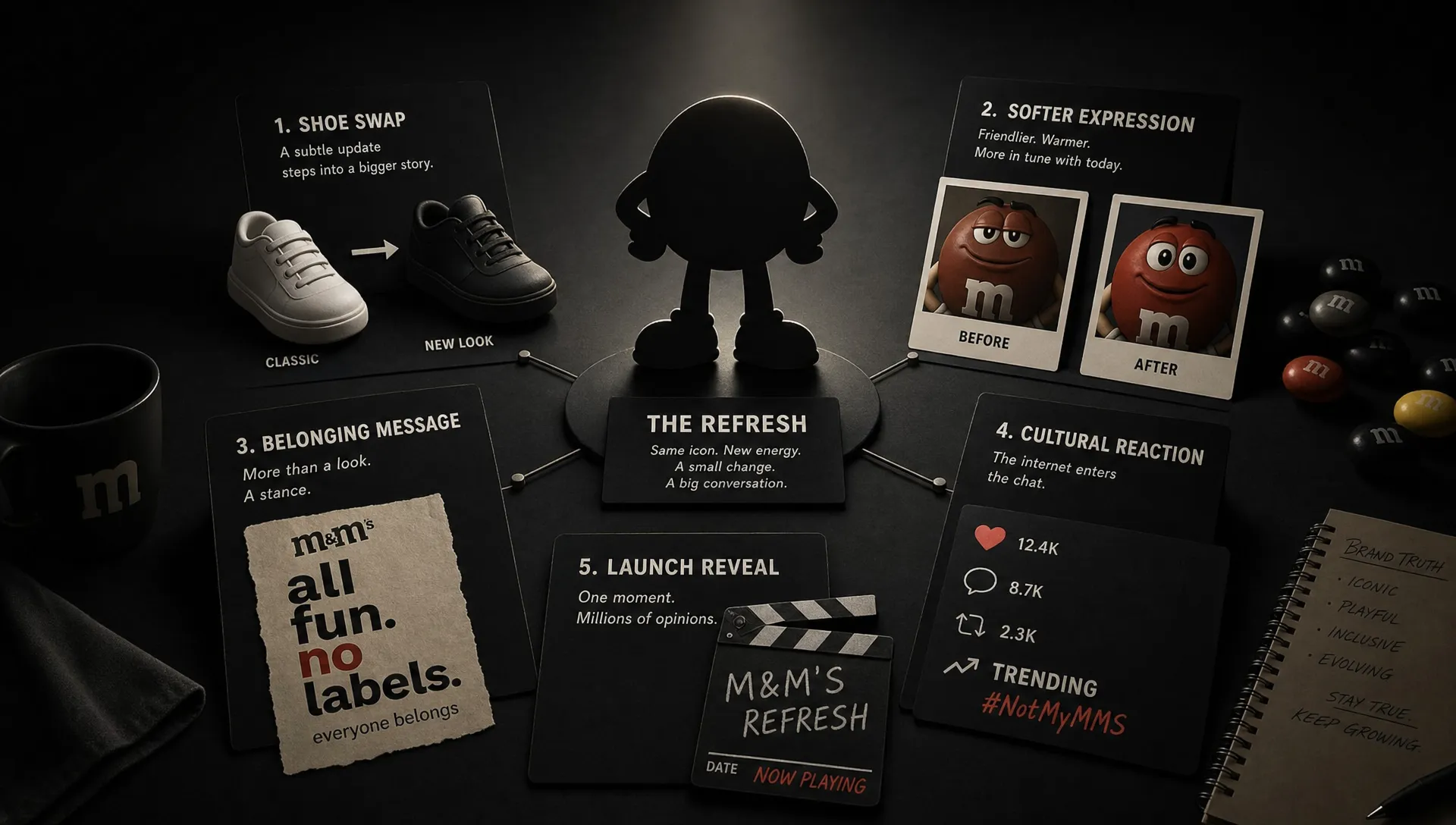
The rebranded M&M’s looked, on the surface, like a playful update to a candy icon. The brand refreshed its spokescandies, softened some personality cues, and leaned into a broader message of belonging through its For All Funkind platform.
Then the internet did what the internet does. Tiny footwear changes, mascot personalities, and brand purpose language became a national conversation. Some audiences saw a modernized brand trying to stay culturally relevant. Others saw unnecessary corporate signaling. M&M’s eventually announced an indefinite pause on the characters, introduced Maya Rudolph as a spokesperson for its Super Bowl campaign, then brought the spokescandies back.
For founders, CMOs, and challenger brands, the lesson is not that change is dangerous. The lesson is that change is interpreted. A rebrand does not land in a vacuum. It lands inside customer memory, cultural tension, category expectations, and media narratives.
M&M’s gives us one of the clearest modern examples of how even small brand changes can become big strategic moments.
What actually changed in the M&M’s refresh?
M&M’s did not abandon its name, product, logo system, or core candy experience. This was not a total rebrand in the way Facebook became Meta or Twitter became X. It was closer to a brand refresh with a renewed purpose platform and updated character system.
The brand’s well-known spokescandies were adjusted to feel more current and inclusive. The Green character swapped high-heeled boots for sneakers. Brown’s shoes became more understated. Orange’s anxious personality was softened. The brand also placed more emphasis on belonging, togetherness, and fun across its platform.
Those choices may sound subtle, but subtle is not the same as insignificant. M&M’s characters are not decorative side assets. They are part of the brand’s emotional memory. For decades, they helped turn a commodity product into an entertainment property. When a brand changes an asset people have built opinions around, even a small change can feel personal.
That is the first major lesson: the more recognizable your brand assets are, the more carefully you need to manage their evolution.
Why the M&M’s reaction became bigger than candy
The M&M’s backlash was not really about shoes. It was about what people believed the shoes represented.
That distinction matters. Customers rarely evaluate brand change like designers do. They do not say, this character system has been modernized to improve relevance across global markets. They say, why did they change the thing I liked? Or, finally, this brand feels more in step with today.
Brand change is decoded through emotion before strategy. Audiences ask themselves:
- Does this still feel like the brand I know?
- Is the brand trying too hard?
- Is this change for me, or at my expense?
- Does the new message match the product experience?
- Is the company making a real choice, or borrowing cultural language for attention?
That is why a rebrand can become controversial even when the commercial offer has not changed. M&M’s still sold colorful chocolate candy. But the meaning system around that candy shifted, and meaning is where brands live.
Lesson 1: Change the brand, not the contract
Every brand has an unwritten contract with its audience. It includes what people expect you to look like, sound like, stand for, and deliver. Strong rebrands evolve that contract. Weak rebrands break it without warning.
M&M’s had a clear advantage: its core contract stayed intact. The candy, color equity, humor, character-led storytelling, and playful tone remained recognizable. That continuity is one reason the moment did not permanently damage the brand. People could argue about the characters, but they were still arguing about M&M’s.
For challenger brands, this is critical. If you are changing your positioning, identity, website, product experience, or messaging, define what must not change. Distinctive assets are not nostalgia for nostalgia’s sake. They are mental shortcuts that help people recognize and trust you faster.
Before you evolve a brand, separate your assets into three groups: what is sacred, what can flex, and what needs to go. If you cannot answer that clearly, you are not ready to change publicly.
Lesson 2: Purpose needs proof, not just language
The most polarizing part of many modern rebrands is not the design. It is the purpose statement.
M&M’s leaned into belonging and inclusivity, a direction many global brands have taken over the last decade. The issue is not whether brands should stand for something. They should. The issue is whether the audience can connect that purpose to the brand’s behavior, product, and role in culture.
For M&M’s, the strategic logic was understandable. The product is inherently social: candy shared at parties, movie nights, offices, and family gatherings. A message about fun and belonging is not random. But the execution still became vulnerable because the most visible proof point was mascot redesign.
That is a risk for any brand. If your purpose lives mainly in language and visual symbolism, people can dismiss it as performance. If it is visible in your customer experience, partnerships, hiring, product design, community, and service model, it is harder to reduce to a campaign.
This applies across categories. A high-trust travel company, for example, cannot simply say it offers authentic local experiences. A brand like Uganda safari specialists planning gorilla trekking and wildlife tours has to prove that promise through local expertise, clear itineraries, guest confidence, safety, and the quality of the experience itself. The same principle holds for any challenger brand: the bigger the promise, the more tangible the proof must be.
Lesson 3: Small design details can carry strategic weight
The Green M&M’s sneakers became the symbol of the whole conversation. That is both absurd and completely predictable.
In branding, small details often become proxies for larger debates. A logo curve, a mascot expression, a color shift, a typeface, a name change, or a tone of voice adjustment can become the thing people latch onto because it is visible and easy to discuss.
This is why brand strategy and design cannot operate separately. A designer may see a sneaker as a character modernization. A customer may see it as a cultural statement. A commentator may see it as a headline. A loyalist may see it as a loss of personality.
None of those interpretations are fully controllable. But they are predictable if you pressure test the work before launch.
Challenger brands often move quickly, which is an advantage. But speed becomes a liability when brand teams skip the uncomfortable question: what could this be misunderstood as?
That does not mean you should avoid boldness. It means you should understand the range of likely interpretations before the market teaches you in public.
Lesson 4: Rebrands need a narrative before they need a reveal
One of the biggest mistakes brands make is treating launch day as the beginning of the story. It is not. Launch day is the moment your story is tested.
If your audience does not understand why the change is happening, they will invent their own explanation. That is where confusion, cynicism, and backlash grow.
M&M’s had a strategic explanation: more inclusive characters, a broader sense of belonging, and a refreshed platform for a changing world. But the public conversation quickly compressed the story into a few visual details. That compression happens to every rebrand. You can release a 40-page strategy deck internally, but the market may reduce your work to one headline, one screenshot, or one tweet.
This is why narrative discipline matters. A strong rebrand story should answer three questions quickly:
- What is changing?
- What is staying the same?
- Why does this matter to the people we serve?
If you cannot communicate those points in plain language, the rebrand is not ready for the outside world. Boil has covered this challenge in more depth in its guide to launching a rebrand without confusing customers, where continuity and clarity are treated as core launch requirements, not afterthoughts.
Lesson 5: Know whether you are refreshing, repositioning, or provoking
Not all change has the same job.
A refresh updates the brand so it feels more relevant while preserving the core strategy. A repositioning changes what the brand wants to be known for. A provocation intentionally creates tension to earn attention and signal a sharper point of view.
The M&M’s case blurred these lines. The brand refresh itself was relatively modest, but the surrounding purpose message and public reaction made it feel like a bigger cultural repositioning. Then the Super Bowl pivot with Maya Rudolph added another layer, turning the controversy into a broader entertainment moment.
For challenger brands, the question is not just what are we changing? It is what kind of change are we asking the audience to accept?
If you are refreshing, emphasize familiarity. If you are repositioning, explain the strategic shift. If you are provoking, be honest internally that some people may reject the move, and decide whether that trade-off is worth it.
Problems arise when a brand thinks it is doing a safe refresh, but the market reads it as ideological repositioning or attention-seeking provocation.
Lesson 6: Backlash is not always failure, but confusion is costly
A common mistake is assuming negative reaction means a rebrand failed. Sometimes backlash is the price of becoming more relevant to the customers you want next. Other times, backlash reveals that the strategy was underdeveloped, poorly communicated, or detached from customer reality.
The difference is intent.
If you know who the rebrand is for, why it matters, and what trade-offs you are making, criticism may be manageable. If you are surprised by basic audience reactions, you likely skipped strategic validation.
M&M’s did not disappear after the controversy. The brand remained famous, culturally present, and commercially resilient. In fact, the debate may have increased attention around its Super Bowl presence. But most challenger brands do not have M&M’s scale, media budget, or decades of brand equity. They cannot rely on fame to absorb confusion.
That makes preparation more important. If you are not a category giant, a messy rebrand can create real friction in sales conversations, investor narratives, recruitment, partnerships, and customer retention.
For growing companies, the smarter goal is not to avoid all disagreement. It is to avoid avoidable confusion.
A practical checklist before changing a beloved brand asset
Before you alter a recognizable name, logo, character, product mark, color system, tagline, or tone of voice, pressure test the change with a few hard questions.
- What business problem is this change solving?
- Which audience are we trying to become more relevant to?
- Which existing customers might feel a sense of loss?
- What assets must remain recognizable after launch?
- What will people assume this change means?
- Do our internal teams have the same explanation for the change?
- Where will the new brand be experienced first, and does that touchpoint have enough context?
These questions do not slow down ambitious brands. They prevent expensive second-guessing after launch.
If your team is already worried about alienating loyal customers, start with Boil’s thinking on rebranding without losing your audience. The best rebrands are not acts of replacement. They are acts of translation, moving the brand into its next stage without erasing the reasons people cared in the first place.
What challenger brands should take from M&M’s
The rebranded M&M’s moment is useful because it sits in the messy middle of modern branding. It was not a clean triumph or a simple disaster. It was a live case study in how brands, audiences, culture, and media now interact.
For challenger brands, the takeaways are clear.
First, recognizable assets are powerful because people feel ownership over them. Treat them with respect, even when they need to evolve.
Second, purpose must be connected to the actual customer experience. If people cannot see the proof, they will debate the performance.
Third, launch communication is part of the brand work. The reveal is not just a design moment. It is a trust moment. Your internal teams, customers, partners, and public channels all need a shared story, which is why planning how to communicate a rebrand internally and externally matters as much as the identity itself.
Fourth, not every critic is your customer. But if loyal customers are confused, listen closely. They may be telling you where the bridge between old and new is missing.
Finally, change should create momentum, not just attention. A rebrand that earns headlines but weakens trust is not strategic. A rebrand that sharpens relevance, protects recognition, and gives the business a clearer path to growth can become a competitive advantage.
Frequently Asked Questions
Was the M&M’s update a full rebrand? Not exactly. It was more of a brand refresh and purpose-led repositioning than a full rebrand. The name, product, and core visual recognition remained intact, while characters and messaging were updated.
Why did the M&M’s rebrand get backlash? The backlash came because audiences interpreted small design and personality changes as cultural signals. The debate was less about candy and more about what people believed the brand was trying to say.
What should brands learn from the Green M&M’s sneakers? Small details can carry big meaning when they affect familiar brand assets. Before launch, brands should consider how visible changes might be interpreted by loyal customers, media, and cultural commentators.
Should challenger brands avoid bold rebrands? No. Bold rebrands can help challenger brands grow, reposition, and stand out. The key is to anchor change in strategy, protect what customers still value, and communicate the reason for change clearly.
Ready to make change work harder for your brand?
The lesson from M&M’s is not to stay still. It is to change with intent.
If your brand has outgrown its positioning, looks too much like the competition, or needs a sharper go-to-market story, Boil can help you turn change into growth. Explore Boil’s branding, rebranding, and go-to-market work and build a brand your next audience can believe in without losing the trust you have already earned.
