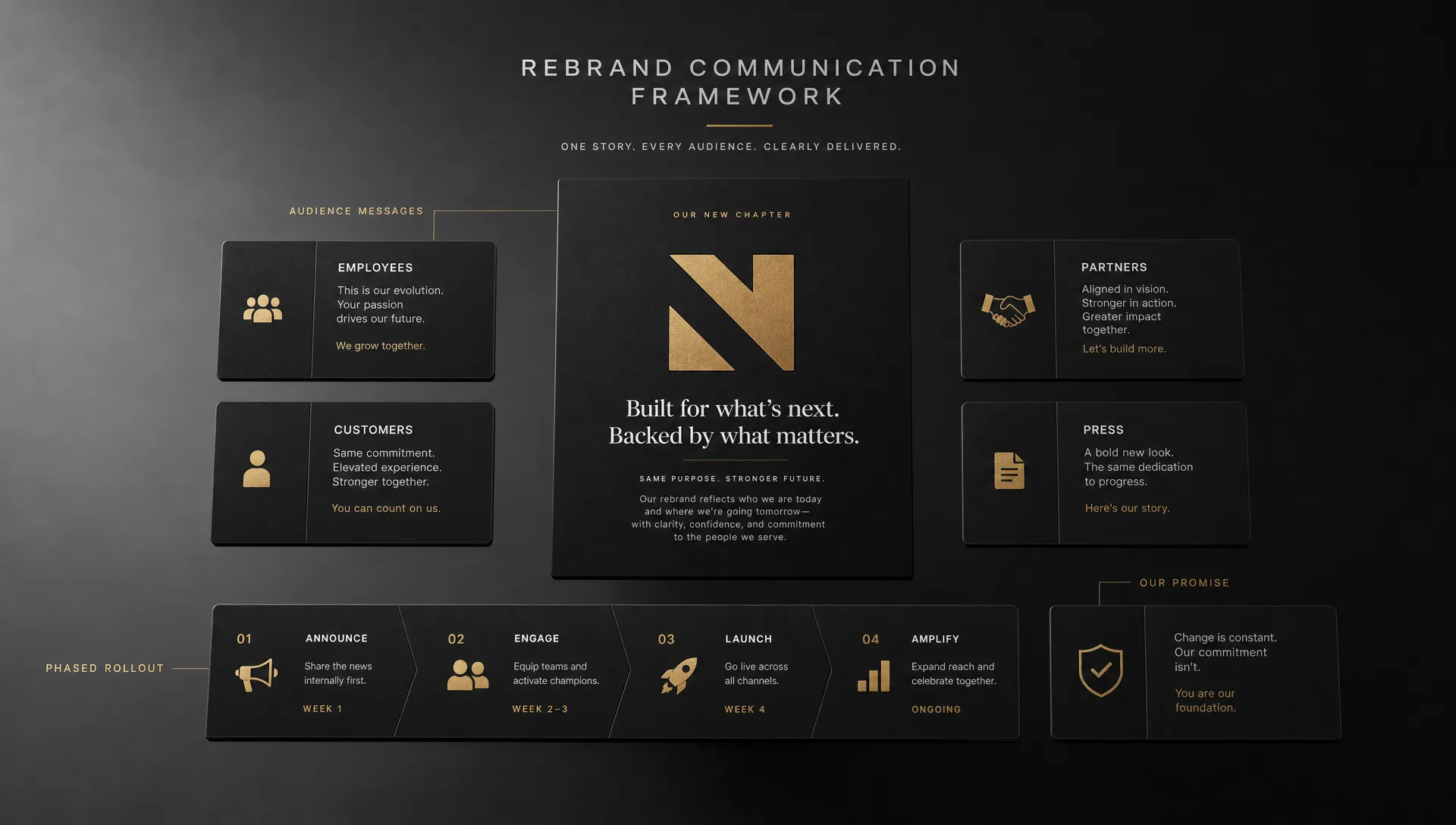
A rebrand is not fully launched when the new logo goes live. It is launched when employees can explain it confidently, customers understand what it means for them, and the market connects the change to a clearer business promise.
That is why a strong rebranding communication strategy has to work in two directions: internally first, then externally with the same strategic logic. If your own team hears the story after your customers do, you create confusion. If your customers see a new identity without context, you create doubt. The job is to make the change feel intentional, relevant, and reassuring before anyone has to fill in the gaps themselves.
Below is a practical framework for communicating a rebrand across teams, customers, partners, and public channels without losing momentum or trust.
Start with the strategic story, not the announcement
Before you write an internal email, publish a social post, or update the website, clarify the story behind the rebrand. The announcement is only the surface. The strategic story is what helps people understand why the change is happening now and why it matters.
A good rebrand story should answer a few essential questions:
- Why are we changing now?
- What business shift, market shift, or audience shift made this rebrand necessary?
- What is changing and what is staying the same?
- How does this make the brand more useful, relevant, or valuable to customers?
- What proof supports the new direction?
- What should each audience do next?
This is where many companies go wrong. They lead with visual decisions, such as a new logo, new colors, or a redesigned website, before explaining the strategic reason behind them. Design matters, but design without context can look like decoration. Strategy gives the change meaning.
If your team is still debating whether the rebrand is a visual refresh, a positioning shift, or a deeper business transformation, start with a clearer decision framework. Boil’s guide to rebranding decisions for high-growth teams is a useful reference before you move into launch communications.
Build one narrative, then adapt it for each audience
A rebrand needs one central narrative, but it should not be communicated in exactly the same way to every group. Your employees, customers, investors, partners, press contacts, and prospects all care about different parts of the change.
The central narrative should stay consistent. It should define the reason for the rebrand, the future direction of the company, the customer benefit, and the continuity people can trust. From there, tailor the emphasis.
Employees need to know how to explain the rebrand and how it affects their day-to-day work. Customers need to know whether the product, service, pricing, support, or relationship they trust is changing. Prospects need to see a sharper reason to consider you. Partners need clarity on co-marketing, sales materials, legal names, and operational details. Investors or board members need to see how the rebrand supports growth.
Think of the narrative as the source code of the launch. Every email, landing page, sales deck, LinkedIn post, press note, and customer conversation should be built from the same strategic logic.
Communicate internally before you communicate externally
Internal communication is not a courtesy step. It is the foundation of the external launch. Employees are the first interpreters of your rebrand, especially in sales calls, customer support conversations, hiring discussions, investor updates, and partner meetings.
If they are not prepared, the market will feel it. The new brand may look polished, but the experience around it will feel inconsistent.
Start with leadership alignment. Before the wider team sees anything, the executive team should agree on the reason for the rebrand, the language used to explain it, the boundaries of what can be shared, and the role each leader will play in reinforcing the message.
Then brief managers and team leads. They need more than the final announcement. They need the context behind decisions, the likely questions from their teams, and the confidence to translate the rebrand into practical implications.
Finally, bring the wider team in through a structured internal launch. Depending on the size of the company, this might include an all-hands presentation, department-specific sessions, a written FAQ, and a shared asset hub.
A useful internal rebrand kit can include:
- A short narrative explaining why the brand is changing
- A simple explanation of what is changing and what is not changing
- Updated messaging and positioning guidance
- New visual identity assets and usage rules
- Sales and customer support talking points
- A timeline of internal and external launch moments
- A clear escalation path for questions or concerns
The most important part is not the asset folder. It is comprehension. People support what they can explain. If employees can only say that the company has a new look, the rebrand has not landed internally yet.
Equip each department with role-specific guidance
A rebrand touches different teams in different ways. A single internal announcement rarely gives every department enough clarity to act well.
Sales teams need to understand how the new positioning affects outreach, proposals, qualification, and objection handling. Customer success teams need to know how to reassure existing accounts and explain continuity. Marketing teams need channel-by-channel launch plans. Product and web teams need to understand how the identity and messaging will appear across digital experiences. HR and recruiting teams need to align employer brand materials with the new story.
Legal, finance, and operations may also need practical guidance if the rebrand includes a name change, entity change, contract updates, invoice updates, domain migration, or compliance-sensitive language.
This is especially important when a rebrand reflects a deeper transformation, such as new technology infrastructure, platform modernization, or a shift toward digital independence. In those cases, specialist partners like digital transformation and technology sovereignty experts may need to be involved early so the claims, proof points, and operational timelines stay accurate.
Prepare external audiences without making them uncertain
External rebrand communication has one main job: make the change feel like progress, not instability.
Customers and prospects should not be left wondering whether the company has been acquired, whether the product is changing, whether pricing is changing, or whether the team they know is still in place. Even when the rebrand is bold, the communication should create a sense of continuity.
A strong external message usually includes five elements:
- The reason for the rebrand
- The benefit to customers or the market
- The parts of the experience that remain consistent
- The visible changes people will notice
- The next step, if any action is required
For existing customers, the continuity message is especially important. Make it explicit. If their service, contracts, contacts, support, or account access remain the same, say so. If anything does change, explain it clearly and early.
For prospects, the focus can shift toward relevance. The rebrand should make it easier to understand what you stand for, who you serve, and why your offer matters now. For partners, the focus should be operational clarity. They may need updated logos, boilerplate copy, co-branded materials, referral language, or marketplace listings.
If your priority is protecting trust during the public reveal, Boil’s guide on announcing a rebrand without losing brand equity goes deeper into how to separate new signals from familiar strengths.

Use a phased rollout instead of a single launch blast
A rebrand should feel coordinated, not chaotic. That usually means planning the rollout in phases rather than relying on one big launch day.
The exact timeline depends on the size of the company and the complexity of the rebrand, but the sequence below works for many challenger brands and high-growth teams.
Strategy lock: Finalize positioning, messaging, brand identity, launch narrative, and the list of affected touchpoints. This is where the team confirms what must be ready for launch and what can be updated after launch.
Leadership and manager briefing: Align senior leaders first, then equip managers with context and talking points. This prevents conflicting explanations inside the company.
Internal launch: Share the rebrand with the full team before the public reveal. Give employees time to ask questions, explore assets, and understand what the change means in their roles.
Priority stakeholder outreach: Brief key customers, investors, partners, advisors, or strategic accounts before the broad public announcement. This helps important relationships feel respected rather than surprised.
Public launch: Update the website, social profiles, email signatures, sales materials, product surfaces, paid campaigns, press materials, and customer communications in a coordinated window.
Post-launch reinforcement: Continue explaining the rebrand after launch day. A single announcement rarely does the full job. Use follow-up content, founder notes, customer conversations, team posts, and product updates to reinforce the new positioning.
The goal is not to make every touchpoint perfect on day one. The goal is to make the experience coherent enough that people understand the change wherever they encounter it.
Write messages that reduce ambiguity
Good rebrand communication is clear, calm, and specific. It avoids vague phrases like exciting new chapter unless they are backed by a concrete reason.
For internal audiences, your message can follow this structure:
What is happening: We are evolving our brand to better reflect who we are, who we serve, and where we are going.
Why now: The company has grown, our market has changed, and our current brand no longer gives customers the clearest picture of our value.
What it means: Our strategy, messaging, and identity are becoming sharper and more aligned with our next stage of growth.
What stays the same: The core team, customer commitment, and service standards remain in place unless otherwise specified.
What happens next: Employees will receive updated assets, talking points, and launch timing so every team can communicate consistently.
For external audiences, the structure is similar, but the emphasis should be customer value:
What is changing: Our brand identity and messaging have evolved.
Why it matters: The new brand makes it easier to understand what we do, who we help, and the outcomes we are focused on creating.
What customers can expect: The experience they trust remains consistent, with a clearer expression of the value behind it.
Where to go next: Visit the updated website, contact your account team, or look out for new materials that reflect the evolved brand.
The best rebrand messages are not long. They are precise. They make the logic of the change easy to repeat.
Anticipate objections before launch day
Every rebrand creates questions. Some are practical. Some are emotional. Some are strategic. Ignoring them does not make them disappear.
Employees may ask whether the rebrand signals a change in direction, leadership, culture, or priorities. Customers may ask whether pricing, contracts, product features, or support are changing. Partners may ask when they should update shared materials. Prospects may wonder whether the new brand is relevant to them or whether the company has moved away from their needs.
Prepare answers before the launch. Better yet, collect likely questions from sales, customer success, support, and leadership during planning. These teams are closest to the market and can often predict concerns better than the brand team alone.
Common mistakes to avoid include treating the rebrand as a design reveal, surprising major customers, leaving employees with only generic talking points, changing visual assets before the story is clear, and updating channels at different times without a visible plan.
A rebrand is a trust moment. People do not need every behind-the-scenes detail, but they do need enough context to believe the change has been thought through.
Measure whether the message landed
Launch day visibility is not the same as communication success. The real question is whether the right audiences understood the rebrand and responded in the intended way.
Track both qualitative and quantitative signals. Internally, review employee questions, manager feedback, sales confidence, and how consistently teams describe the rebrand. Externally, monitor customer replies, support tickets, sales objections, website engagement, social sentiment, partner questions, and press or community interpretation.
If people keep asking the same question, that is not a nuisance. It is data. It means part of the message needs to be clarified, repeated, or translated into more specific language.
Post-launch communication should continue for weeks or months, especially if the rebrand supports a larger go-to-market shift. Reinforce the story through customer communications, case studies, product updates, leadership posts, sales enablement, and the brand experience itself.
Frequently Asked Questions
When should employees find out about a rebrand? Employees should find out before the public launch, ideally after leadership and managers have been briefed. They need enough time to understand the reason for the change, ask questions, and prepare for customer or partner conversations.
How do you announce a rebrand to customers? Announce it with a clear explanation of why the brand is changing, what customers will notice, what stays the same, and whether they need to take any action. Avoid making the announcement only about visuals. Connect the rebrand to customer value.
Should a company tell key customers before the public launch? In many cases, yes. Strategic accounts, long-term customers, investors, and major partners should often be briefed before the broad announcement. This helps protect trust and prevents important stakeholders from feeling surprised.
What is the biggest risk in rebrand communication? The biggest risk is ambiguity. If people do not understand why the rebrand is happening, they may assume the wrong thing. Clear internal alignment, customer continuity messaging, and a phased rollout reduce that risk.
How long should rebrand communication continue after launch? Rebrand communication should continue well beyond launch day. The first announcement creates awareness, but repetition across sales, marketing, customer success, recruiting, and digital experiences is what creates understanding.
Make the rebrand easier to believe
A rebrand is only as strong as the story people repeat after they see it. When internal teams understand the change and external audiences feel reassured, the new brand has a much better chance of building momentum instead of confusion.
Boil helps ambitious challenger brands turn brand strategy, go-to-market thinking, and digital experience into clearer market growth. If your rebrand needs to do more than look different, Boil can help you make the change easier to understand, easier to launch, and easier to believe.
