
Announcing a rebrand is not a design reveal. It is a transfer of trust.
Customers, partners, investors, employees, and the market have built memory around your current name, identity, story, and proof. If the announcement feels sudden or self-indulgent, people can interpret progress as instability. If it feels strategic, clear, and useful, the same change can sharpen your position and make the brand easier to choose.
For challenger brands, this matters even more. You may not have the budget or market dominance of an incumbent, so your existing brand equity is precious. The goal is not to erase the past. The goal is to carry the strongest parts of it into a sharper future.
Why rebrand announcements can destroy value
A rebrand usually begins inside the business: a new strategy, a new market, a merger, a founder shift, a product expansion, or a brand that no longer reflects the company you have become. But the audience only sees the public moment. They see a new name, logo, website, or message and instantly ask: Is this still the company I trust?
That gap between internal logic and external perception is where brand equity gets lost.
Brand equity is built through recognition, reputation, preference, and repeated experience. It lives in distinctive assets, search demand, customer language, sales decks, product habits, press mentions, social proof, and the emotional shortcuts people use to remember you. When you announce a rebrand poorly, you disrupt those shortcuts without replacing them with a clearer one.
A strong announcement does three jobs at once:
- It explains why the change is happening.
- It reassures people about what will not change.
- It gives the market a simple story to repeat.
That last point is often overlooked. Your audience should not need to decode the rebrand. They should be able to explain it back in one sentence.
Start with an equity audit before you write the announcement
Before writing a launch post or briefing a designer on social assets, identify what equity you must preserve. This prevents a common mistake: treating the rebrand as a blank page when it is actually an inheritance.
Look at four types of equity.
Recognition equity includes your name, colors, logo, shapes, tone of voice, packaging cues, founder presence, taglines, product UI patterns, and any other asset people associate with you. Some assets may feel outdated internally but still work hard externally.
Trust equity includes reviews, testimonials, certifications, case studies, partnerships, community relationships, and category credibility. These must be carried into the announcement so people do not feel the business has become unproven overnight.
Commercial equity includes SEO rankings, branded search volume, conversion pages, sales collateral, email lists, partner referrals, and pipeline momentum. A rebrand that looks great but breaks commercial flow is not a successful rebrand.
Cultural equity includes what employees believe the company stands for, the language teams use, and the internal rituals that make the brand feel real. If employees cannot explain the rebrand, the market will feel the confusion.
This is why a rebrand announcement should never be planned as a final-week communications task. It belongs inside the broader rebranding process. If you are still defining the scope, timing, and risk plan, use a structured resource like Boil’s rebrand agency checklist before you move into launch mode.
Define what is changing and what is staying the same
The best rebrand announcements reduce anxiety by making continuity visible. People are more open to change when they can see the thread connecting the old brand to the new one.
This does not mean you need to play small. A challenger brand may need a bold repositioning, a new name, or a radical identity to claim a more ambitious market position. But boldness needs context. Without context, bold looks random.
Before announcing, align your leadership team on three statements:
- What changed in the business or market? For example, your company expanded beyond its original product, entered a new region, moved upmarket, merged with another company, or discovered a stronger category opportunity.
- What does the new brand make clearer? This could be your audience, promise, category, product architecture, purpose, or go-to-market focus.
- What remains true? This might be your team, values, service quality, customer commitments, core product, pricing philosophy, or mission.
A simple internal formula helps:
We used to be known for [old association]. Our customers now need us for [new role]. The new brand reflects that evolution while keeping [important continuity].
If you cannot complete that sentence without jargon, your announcement is not ready.
Build the announcement around the business reason, not the design work
Most rebrand announcements spend too much time talking about the logo. That is a problem because customers rarely care about your typography in isolation. They care about what the change means for them.
The visual identity matters, but it should be presented as evidence of a bigger strategic move. Lead with the shift, then show how the identity expresses it.
Weak announcement logic sounds like this: We are excited to unveil our fresh new look, designed to reflect our modern, dynamic, innovative future.
Stronger announcement logic sounds like this: Over the past three years, our customers have started using us not just for project delivery, but for strategic growth. Our new brand reflects that expanded role and makes it easier to understand how we help ambitious teams move from idea to market.
The second version gives people a reason to care. It turns the rebrand from decoration into progress.
If the rebrand is tied to repositioning, category design, or a sharper growth strategy, make that explicit. Boil’s complete rebranding guide goes deeper into when a rebrand should be treated as a strategic business move rather than a cosmetic refresh.
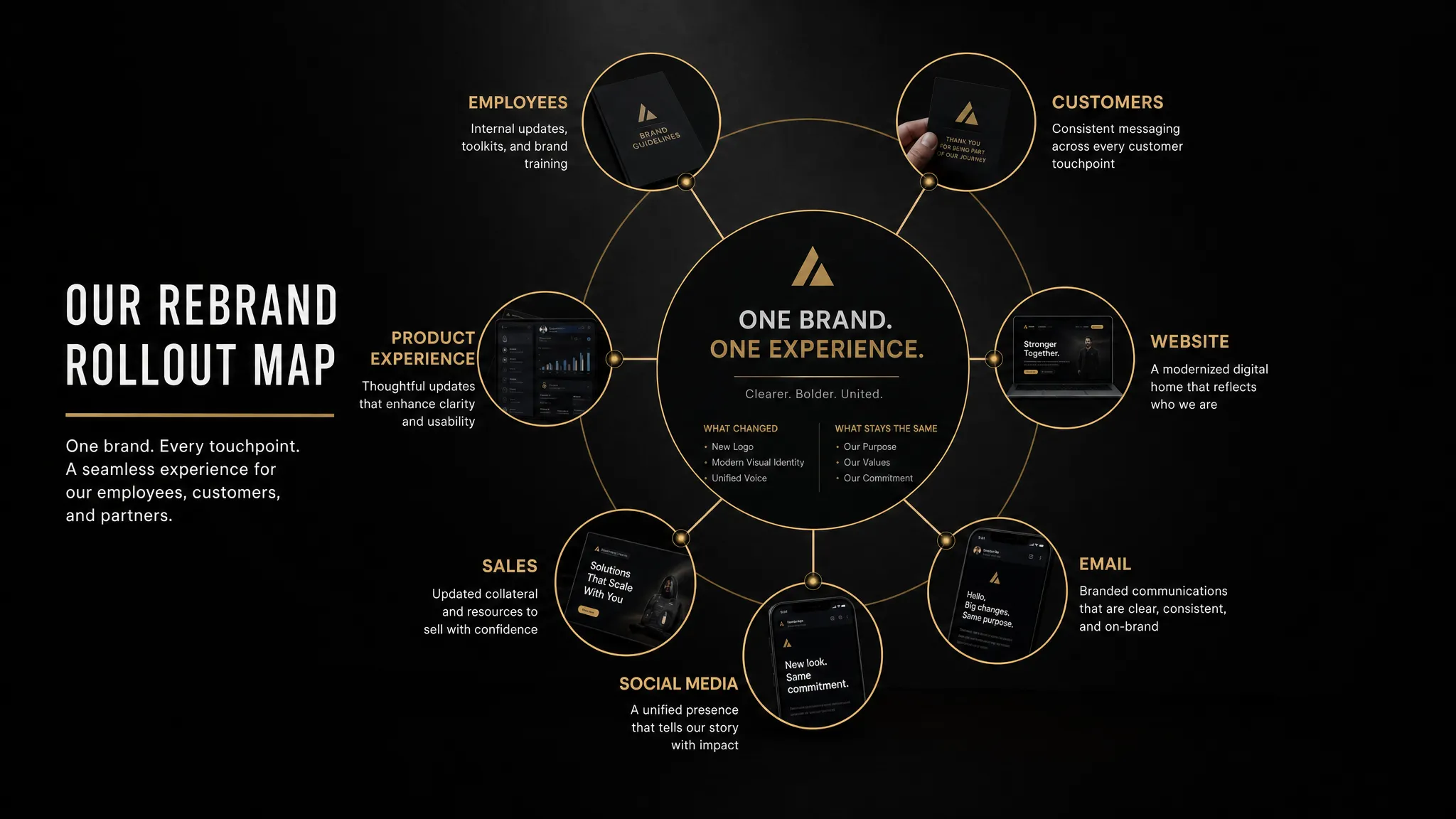
Sequence the announcement by stakeholder, not by channel
A rebrand announcement is not one post. It is a coordinated rollout across people who need different levels of detail.
Internal teams should hear first. They need the strategic rationale, the story, the practical changes, and the words to use with customers. If employees discover the rebrand on LinkedIn, you have already lost control of the narrative.
High-value customers and partners should hear before the public launch, especially if the name, ownership, product experience, contract details, or service model is changing. These relationships deserve a direct message, not a surprise.
Prospects in active sales cycles need special handling. If a deal is close, a sudden brand change can create friction. Sales teams should be equipped with a short explanation, updated decks, and reassurance that the business case remains intact.
Your broader audience can then receive the public announcement through your website, email, social channels, PR, and paid media where relevant.
This is where customer data hygiene becomes practical, not administrative. A well-maintained CRM helps you segment VIP customers, open opportunities, partners, dormant accounts, and newsletter subscribers so each group receives the right message at the right time. Even a lightweight CRM system for small businesses can help teams avoid blasting the same generic rebrand email to every relationship.
Create a message architecture before creating assets
A launch can involve dozens of touchpoints: homepage, email, social bio, LinkedIn posts, press release, founder note, customer FAQ, sales deck, product banners, invoices, app store listings, paid ads, and partner communications. If every team writes from scratch, the story will drift.
Create a message architecture first. It does not need to be complicated. It needs to be repeatable.
Your architecture should include:
- The one-line announcement: Old Brand is now New Brand, built to help [audience] achieve [outcome].
- The reason for change: The market, customer need, or company evolution that made the rebrand necessary.
- The continuity statement: What customers can still count on.
- The customer benefit: What becomes clearer, better, faster, easier, or more valuable.
- The proof: Product improvements, expanded capabilities, stronger team, customer results, new focus, or a clearer market position.
- The next action: Explore the new site, read the story, contact the team, log in, update bookmarks, or follow the new channels.
Once this is aligned, every channel can adapt the same spine. The press announcement may be formal. The founder post may be personal. The customer email may be practical. But the underlying story stays consistent.
For challenger brands, consistency is not corporate bureaucracy. It is how you build memory when you cannot outspend the market leader.
Use the old brand as a bridge
One of the safest ways to preserve equity is to make the transition easy to recognize. This is especially important if you are changing the company name.
For a defined transition period, use bridging language such as:
- Old Brand is now New Brand.
- Formerly Old Brand.
- Old Brand has become New Brand.
- The next chapter of Old Brand.
This should appear on your homepage, social profiles, email footers, customer communications, press materials, and key landing pages. If you have a product login, app, or customer portal, include the bridge there too.
The length of the transition depends on the size of your audience and the radicalness of the change. A small B2B brand with direct customer relationships may only need a few months. A consumer brand, marketplace, or company with strong branded search may need longer.
Do not delete all traces of the old brand overnight. That might feel clean internally, but it can feel suspicious externally. People need to know they are in the right place.
Protect SEO and digital discoverability
Rebrands often lose equity because teams underestimate digital infrastructure. If your name, domain, URL structure, metadata, or content architecture changes, the announcement is also a search migration.
At minimum, you need to prepare:
- 301 redirects from old URLs to the most relevant new URLs.
- A rebrand landing page explaining the change.
- Updated title tags and meta descriptions for important pages.
- Search-optimized copy that includes the old and new brand names naturally.
- Updated Google Business Profile, social profiles, review platforms, directories, and partner pages.
- Monitoring for broken links, ranking drops, crawl errors, and branded search changes.
Google’s own site move guidance is a useful reference if your rebrand includes a domain or URL migration. The key principle is simple: make it easy for both humans and search engines to understand the relationship between old and new.
This also applies to paid media. If people are still searching for the old brand, consider running branded search campaigns during the transition so competitors do not capture confused demand.
Prepare sales, support, and customer success before launch day
Your audience will not only read the official announcement. They will ask questions in meetings, support chats, DMs, comments, and renewal conversations. Those moments are where trust is either reinforced or weakened.
Prepare a short enablement kit for customer-facing teams. It should include the rebrand story, approved language, FAQs, objection handling, updated collateral, email snippets, and escalation rules for sensitive accounts.
Sales teams need to know how the rebrand affects positioning and differentiation. Support teams need to know how to answer practical questions. Customer success teams need to know how to reassure clients that service quality, contracts, data, and points of contact remain stable unless otherwise stated.
If the rebrand is part of a bigger transformation, such as a new product architecture, market focus, or pricing model, be honest about what is changing. Vague reassurance creates more uncertainty than clear specifics.
Announce with proof, not hype
The announcement should not rely on adjectives like bold, innovative, premium, human, or future-ready. Those words are easy to write and hard to believe.
Use proof instead.
If your rebrand reflects a move upmarket, show the capabilities that make you credible. If it reflects a sustainability commitment, show operational changes and measurable actions. If it reflects category leadership, explain the market problem you are reframing. If it reflects a merger, show how customers benefit from the combined expertise.
A strong rebrand announcement can include:
- A founder or leadership note explaining the strategic shift.
- A visual before-and-after story that makes the evolution understandable.
- Customer or partner quotes that validate the direction.
- A clear explanation of what customers need to do, if anything.
- A dedicated FAQ that answers practical concerns.
- A proof page, case study, product update, or manifesto that supports the new positioning.
This is where brand storytelling matters. If you need a practical structure for turning strategy into a message people remember, Boil’s brand story framework can help you shape the narrative before you turn it into campaign assets.
A practical rebrand announcement template
Use this as a starting point, not a script to copy word for word:
Today, Old Brand becomes New Brand.
This change reflects where our company has been heading and what our customers now need from us. We started by helping [audience] with [original problem]. Over time, that work has grown into [broader role or sharper focus].
New Brand is built around that next chapter: [clear promise]. The name, identity, and message are new, but our commitment to [continuity point] remains the same.
For customers, nothing changes in how you access [product, service, team, or support], unless noted below. What does change is [customer benefit or strategic improvement].
Thank you to everyone who helped build the story so far. We are excited to move forward as New Brand and continue helping [audience] [desired outcome].
Notice the order. It does not start with excitement. It starts with clarity. Excitement is earned when the audience understands the point.
Avoid these common rebrand announcement mistakes
The most common rebrand mistakes are not creative. They are operational and narrative.
Launching as a surprise: Surprise can work for a campaign. It rarely works for a rebrand that affects trust. Key stakeholders should not feel ambushed.
Making the announcement about the logo: The identity is important, but it is not the strategy. Explain the business reason first.
Erasing the old brand too quickly: If your audience still searches, says, or recognizes the old name, use it as a bridge.
Using vague language: Phrases like new era, refreshed identity, and next chapter are not enough. Explain what changed and why it matters.
Ignoring internal adoption: Employees are the first distribution channel. If they do not understand the rebrand, the market will not either.
Changing too many customer-facing systems at once: If the name, pricing, product UI, support process, and account team all change simultaneously, customers may experience the rebrand as instability.
Failing to measure after launch: A rebrand announcement is not finished when the post goes live. It is finished when the market understands and adopts the new meaning.
Measure whether equity is transferring
After launch, track whether your existing equity is moving into the new brand or leaking away.
In the first 30 days, focus on confusion and access. Monitor support questions, broken links, direct traffic, branded search for both old and new names, social comments, email replies, and sales objections.
By 60 days, look for adoption. Are customers using the new name? Are sales teams using the new story? Are partners updating references? Are prospects understanding the new position faster?
By 90 days, connect the rebrand to business signals. Review conversion rates, pipeline quality, sales cycle friction, organic visibility, customer retention, win-loss feedback, and share of search where relevant.
Do not expect every metric to spike immediately. A rebrand is a change in meaning, and meaning takes repetition. But you should see confusion decrease and clarity increase.
Rebrand announcement checklist
Before launch, make sure you can answer yes to each of these:
- We know which brand assets and relationships must be protected.
- We can explain the rebrand in one clear sentence.
- We have defined what is changing and what is staying the same.
- Internal teams are briefed before the public announcement.
- Key customers and partners have a tailored communication plan.
- Sales, support, and customer success have approved talking points.
- SEO redirects, old-name searches, and profile updates are planned.
- The old brand is used as a bridge where needed.
- The announcement includes proof, not just design language.
- We have a 30/60/90 measurement plan.
If any of these are missing, pause. It is better to delay a rebrand announcement than to launch one that burns trust.
Frequently Asked Questions
How do you announce a rebrand without confusing customers? Lead with the reason for the change, clearly state what stays the same, and use bridging language such as Old Brand is now New Brand. Segment communications so important customers hear directly before the public rollout.
Should we mention the old brand name in the announcement? Yes, if the old brand has recognition, search demand, customer relationships, or market credibility. Removing it too quickly can create confusion. Use the old name as a bridge until the new brand becomes familiar.
How early should employees know about a rebrand? Employees should be briefed before any public announcement. Customer-facing teams need extra time to learn the story, review FAQs, update collateral, and prepare for customer questions.
What should a rebrand announcement include? Include the old and new brand names, the strategic reason for the change, what customers can still rely on, what improves, any practical actions customers need to take, and where to find more information.
How do you protect SEO during a rebrand? Plan redirects, preserve important content, create a rebrand explainer page, update metadata, monitor old and new branded searches, and update external profiles and directory listings. Treat the announcement as a search migration if the domain or URL structure changes.
Should we tease a rebrand before launch? Teasing can build anticipation, but it should not replace clarity. For most B2B and challenger brands, it is better to brief key stakeholders privately, then launch publicly with a clear explanation and practical next steps.
Ready to announce your next chapter with confidence?
A rebrand should not make your audience wonder what happened. It should help them understand why your brand is now easier to believe, choose, and remember.
Boil helps ambitious challenger brands connect rebranding, positioning, creative identity, digital experience, and go-to-market execution so the launch is not just beautiful, but commercially useful. If you are preparing a rebrand and want to preserve the equity you have built while creating room for growth, start a conversation with Boil.
