
Most brands don’t lose because their product is worse. They lose because the market can’t quickly explain why they matter.
That gap is where challenger brands win. When you are the underdog, you cannot rely on default trust, familiarity, or distribution. You win by making meaning: a sharp point of view, a human conflict, and a story people can repeat.
This article gives you a brand story framework built for challengers, the brands that want to take share by changing how customers think, feel, and choose.
What a brand story is (and what it is not)
A brand story is not your origin story. It is not a timeline of funding rounds, features, or founder grit.
A brand story is a strategic narrative that answers, in plain language:
In other words, your brand story is the bridge between positioning and go-to-market execution.
If you want a quick gut check: when a customer retells your story to someone else, do they sound like they are repeating your website, or do they sound like they are sharing an idea worth spreading?
Why challengers need a different story structure
Incumbents can afford “safe” narratives because their brand is already mentally available. Challengers have to create that availability.
The Ehrenberg-Bass Institute’s work on mental availability and distinctive brand assets is a useful reminder here: growth comes from being easy to notice and easy to remember, not from being subtly better explained in a pitch deck. If your story is generic, you will be forgettable, and forgettable brands do not take share.
A challenger story has to do three extra jobs:
This is tightly connected to the “why” behind challenger behavior. If you want the philosophical baseline, Boil’s piece on the challenger mindset is a good companion read.
The Challenger Brand Story Framework (7 parts)
Think of this as a modular system. You can use it to write your homepage narrative, your pitch, your launch campaign, and your sales story without rewriting from scratch each time.
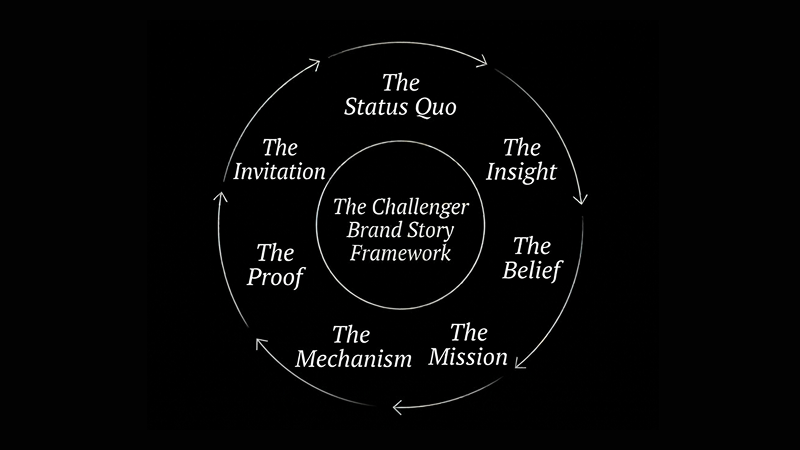
1) The Status Quo (name the thing you are challenging)
Start with the world as it is today. Not as you wish it were.
A strong status quo statement is specific enough that your ideal customer nods immediately. It points to:
This is where many brands get lazy. They say “the industry is broken” and move on. A challenger story earns attention by being precise.
Prompt: What do customers complain about, but still tolerate because they think there is no alternative?
2) The Insight (the truth you see that others ignore)
Your insight is the hinge of the entire story. It is the “aha” that changes interpretation.
It should be:
If you are working with category creation, this is where your new frame begins. Boil’s intro to category design is helpful if your ambition is to define a new game instead of playing the old one.
Prompt: If the category’s best practices are actually the problem, what is the better principle?
3) The Belief (your point of view in one sentence)
A challenger does not merely offer a product, it offers a belief customers can adopt.
Your belief is a short, repeatable sentence that would still be true even if your product changed.
Examples of belief structures:
This is the seed of a manifesto, tone of voice, and messaging system. If you need clarity on how Boil defines terms like brand story, manifesto, and messaging frameworks, see the challenger glossary.
Prompt: What do you believe that would make an incumbent uncomfortable to say out loud?
4) The Mission (the change you are here to make)
Mission is belief with stakes.
A useful mission statement is not “to be the best.” It is a change in the customer’s world, and it makes a clear promise about direction.
For challengers, mission also prevents random acts of marketing. It tells your team what to say no to.
Prompt: In three years, what will be different because you exist (for a specific customer, in a specific context)?
5) The Mechanism (how you make the mission real)
This is where you translate inspiration into credibility.
Mechanism is not a feature list. It is your distinct approach: how you do things differently, and why that difference matters.
Mechanisms can come from:
If you have a proprietary method, name it, but only if you can consistently use it across touchpoints. Boil references its own approach as the Boil Method, rooted in validating assumptions instead of guessing.
Prompt: What is the one capability competitors cannot easily copy in a quarter?
6) The Proof (why anyone should believe you)
Challengers must earn trust faster than incumbents.
Proof is a combination of credibility signals that reduce perceived risk:
Important: proof should support the belief. If your belief is “the industry overcomplicates,” your proof should feel simple and transparent.
Prompt: What would a skeptical buyer accept as evidence that your story is true?
7) The Invitation (what you want the customer to do next)
Great stories move. They do not just explain.
Invitation is your call-to-action, but in challenger language. It should sound like participation in change, not “book a demo” tacked onto a page.
Strong invitations have three properties:
If you are building a launch, this invitation should be integrated into your go-to-market plan. Boil’s guide on go-to-market mistakes to avoid is a practical safeguard here.
Prompt: What is the smallest “yes” that gets your customer to experience the difference?
Turn the framework into messaging you can deploy
A framework is only valuable if it ships. Here is a simple way to translate the seven parts into real assets.
A practical rule: if your sales team has to invent their own narrative because marketing is vague, your brand story is not a system, it is a slogan.
A fill-in template you can use (without sounding templated)
Use this as a drafting tool, then rewrite in your own voice.
If the first line does not make your ideal customer feel seen, do not move forward. Go back to the status quo.
Common ways challenger brand stories fail (and how to fix them)
They make the founder the hero
Founder stories are fine, but customers buy a better future for themselves. If your narrative sounds like “look at us,” it will underperform.
Fix: rewrite every paragraph so the customer is the protagonist and your brand is the catalyst.
They confuse “purpose” with “positioning”
Purpose is why you care. Positioning is why you win.
Fix: keep purpose as the emotional core, but anchor it in a clear category problem, a clear alternative, and a clear reason to believe.
They skip proof because it feels “too tactical”
Challengers often over-index on belief and under-invest in evidence. The market then files them under “nice idea.”
Fix: decide your top three proof points and make them unavoidable, above the scroll, in the deck, and in the demo.
They tell one story on the homepage and a different one in ads
Inconsistency kills momentum. It forces the market to relearn you every time.
Fix: build a message hierarchy once, then enforce it across brand, GTM, and digital experience.
How to know your story is working (signals that matter)
Brand story impact is partly qualitative, partly measurable.
Qualitative signals:
Quantitative signals (choose a few you can actually track):
If you want to test story and messaging without falling into the assumption trap, run small campaigns to validate which frames land, then scale what performs. That validation loop is often what separates challengers who get attention from challengers who take share.

Where Boil fits (if you want help building and shipping the story)
A challenger brand story is not a copywriting exercise. It is strategy, narrative, design, and go-to-market working as one.
Boil works with ambitious challengers on branding, rebranding, go-to-market strategy, and digital experiences. If you want a brand story that can carry a launch, unify your messaging, and help you take market share, you can explore Boil’s thinking across the site, then talk to Boil about your next chapter.
