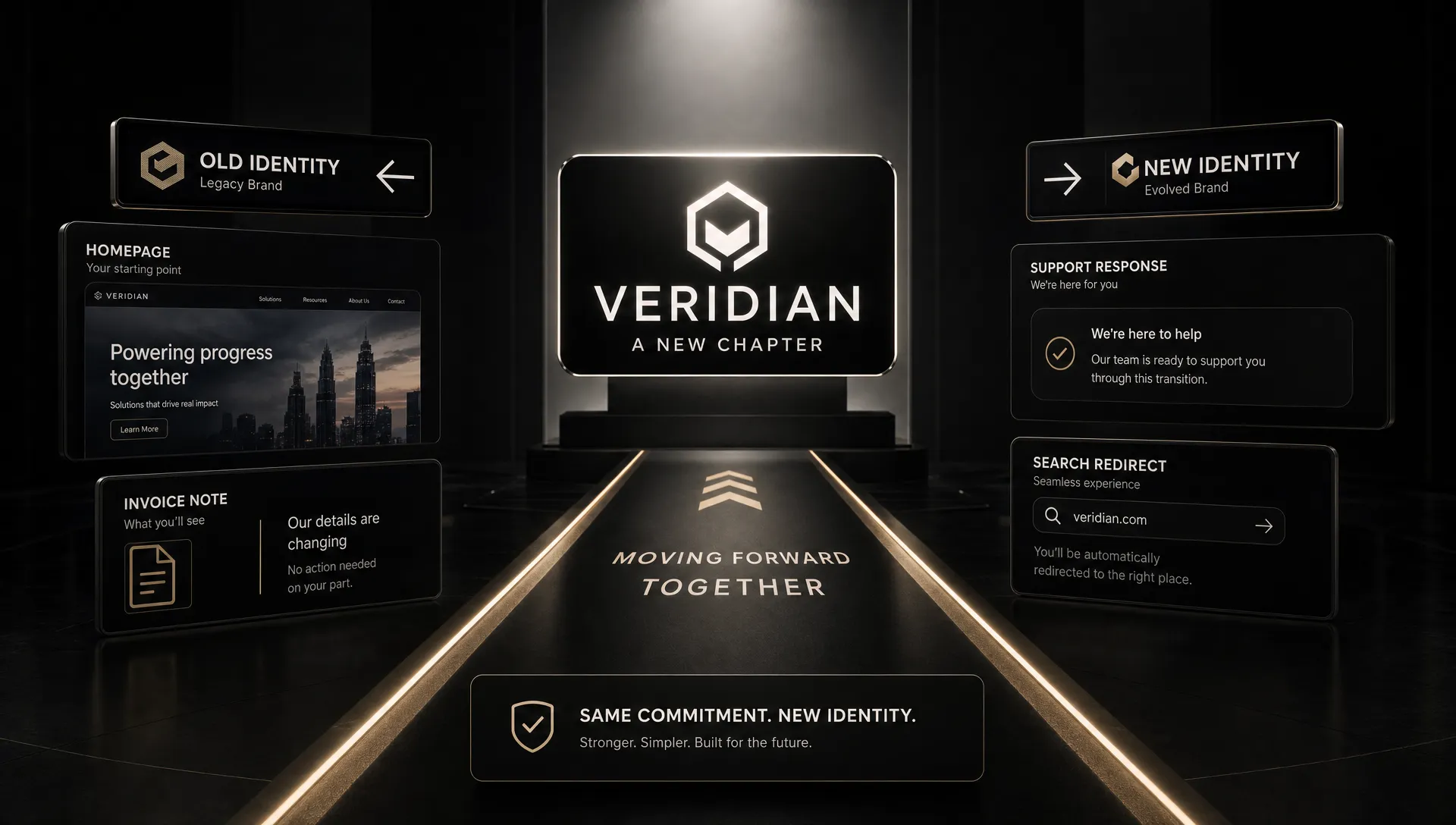
A rebrand is supposed to create clarity. It should help the market understand who you are, why you matter, and why now is the right time to pay attention. Yet many rebrands create the opposite effect: customers wonder if they are in the right place, whether the company has changed ownership, or if the product they trusted is still the same.
That confusion usually does not come from the new logo, color palette, or tagline alone. It comes from gaps in the launch. Customers see the change in fragments: an email signature here, a new website there, a social profile with a different name, an invoice that no longer looks familiar. When those fragments do not tell one coherent story, trust leaks.
When launching a rebrand, the goal is not to make every customer admire the transformation. The goal is simpler and more commercially important: make it easy for people to recognize you, understand what changed, and keep moving forward with confidence.
The real risk when launching a rebrand
Most teams worry that customers will dislike the new identity. That can happen, but it is rarely the biggest risk. The bigger risk is uncertainty.
Customers may ask themselves:
- Is this still the same company I bought from?
- Has the product, service, or support changed?
- Do I need to update billing, contracts, bookmarks, integrations, or contacts?
- Why did this change happen now?
- Does the new brand still represent the values I trusted?
These questions matter because rebrands touch memory. A customer may not remember your full positioning statement, but they remember visual cues, product names, founder faces, support language, and the promise they associated with you. If you remove those cues all at once without a bridge, you can accidentally erase useful recognition.
For challenger brands, this is especially important. You rebrand to sharpen your position, enter a new stage, or win a bigger share of the market. But market momentum depends on continuity. The launch has to say: we have evolved, and you are still in the right place.
Start with customer continuity, not the big reveal
Marketing teams often think of a rebrand as a reveal moment. Customers experience it as a continuity test.
Before you write the announcement, publish the new site, or update the product interface, define the customer continuity message. This is the plain-language bridge between the old brand and the new brand.
A strong continuity message answers four questions:
- What is changing?
- What is not changing?
- Why is the change happening?
- What, if anything, does the customer need to do?
For example, a simple message might say: same team, same service, sharper identity, broader ambition. That may not be the final copy, but it captures the emotional job. It reassures customers before asking them to appreciate the creative work.
The more dramatic the rebrand, the more explicit the continuity message needs to be. A light visual refresh may only need a short launch note. A rename, merger, repositioning, or product architecture change needs a much clearer transition narrative.
If you are still deciding how much equity to keep versus change, Boil has a deeper guide on how to announce a rebrand without losing brand equity, which is useful before you move into launch execution.
Audit the recognition assets customers already trust
Not all brand assets are equal. Some are decoration. Others are trust signals.
Before launching a rebrand, identify the elements customers use to recognize you. These might include your name, logo, domain, app icon, product interface, packaging, proposal format, invoice layout, customer support tone, founder presence, or even a specific phrase your sales team uses.
The mistake is assuming brand equity only lives in the logo. In reality, it often lives in patterns. A buyer recognizes the way your proposals are structured. A user recognizes the product navigation. A partner recognizes the old company name in a procurement system. A customer recognizes the support email sender name.
Once you know which assets carry recognition, decide what to retain temporarily, what to update immediately, and what to phase out. If you are rebranding a product rather than the entire company, this is even more sensitive because customers may rely on product names for workflows, training, reporting, and internal adoption. Boil’s guide to product rebranding strategy that protects brand equity explores that specific challenge in more depth.
The safest principle is this: if you change a high-recognition asset, keep another familiar cue nearby during the transition. A new name can be paired with a familiar product descriptor. A new logo can appear beside a short formerly known as line. A redesigned app can keep key navigation labels stable while users adjust.
Build a rebrand launch map across every touchpoint
Customers do not experience your rebrand in the order you planned it. They encounter it wherever they happen to be: a bookmarked login page, a sales deck, a renewal email, a LinkedIn post, a receipt, a conference booth, or a customer support thread.
That is why you need a launch map. This is not just an asset checklist. It is a customer journey map focused on rebrand recognition.
Start with your highest-traffic and highest-trust touchpoints. These usually include the homepage, product login, onboarding emails, sales proposals, paid ads, organic search results, customer support templates, billing documents, app store listings, social profiles, and partner pages.
Then classify every touchpoint into one of three actions:
- Update immediately because customers expect the new brand to be consistent there.
- Bridge temporarily because customers may need old and new cues together.
- Retire later because changing it too early could create unnecessary friction.
This exercise prevents a common launch problem: the brand team updates the visible marketing assets, but operational assets lag behind. A customer sees the new brand on the website, then receives an invoice under the old name, then contacts support from an email address with mixed branding. None of those moments is catastrophic alone. Together, they create doubt.
Choose the right launch model
There is no universal best way to launch a rebrand. The right model depends on how much is changing, how regulated your industry is, how large your customer base is, and how often customers interact with you.
A big-bang launch works when the change is mostly visual, operational risk is low, and the team can update major touchpoints quickly. It creates energy and gives the market one clear moment to notice.
A phased rollout works when the rebrand affects product interfaces, packaging, customer contracts, compliance materials, or multi-market operations. It gives customers time to adapt and lets your team fix issues before they scale.
A quiet infrastructure rollout followed by a public launch works when technical, legal, or channel changes need to be in place before the story goes live. This is common when domains, product names, app listings, redirects, or partner integrations are involved.
The key is to avoid an accidental hybrid. Many confusing launches happen because the public story says the rebrand has launched, while half the customer experience still reflects the old system. If you need a phased rollout, say so. Customers do not mind transition periods when they are explained clearly.
Make the announcement part of a wider orientation system
The rebrand announcement is important, but it cannot carry the whole launch. Most customers will skim it, miss it, or see it after they have already noticed the change somewhere else.
Think of the announcement as one part of an orientation system. That system should include launch copy, customer FAQs, sales talking points, support responses, transition labels, homepage messaging, social updates, and internal training.
Your announcement should not only celebrate the new identity. It should reduce the cognitive work customers have to do. Tell them what changed, why it changed, what stays the same, and what happens next.
A strong launch message usually includes three layers. First, the strategic reason for the rebrand, such as a clearer market position, a new stage of growth, or a better expression of the company’s ambition. Second, the customer reassurance, such as continuity of team, service, product quality, or support. Third, the practical next step, such as no action required, update your bookmarks, watch for new billing details, or expect product changes over the coming weeks.
Segment the message by audience
A single rebrand story can have multiple audience versions. That does not mean changing the truth. It means emphasizing the part each audience needs most.
Existing customers need reassurance and practical clarity. Prospects need sharper positioning and a reason to care. Partners need operational details and co-marketing guidance. Employees need confidence and language they can repeat. Investors and advisors need the strategic logic behind the move.
This segmentation is especially valuable for SaaS and digital products, where a rebrand can coincide with a new ICP, pricing motion, category narrative, or acquisition channel. If you are using the rebrand to refocus growth, it can help to pressure-test your target audience and channel priorities with a 90-day acquisition plan for SaaS teams before the launch narrative goes live.
The customer version should be the clearest and least self-congratulatory. Customers care less about the internal brand journey and more about what the change means for them. Lead with relevance, not theater.

Equip sales, support, and customer-facing teams first
Customers will often ask people, not campaigns, to explain the rebrand. That makes internal enablement one of the most important parts of launch.
Your sales team needs to explain the rebrand without derailing active deals. Customer success needs language for renewals and onboarding. Support needs practical answers for confused users. Finance may need to explain billing name changes. Leadership needs a concise narrative for public conversations.
Give teams more than a brand deck. Give them usable language.
Useful enablement assets include:
- A one-paragraph explanation of the rebrand.
- A shorter one-sentence version for quick replies.
- A customer FAQ that covers practical concerns.
- A list of what is changing and what is not changing.
- Email templates for customers, partners, and prospects.
- Objection handling for concerns about stability, ownership, pricing, or product changes.
Internal alignment should happen before public launch. If customers hear different explanations from different people, the rebrand will feel less strategic, even if the creative work is strong.
Plan the transition window deliberately
A transition window is not a sign of hesitation. It is a trust tool.
During this period, old and new brand cues appear together in selected places to help customers connect the dots. You might use a formerly known as line, an email footer note, a banner inside the product, a short note on invoices, or a support article explaining the change.
The right length depends on the buying cycle and the level of operational change. A consumer brand with frequent purchases may only need a short transition. A B2B company with annual contracts, procurement systems, or regulated documentation may need several months of bridge messaging.
Be selective. You do not want to dilute the new identity forever. The transition window should have a planned end point. Decide in advance when the old name, old logo, old product labels, or old explanations will disappear from each touchpoint.
This is where discipline matters. If the transition is too short, customers may feel disoriented. If it is too long, the new brand never fully takes hold.
Protect search, links, and channel trust
Customer confusion is not only emotional. It is also practical. If people cannot find you, log in, recognize your emails, or understand your search results, the rebrand creates friction.
Before launch, make sure redirects, domains, tracking, analytics, email authentication, social handles, knowledge panels, app listings, review platforms, and partner links are accounted for. Organic search can be particularly sensitive during a rename or domain migration because customers may still search for the old brand for months.
Do not treat old-brand search demand as a problem. Treat it as an asset. Create clear paths from old queries to the new brand. Use bridge copy in meta titles, landing pages, and help content where appropriate. Make it obvious that the new brand is the continuation of the old one.
Paid media and outbound campaigns need the same care. If prospects have seen the old brand in ads for six months, a sudden new identity with no explanation may reduce recognition. A short transition campaign can help transfer memory from old to new.
Measure confusion after launch
A rebrand launch is not finished when the new site goes live. The first weeks after launch are when you learn whether customers understood the change.
Track signals that reveal confusion, not just awareness. Brand impressions and social engagement are useful, but they do not show whether customers are oriented.
Watch for:
- Support tickets mentioning the old name, login issues, billing confusion, or uncertainty about ownership.
- Sales objections related to stability, trust, or what changed.
- Drops in branded search click-through rate or conversion rate.
- Increases in direct traffic to old URLs.
- Email replies asking whether the company has changed.
- Product usage dips after interface or naming changes.
- Customer success notes from renewal conversations.
These signals should feed a rapid response loop. If customers keep asking the same question, add the answer to the homepage, FAQ, onboarding flow, sales follow-up, or support macro. Confusion is usually fixable if you catch it early.
Common launch mistakes to avoid
The most common mistake is over-focusing on the creative reveal and under-planning the customer transition. A beautiful launch film will not help a customer who cannot recognize their invoice or find the login page.
Another mistake is using abstract language. Phrases like next chapter, bold evolution, and future-ready transformation may sound polished, but they often fail to answer the customer’s real question: what does this mean for me?
A third mistake is changing too many recognition cues at once. If the name, logo, colors, product UI, pricing labels, navigation, and email sender all change on the same day, even loyal customers may hesitate. Sequencing matters.
Finally, some brands hide the old identity too quickly. This can feel clean from an internal brand perspective, but customers do not live inside your launch plan. They need enough time and repetition to connect the old memory to the new brand.
Frequently Asked Questions
How long should a rebrand transition period last? It depends on your buying cycle, customer base, and operational complexity. A simple visual refresh may need a few weeks of bridge messaging. A B2B rename, product rebrand, or regulated industry rebrand may need several months.
Should customers be told before launch day? Key customers, partners, investors, and customer-facing teams often benefit from advance notice. For the broader market, launch day can work if the announcement is clear and the transition cues are already in place.
What should stay the same during a rebrand? Preserve the cues customers rely on most, at least temporarily. This could include product navigation, support contacts, login flows, customer success relationships, service promises, or recognizable messaging.
How do you know if a rebrand is confusing customers? Look for repeated questions, support tickets, lower conversion on branded traffic, login or billing confusion, sales objections about stability, and customers using the old name without understanding the new one.
Is a rebrand launch mainly a marketing project? No. Marketing may lead the story, but sales, support, product, finance, legal, leadership, and customer success all shape how customers experience the change.
Launch the rebrand as a growth move, not a cosmetic switch
A clear rebrand launch helps customers feel oriented while the market sees a sharper version of your company. That balance matters for challenger brands because growth depends on both fresh attention and existing trust.
If you are preparing a rebrand and want it connected to market share, go-to-market strategy, and digital experience, Boil helps ambitious brands turn brand change into brand growth. The launch should not just show what changed. It should make the next stage easier for customers to believe in, buy into, and remember.
