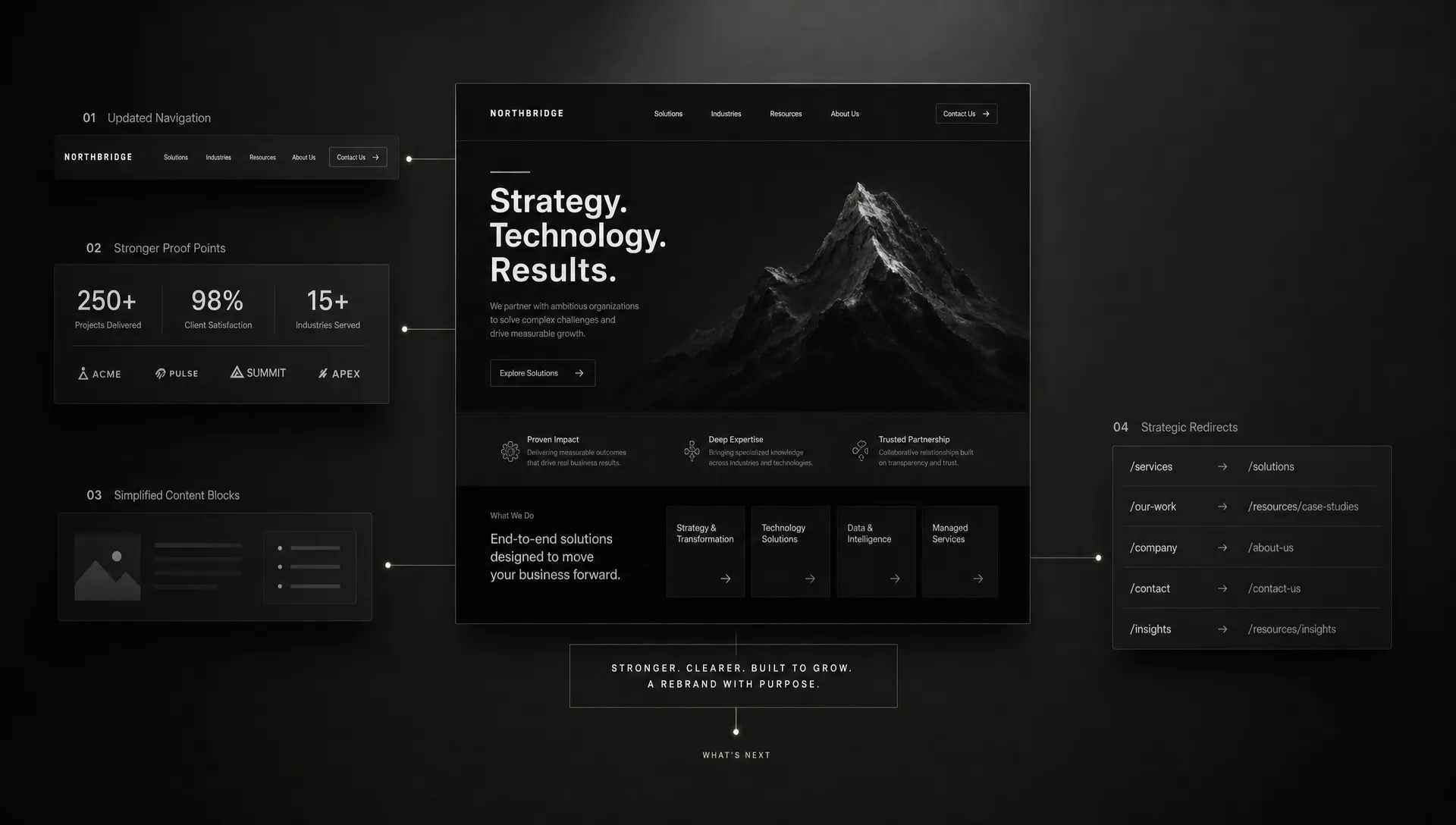
A website rebranding starts with a tension: your current site is holding the brand back, but parts of it may still carry valuable recognition, trust, and search equity. Change too little and the rebrand feels cosmetic. Change too much and customers may wonder whether they are in the right place.
The smartest website rebrands are not complete resets. They are selective upgrades. They make the brand clearer, sharper, and more competitive while protecting the signals your audience already understands.
For challenger brands, this is especially important. Your website often has to do more than look credible. It has to explain your difference quickly, reduce buyer uncertainty, support sales conversations, and make a market believe you are the stronger alternative.
Start with the job your website rebrand must do
Before deciding what to redesign, clarify why the website rebrand is happening. A site that needs to attract a new audience requires different decisions from one that needs to improve conversion, support a new product architecture, or signal a more premium market position.
Common triggers include a shift in strategy, a new go-to-market motion, an expanded product offer, poor conversion, outdated visuals, unclear messaging, weak differentiation, or a brand that has outgrown its original identity.
This is where many teams make the first mistake. They treat the website as a design project when it is really a business clarity project. Visual change is only useful if it helps the right people understand who you are, why you matter, and what to do next.
If you are not sure whether you need a full rebuild or a lighter update, Boil’s guide to choosing between a brand refresh and a bigger rebuild is a useful starting point.
What to change in a website rebranding
Change the messaging if the old story no longer matches the market
Messaging is often the first thing that needs to evolve. If your website still explains what you did two years ago, speaks to an audience you have moved beyond, or hides your strongest commercial advantage, the rebrand should fix that.
Look closely at your homepage headline, product or service descriptions, proof points, calls to action, and navigation labels. Ask whether the language reflects your current strategy or simply preserves internal habits.
Strong rebrand messaging should answer three questions quickly:
- Who is this for?
- What problem does it solve better than the alternatives?
- Why should I believe this brand can deliver?
For challenger brands, this is where positioning matters. You do not need to sound bigger than you are. You need to sound more specific, more relevant, and more useful than the category default.
Change the information architecture when users cannot find the value
A visual redesign cannot save a confusing structure. If users struggle to understand what you offer, which page applies to them, or how your services connect, your information architecture needs work.
This may mean reorganizing your navigation, separating audience-specific paths, simplifying service pages, consolidating thin content, or creating clearer journeys from problem to proof to action.
The goal is not to show everything at once. The goal is to help each visitor get to the most relevant next step with minimal friction. A good website rebrand makes the brand easier to understand, not just more attractive.
Change the visual identity when it creates the wrong perception
Visual change matters when your current identity sends a signal that no longer fits. Maybe the brand looks too early-stage, too corporate, too generic, too complex, or too similar to competitors. Maybe it fails to express the energy, confidence, or sophistication of the business today.
In a website rebranding project, visual updates often include typography, color, layout, imagery, iconography, motion, art direction, and the design system behind the site.
But visual identity should not be judged only by taste. Judge it by whether it improves recognition, distinctiveness, readability, credibility, and usability. The best design choices are not decorative. They help the brand compete.
Change conversion paths that were built around an old buyer journey
Your site may have been designed for a different buying motion. A founder-led business might have relied on direct referrals. A more mature brand may now need content journeys, product education, case studies, demo requests, newsletter capture, or clearer sales qualification.
Rebranding is a good moment to ask whether every key page has a meaningful next step. Not every call to action needs to be aggressive. Some visitors are ready to talk. Others need to compare, learn, or build internal confidence first.
For example, a service marketplace or comparison platform needs to preserve trust while helping users act with confidence. Homeowners comparing local professionals on HaMuch’s UK tradesperson comparison platform rely on cues like pricing context, trade categories, reviews, and local relevance, and those are exactly the kinds of decision signals a rebrand should make easier to find, not harder.
Change content that creates doubt
Old content can quietly weaken a rebrand. Outdated case studies, inconsistent service descriptions, low-quality blog posts, old screenshots, missing team information, vague testimonials, and unsupported claims can all make a redesigned website feel unreliable.
A content audit should identify what to rewrite, merge, remove, redirect, or expand. Keep content that still earns attention and supports buyer confidence. Improve content that is strategically important but underperforming. Remove content that no longer fits the brand or creates confusion.
This is also the moment to align brand voice across the site. A rebrand falls apart quickly when the homepage sounds strategic, the product pages sound technical, and the contact page sounds like it belongs to another company.
What to keep in a website rebranding
Keep the equity your audience already recognizes
Not everything old is a problem. Some assets carry memory. Your name, tagline, color, tone, product labels, page names, or signature phrases may be doing more work than you think.
Before changing them, find out whether customers actually recognize and value them. Interview buyers. Speak to sales and customer success teams. Look at branded search data. Review customer language in testimonials, calls, support tickets, and social comments.
The key is to separate internal fatigue from external weakness. Your team may be tired of an asset because they see it every day. Your audience may still use it to identify and trust you.
Keep high-performing pages and URLs wherever possible
A website rebrand can damage search performance if SEO is treated as an afterthought. Pages that already rank, attract qualified traffic, earn backlinks, or convert visitors should be handled carefully.
This does not mean you can never change URLs or consolidate content. It means changes should be intentional, mapped, and technically managed. If URLs must change, use proper redirects and preserve relevance between old and new pages. Google’s documentation on site moves and URL changes is a useful technical reference for planning this part of the project.
Keep a record of your top organic landing pages, highest-converting pages, strongest backlinks, and branded search queries before the new site goes live. That baseline will help you spot issues quickly after launch.

Keep familiar navigation patterns unless there is a strong reason to change them
Rebranding should not make users relearn basic website behavior. Navigation, page hierarchy, buttons, filters, forms, and purchasing or inquiry flows should feel intuitive.
You can modernize the experience without creating unnecessary novelty. Users do not reward brands for making simple tasks feel unfamiliar. They reward brands that help them get what they came for.
If a page or flow already performs well, improve the design around it carefully. Test new labels. Watch how users move through the site. Do not remove practical clarity just because the layout looks cleaner without it.
Keep proof that reduces risk
Trust signals are often more important after a rebrand because users are recalibrating their understanding of the brand. Keep the proof that helps people believe the new story.
This may include case studies, testimonials, client logos, before-and-after examples, data points, certifications, press mentions, reviews, founder credibility, methodology, or product evidence.
The form may change. The proof itself should not disappear. In fact, a strong website rebrand usually makes proof more visible, more specific, and more connected to the claims on each page.
Keep customer continuity
A rebrand should create forward momentum, not make existing customers feel abandoned. If you serve current users, subscribers, partners, or clients through the website, they need reassurance.
Keep practical continuity signals such as login access, support pathways, product names where needed, customer documentation, help content, and clear explanations of what has changed.
If your rebrand will be public-facing, plan the announcement as carefully as the design. Boil’s article on launching a rebrand without confusing customers explores this continuity challenge in more depth.
Use a keep, change, protect framework
A simple way to make decisions is to divide every website asset into three categories.
- Keep: Elements that still create recognition, trust, usability, conversion, or search value.
- Change: Elements that conflict with the new strategy, weaken perception, confuse users, or underperform.
- Protect: Elements that may change visually or structurally but need careful handling, such as URLs, key landing pages, conversion flows, customer access points, and high-equity brand assets.
This framework helps prevent opinion-led decision-making. It also gives stakeholders a shared language. Instead of debating whether someone likes a color, page, or headline, the team can ask what role that element plays in the rebrand.
The biggest mistakes to avoid
One common mistake is changing everything at once to make the rebrand feel dramatic. This can create a short-term reveal but a long-term recognition problem. If customers cannot connect the new site to the brand they already trust, the rebrand has gone too far.
Another mistake is keeping too much because the team is afraid of disruption. This leads to a diluted rebrand where the old structure, language, and assumptions survive under a new visual layer. The result looks redesigned but still feels strategically stuck.
A third mistake is launching without internal alignment. Sales, marketing, customer support, leadership, and product teams all need to understand what changed, what stayed the same, and how to explain the new direction. A website rebrand is not just a customer-facing moment. It is an operating system for how the brand shows up.
Finally, do not delay SEO, analytics, and technical planning until the end. Redirects, metadata, tracking, accessibility, performance, and content migration should be part of the rebrand from the start.
A practical website rebranding checklist
Use these questions before approving the new site:
- Does the homepage communicate the new positioning within seconds?
- Are the main navigation labels clear to customers, not just internal teams?
- Have high-performing pages and URLs been identified before changes are made?
- Is there a redirect plan for any removed or changed URLs?
- Are proof points specific, current, and connected to key claims?
- Do calls to action match the buyer journey?
- Can existing customers still find support, login, documentation, or account-related information?
- Has the new brand voice been applied consistently across major pages?
- Are analytics, events, and conversion tracking ready for launch?
- Is there a clear rollout message explaining what is changing and what is staying the same?
This checklist will not replace strategy, but it will catch the issues that often turn a promising rebrand into a messy launch.
Frequently Asked Questions
What is website rebranding? Website rebranding is the process of updating a website so it reflects a new or evolved brand strategy. It can include messaging, visual identity, user experience, content, technical structure, and conversion journeys.
How do I know what to keep during a website rebrand? Keep the elements that still create recognition, trust, usability, search performance, or conversion value. Use customer research, analytics, branded search data, and sales feedback rather than relying only on internal opinion.
Will website rebranding hurt SEO? It can if rankings, URLs, redirects, internal links, and content relevance are not managed carefully. A well-planned rebrand protects high-performing pages and measures performance before and after launch.
Should a website rebrand include a new logo? Not always. A new logo may be useful if the current identity no longer supports the brand’s position, but many website rebrands focus on messaging, structure, design system, content, and user experience without replacing the core mark.
How long does a website rebrand take? Timelines vary based on the size of the site, the depth of strategy work, content needs, technical complexity, and stakeholder alignment. A focused refresh may move quickly, while a full strategic rebrand and website rebuild requires more discovery, design, content, and launch planning.
Ready to rebrand without losing what makes you valuable?
A strong website rebrand should sharpen your position, improve the user journey, and help the market understand why you are the brand to choose next. It should not erase the trust, recognition, and momentum you have already built.
Boil helps ambitious challenger brands grow through branding, rebranding, go-to-market strategy, creative design, and digital experiences. If your website needs to signal the next stage of growth, start the conversation with Boil.
