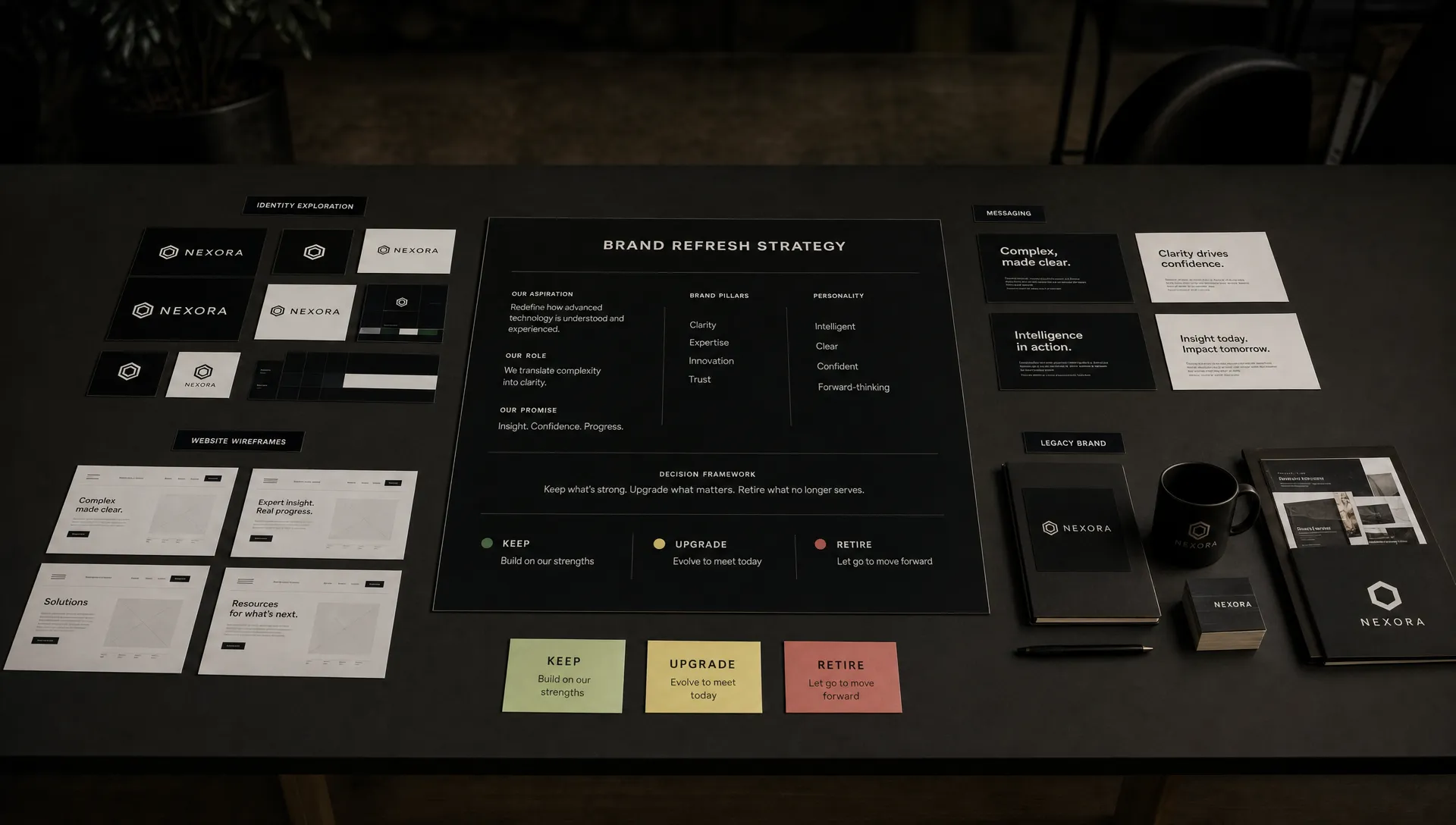
A brand refresh strategy is not a design exercise. It is a growth decision: how much of your brand should change so the business can move faster, win sharper, and stay recognizable while it evolves?
For challenger brands, the stakes are especially high. Move too lightly and you keep carrying old confusion into a bigger market. Move too heavily and you risk burning the trust, recognition, and memory structures you have already earned. The right answer is rarely “new logo or not?” It is usually “what is the smallest meaningful change that removes the biggest barrier to growth?”
That is the difference between updating and rebuilding. An update modernizes the expression of a brand while protecting its underlying equity. A rebuild rethinks the strategic foundation: who the brand is for, what it stands for, how it competes, and how it enters the market.
Here is how to choose the right path.
What a brand refresh strategy should decide
A strong brand refresh strategy defines what needs to change, what must stay consistent, and how the business will use the updated brand to create commercial momentum. It should connect brand decisions to market realities, not internal taste.
At minimum, your strategy should answer four questions:
- What growth problem are we solving? Maybe the brand feels dated, the offer has expanded, the category has shifted, or the current positioning no longer helps sales teams explain the value.
- Which assets already create recognition? These might include your name, color system, product language, tagline, tone of voice, founder story, or customer proof points.
- How much change can the market absorb? A loyal niche audience may tolerate subtle evolution, while a move into a new category may require a sharper strategic shift.
- How will the brand show up after launch? A refreshed identity means little if the website, sales decks, campaigns, product experience, and customer communications still tell the old story.
If you are already leaning toward a lighter change, Boil’s guide on when a light update beats a full rebrand is a useful companion. This article goes one level deeper into the strategic decision: update the current system or rebuild the brand from the ground up.
Update vs rebuild: the practical difference
A brand update keeps the strategic core intact. You may refine the messaging, sharpen the visual system, improve the website, modernize templates, and create a more consistent experience across touchpoints. The brand becomes clearer and more current, but customers still feel they are dealing with the same company.
A rebuild changes the foundation. It may involve a new positioning platform, audience focus, brand architecture, naming system, voice, visual identity, or go-to-market story. Customers may still recognize parts of the old brand, but the business is intentionally signaling a bigger shift.
Think of it this way: an update improves how the brand performs. A rebuild changes what the brand means.
That distinction matters because the wrong scope creates waste. A cosmetic refresh cannot fix an unclear strategy. A full rebuild can be overkill if your brand already has valuable recognition and simply needs more clarity, consistency, and confidence.
The five-question diagnostic
Before deciding scope, run the brand through five diagnostic questions. These help separate surface-level symptoms from deeper strategic issues.
1. Is recognition helping or holding you back?
If customers recognize your brand and associate it with positive experiences, protect that equity. You may still need to modernize the identity, but the goal should be continuity with improvement.
If recognition is weak, confused, or tied to the wrong category, a rebuild may be necessary. This is common when a company has outgrown its original niche, moved upmarket, or expanded from a single product into a broader platform.
The key is to distinguish familiarity from value. Some assets are recognizable but not useful. Others are imperfect but deeply tied to trust. A refresh strategy should identify which is which before any creative work begins.
2. Has the market changed more than the brand?
Brands often age because the market around them moves. Competitors sharpen their claims. Customer expectations rise. New buying committees appear. What once felt differentiated becomes generic.
If your core promise still matters but your expression feels behind, update. If the customer problem, buying process, or competitive frame has fundamentally changed, rebuild.
For example, a software company that once sold to technical users may now need to persuade operations, finance, and leadership teams. That is not just a visual problem. The brand may need a new narrative, proof structure, and go-to-market message.
3. Does the current brand help sales explain value?
A brand should make selling easier. If prospects understand what you do, why it matters, and why you are different, your brand is doing strategic work. If the sales team constantly rewrites the story, avoids the website, or creates their own decks, your brand system is probably underpowered.
An update can fix inconsistency in messaging, content, and design. A rebuild is more likely needed when the value proposition itself is unclear or when the company is selling a new kind of outcome.
4. Are internal teams aligned on what the brand stands for?
External confusion often starts internally. If leadership, marketing, product, and sales describe the company differently, the market will feel that fragmentation.
A refresh may be enough when the team agrees on the strategy but lacks a usable system. A rebuild is needed when alignment is missing at the level of audience, category, positioning, or ambition.
This is where challenger brands need to be honest. A new identity will not compensate for strategic disagreement. It will simply make the disagreement look more polished.
5. Will the next stage of growth require a different story?
If your current brand can stretch into the next growth stage with some refinement, update it. If the next stage demands a new level of credibility, a new audience relationship, or a new category frame, rebuild it.
This is especially relevant for brands entering new markets, raising capital, launching a broader product ecosystem, or moving from founder-led selling to scalable demand generation.
When an update is the smarter move
A brand update is usually the right move when the business has momentum, but the brand experience feels inconsistent, underdeveloped, or slightly behind the company’s ambition.
Common signs include an identity that looks dated but is still recognized, messaging that is broadly right but not sharp enough, a website that no longer reflects the quality of the offer, or content and sales materials that feel fragmented across teams.
In these cases, a refresh strategy should prioritize clarity and coherence. You are not trying to reinvent the brand. You are trying to remove friction between how good the business is and how convincingly it presents itself.
A smart update might include:
- Sharpening the positioning statement and customer promise
- Refining the tone of voice so the brand sounds more distinct
- Modernizing the logo, typography, color, or motion system without abandoning recognizable cues
- Redesigning key digital touchpoints, especially the website and conversion paths
- Rebuilding sales and marketing templates so teams show up consistently
For many challengers, this is the highest-return path. It protects what the market already knows while giving the brand more energy, confidence, and commercial usefulness.
When a rebuild is the better decision
A rebuild becomes the better decision when the current brand is attached to the wrong perception, the wrong audience, or the wrong strategic story. In that situation, small improvements can make the brand look better without making it work better.
Consider a rebuild if your company has changed categories, merged with another business, expanded beyond the original product, or needs to distance itself from an outdated promise. A rebuild may also be necessary when the current name, architecture, or identity creates confusion that cannot be solved through messaging alone.
The same applies when brand equity is low. If few customers recognize the existing assets, there may be less risk in creating a stronger system from scratch. The danger is not losing equity. The danger is continuing to invest in a brand that never had enough strategic power to support the next stage.
If you are unsure whether the problem is brand execution, market fit, or strategy, Boil’s rebranding decision guide for high-growth teams can help clarify the scope before you commit budget and leadership energy.

The “keep, upgrade, retire” method
One of the most practical ways to build a brand refresh strategy is to sort every major brand asset into three categories: keep, upgrade, or retire.
Keep the assets that create positive recognition and still support the future strategy. These are the cues customers know, trust, and associate with your strongest advantages. They may not be perfect, but they carry memory.
Upgrade the assets that have strategic value but need better execution. This often includes messaging, visual systems, websites, pitch decks, campaign templates, or product storytelling. The idea is to preserve the intent while improving the impact.
Retire the assets that create confusion, signal the wrong level of quality, or tie the business to an outdated market position. These are the elements that make the brand harder to understand, harder to sell, or harder to believe.
This method keeps the conversation objective. Instead of debating personal preferences, teams can ask: does this asset help us win the next market, or does it pull us back into the old one?
Match the scope to the business moment
The right level of change depends on timing. A startup preparing for its first serious growth push has different needs from a scaleup entering a new region or a mature challenger repositioning against larger competitors.
If you are close to a major launch, do not rebuild unless the current brand will actively damage the launch. A focused update may create enough clarity without slowing momentum. If you are preparing for a market entry, acquisition, funding round, or category shift, a deeper rebuild can create the foundation for a stronger go-to-market system.
Budget and bandwidth matter too. A rebuild requires more leadership involvement, more stakeholder management, more implementation planning, and more customer communication. If the team cannot support that level of change, a phased refresh may be more effective than a rushed transformation.
A useful rule: choose the boldest change you can implement well, not the biggest change you can imagine.
Test the strategy before you launch the look
Many brand refresh projects fail because teams fall in love with a visual direction before validating the strategic direction. The better sequence is strategy first, expression second, rollout third.
Before finalizing the refresh, test the core narrative with real sales conversations, customer interviews, landing page copy, investor materials, or campaign concepts. You are looking for faster understanding, stronger differentiation, and fewer explanations.
You do not need to over-research every design decision. But you do need evidence that the new direction helps the market understand why you matter.
This is also the point to map launch touchpoints. Your refreshed brand may need to show up across the website, email journeys, sales enablement, social, product screens, events, packaging, paid media, and customer support scripts. For brands that use offline activation as part of their go-to-market motion, an omni-channel direct mail platform such as DirectMail.io can help connect physical campaigns with data, automation, tracking, and attribution.
Roll out change without creating confusion
The bigger the change, the more intentional the rollout needs to be. A light update can often be introduced through a website launch, refreshed messaging, and coordinated campaign assets. A rebuild needs a clearer communication plan.
Customers should understand what is changing, what is staying the same, and why the change benefits them. Internal teams need the same clarity before the market sees the new brand. If your employees cannot explain the change simply, customers will not experience it clearly.
A good rollout plan includes launch messaging, internal enablement, customer communications, sales scripts, updated touchpoints, and a transition plan for legacy assets. If the change is significant, Boil’s guide to launching a rebrand without confusing customers is worth reviewing before you go live.
The objective is not to make a dramatic announcement for its own sake. It is to create continuity and momentum. Customers should feel that the brand has evolved in a way that makes sense.
Common mistakes to avoid
The most common mistake is treating a refresh as a visual makeover. Visual identity matters, but if positioning, messaging, offer architecture, and customer experience remain unclear, the new look will not solve the growth problem.
The second mistake is overcorrecting. Teams sometimes become bored with assets that customers still find useful. Internal fatigue is not the same as market fatigue. Before removing a distinctive cue, make sure you are not deleting a shortcut to recognition.
The third mistake is underestimating implementation. A new brand system has to live in the real world. If it only works in a keynote deck, it is not finished. It needs to work across small ads, long-form sales materials, mobile screens, product flows, event booths, and customer emails.
Finally, avoid vague ambition. “We need to feel more premium” or “we need to look more modern” is not enough. Define the commercial outcome. Better qualified leads, clearer market entry, stronger enterprise credibility, improved conversion, easier recruitment, or more consistent global execution are all sharper objectives.
A simple decision rule
Choose an update when your brand has useful equity, the strategic core is still right, and the main problem is expression, consistency, or relevance.
Choose a rebuild when the strategic core is wrong, the market has changed significantly, the current brand creates persistent confusion, or the next stage of growth requires a different story.
The strongest brand refresh strategy is not the one that changes the most. It is the one that changes the right things, protects the right assets, and gives the business a sharper way to compete.
Frequently Asked Questions
What is a brand refresh strategy? A brand refresh strategy is a plan for updating a brand’s messaging, identity, and touchpoints while deciding which existing assets should be preserved, improved, or retired. It connects creative change to business goals.
How do I know if I need a brand refresh or a full rebrand? Choose a refresh if your brand still has positive recognition and the core positioning remains relevant. Choose a full rebrand if your audience, category, offer, or market perception has changed enough that the old brand no longer supports growth.
Can a brand refresh include a new logo? Yes, but it does not have to. A refresh can include logo refinement, new typography, improved messaging, a redesigned website, updated campaigns, or a more consistent customer experience. The scope should match the strategic problem.
How often should a company refresh its brand? There is no fixed schedule. A brand should be refreshed when it no longer reflects the business, creates friction in sales or marketing, feels outdated to the market, or cannot support the next stage of growth.
What should stay the same during a brand refresh? Keep the assets that create positive recognition and still support your future strategy. This might include the name, core promise, certain colors, product language, customer proof, or a distinctive tone of voice.
Need help choosing the right level of change?
For ambitious challenger brands, the question is not whether change is exciting. It is whether change will help the brand win more of the market it deserves.
Boil helps brands make that decision with strategy, creative identity, go-to-market thinking, and digital experiences built around growth. If your brand is at a turning point, start by defining the scope: update what is working, rebuild what is holding you back, and make every change count.
