
Not every brand problem needs a revolution. Sometimes the smartest move is not to change your name, rewrite your story, or throw your visual identity into the fire. Sometimes, what your brand needs is a sharper edge, a cleaner system, and a more confident expression of what already works.
That is where a brand refresh comes in.
For challenger brands, the difference matters. A full rebrand can unlock growth when your strategy, audience, or market position has fundamentally changed. But it can also create unnecessary disruption if your brand still has valuable equity. A brand refresh gives you a lighter, faster way to modernize, clarify, and strengthen your market presence without losing the recognition you have already earned.
The key is knowing when a light update is enough, and when you are only postponing a deeper strategic reset.
What is a brand refresh?
A brand refresh is a focused update to your existing brand. It keeps the core of the brand intact while improving how it shows up across key touchpoints.
Think of it as sharpening the signal, not replacing the transmitter.
A refresh may include updates to your messaging, tone of voice, visual system, website, sales materials, social templates, campaign style, or go-to-market assets. It might refine your logo, modernize your typography, simplify your color palette, or make your digital experience feel more current. But it does not usually change the brand’s fundamental promise, market position, name, or identity architecture.
A full rebrand is different. Rebranding changes the strategic foundation. It often involves a new positioning, a new story, a new identity system, sometimes a new name, and a broader rollout across the business. If a brand refresh is a tune-up, a rebrand is an engine rebuild.
Neither is better by default. The right choice depends on the problem you are solving.
Why a light update can beat a full rebrand
A full rebrand is attractive because it feels decisive. It signals a new chapter. It gives teams a blank page. It can create momentum inside the company and attention outside it.
But not every business challenge requires a blank page.
A brand refresh can be more powerful when your brand already has recognition, trust, and a clear reason to exist. In those cases, the job is not to reinvent the brand. The job is to remove friction between what the brand has become and how the market experiences it.
A refresh often wins because it protects equity. If customers already recognize your name, colors, product cues, or tone, throwing them away can be expensive. The Ehrenberg-Bass Institute has long emphasized the commercial value of distinctive brand assets: the more easily people recognize you, the less you need to explain who you are every time you show up. A refresh lets you improve those assets without destroying memory structures.
It is also easier to implement. A full rebrand touches everything: legal, recruitment, product UI, packaging, investor decks, sales enablement, customer support, partner materials, paid media, and sometimes culture. A refresh can focus on the highest-impact surfaces first, such as the homepage, pitch deck, product narrative, campaign templates, and sales story.
For challengers with limited resources, that matters. You do not win by doing the biggest brand project. You win by making the highest-leverage move.
Signs a brand refresh is enough
A brand refresh is usually the right move when the brand’s foundation still holds, but the expression has started to lag behind the business.
Your strategy is still true, but your identity feels dated
If your positioning still reflects why customers choose you, you may not need a full rebrand. You may simply need to modernize the way that positioning is expressed.
This is common in scale-ups. The company has grown, the product has matured, and the team is now selling to more sophisticated buyers. The original identity may feel too scrappy, too startup-like, or too narrow for the next stage. But the strategic center is still right.
In that case, a refresh can raise perceived quality without confusing the market.
Your audience has evolved, not completely changed
Brands often outgrow their early audience. That does not always mean the old audience is wrong. It might mean you now need to speak to multiple decision-makers, more senior buyers, new geographies, or a broader set of use cases.
If the new audience still values the same core promise, a refresh can help you adjust emphasis. You might make the language more outcome-driven, the proof more mature, or the visual identity more credible for enterprise, premium, or international contexts.
But if the audience has fundamentally changed, and your old brand is built around a buyer you no longer serve, that points toward rebranding.
You have valuable brand recognition
Recognition is not always obvious from vanity metrics. It shows up in sales calls, referrals, search behavior, social mentions, customer language, and category conversations.
If people know you, remember you, or associate you with something useful, be careful. A full rebrand can break those associations.
For example, a mission-led local organization such as Ons Plekske builds trust through clarity, warmth, and familiarity. If an organization like that wanted to improve its digital presence, a refresh would likely protect the human cues people already recognize while making navigation, messaging, and visual consistency stronger.
The same principle applies to challenger brands. If your market already connects you with a specific problem, belief, or customer experience, do not discard that advantage casually.
Your brand system is inconsistent because you grew fast
Fast-growing brands often collect design debt. One team creates sales decks. Another builds landing pages. Product uses one tone. Paid ads use another. Hiring materials look like they came from a different company.
This does not always mean the brand is broken. It means the system is underdeveloped.
A refresh can turn scattered assets into a coherent brand system. It can define clearer rules for typography, color, layout, photography, motion, iconography, messaging, and tone. That helps the brand scale without forcing every team to invent from scratch.
If this is your problem, do not start with a new logo. Start with the system. Boil has explored this idea in more depth in its guide on building a brand system, not just a logo.
Your website is underperforming, but the brand still has pull
Sometimes leadership says the brand is wrong when the real issue is digital execution.
Your homepage may not explain the offer clearly. Your product pages may lack proof. Your conversion paths may be messy. Your visual hierarchy may make every message feel equally important. Your calls to action may not match buyer intent.
A website refresh, supported by clearer messaging and stronger design, can solve a lot without touching the deeper brand foundation.
This is especially true in B2B, fintech, SaaS, health, sustainability, and technical categories where buyers need clarity before they need entertainment.
When a full rebrand is the better choice
A brand refresh becomes dangerous when it is used to cover a strategic problem. If the foundation is wrong, better visuals will only make the confusion look more polished.
A full rebrand is more likely needed when your business has changed so much that the existing brand no longer tells the truth.
Common triggers include a major shift in product strategy, a new business model, expansion into a different market, a merger or acquisition, a reputation issue, a name that limits growth, or a positioning that no longer differentiates you.
The biggest warning sign is internal disagreement. If your leadership team cannot clearly answer who you serve, what you help them do, why you win, and what category you belong in, a refresh will not fix the problem. You need strategic alignment before expression.
Another warning sign is negative or irrelevant equity. If the market knows you for something you no longer want to be known for, preserving recognition may preserve the wrong idea. In that case, a full rebrand can create the distance needed to reposition.
You can explore the broader decision logic in Boil’s rebranding decision guide for high-growth teams.
The brand refresh decision test
Before committing to a brand refresh, ask one practical question: are we trying to express the same truth better, or are we trying to create a new truth?
If the truth is the same, a refresh is probably enough.
If the truth has changed, you are entering rebrand territory.
A useful diagnostic includes these questions:
If most answers support continuity, choose a refresh. If most reveal misalignment, choose a deeper rebrand.
What to update in a smart brand refresh
A strong brand refresh is not cosmetic decoration. It should improve business performance by making the brand easier to understand, remember, trust, and choose.
Messaging and positioning language
Even if the positioning does not change, the words may need work. Many brands carry old language from earlier stages: vague taglines, feature-heavy explanations, founder-centric stories, or category jargon that buyers do not use.
A refresh can sharpen your one-liner, homepage headline, pitch narrative, sales deck, proof points, and product messaging. The goal is not to say more. The goal is to make the buying logic easier to grasp.
For challengers, this matters because you often need to explain a different way of thinking. Your message must be simple enough to travel and sharp enough to create contrast.
Visual identity system
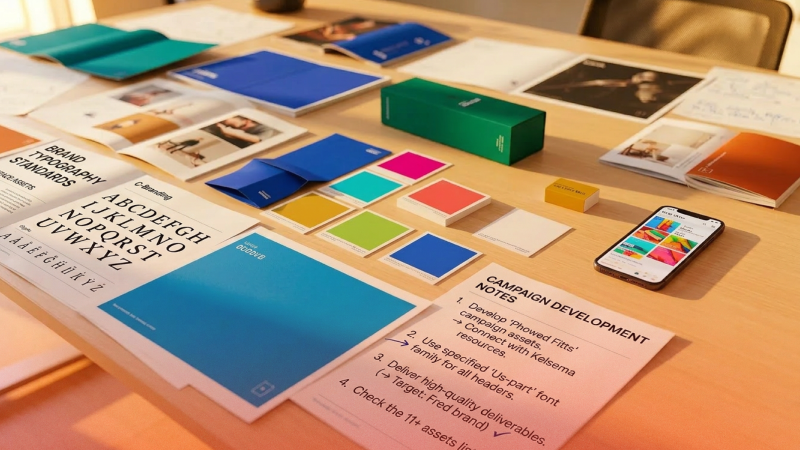
A visual refresh might include logo refinement, updated typography, a more flexible color system, new imagery direction, improved layout principles, motion guidelines, or stronger campaign templates.
The goal is coherence. Your brand should feel like one brand across the website, product, ads, events, investor materials, and sales conversations.
Be careful not to over-sanitize. Many refreshes fail because they remove the weird, memorable, emotionally useful parts of the brand in pursuit of a safer look. If you are a challenger, distinctiveness is not a decoration. It is a competitive weapon.
Digital experience
In 2026, brands are judged heavily through digital touchpoints. Your website, product experience, onboarding, emails, landing pages, and paid media all influence trust.
A brand refresh should consider how the identity performs in real environments. Does the typography work on mobile? Do campaign templates scale? Can internal teams use the system? Does the website explain value quickly? Do visuals support conversion rather than slow it down?
A beautiful refresh that fails on real touchpoints is not a brand improvement. It is a presentation exercise.
Sales and go-to-market assets
A refresh should help teams sell, hire, fundraise, and launch. That means updating pitch decks, proposal templates, case study formats, social assets, ad concepts, event materials, and customer success communication.
This is where many brand refreshes create immediate value. The market may not notice every design refinement, but sales teams will notice when the story becomes easier to tell.
How to run a brand refresh without losing equity
The best refreshes are disciplined. They do not start with taste. They start with diagnosis.
Audit what already works
Review your current brand assets, sales materials, website analytics, customer feedback, search data, and competitor landscape. Look for patterns. Which messages convert? Which visuals are remembered? Which proof points appear in customer conversations? Which assets are ignored?
This prevents a common mistake: changing things because the internal team is bored of them, while the market is only just starting to remember them.
Define what must not change
Before deciding what to update, decide what to protect. This might include your name, core promise, signature color, tone, product metaphor, brand belief, or customer-facing language.
A refresh works best when there is a clear line between evolution and erasure.
Prototype on high-impact touchpoints
Do not judge a refresh only in a brand presentation. Test it where it has to work: homepage hero, pricing page, pitch deck cover, LinkedIn ad, sales email, product interface, event booth, or packaging.
A system that looks good in isolation can fail when applied to messy commercial reality.
Roll out with the right level of communication
Not every refresh needs a dramatic launch campaign. Sometimes the best rollout is quiet and phased. Update the website, sales assets, templates, and social presence, then let the improved experience do its work.
But if the refresh signals a meaningful business shift, explain it. Customers do not need a manifesto for every design update, but they do need clarity if your offer, focus, or promise has evolved.
Common brand refresh mistakes
The first mistake is treating a refresh as a cheaper rebrand. A refresh is not a shortcut for avoiding hard strategic decisions. If the positioning is broken, updating colors will not help.
The second mistake is making the brand generic. Many teams use refresh projects to look more mature, but maturity should not mean sameness. If your refreshed identity could belong to any competitor, you have traded distinctiveness for polish.
The third mistake is ignoring internal adoption. A refreshed brand only works if teams can use it. Guidelines, templates, messaging examples, and decision principles matter. Otherwise, inconsistency returns within months.
The fourth mistake is changing too much at once without evidence. A refresh should be intentional. Preserve what carries memory. Improve what creates friction. Remove what weakens trust.
The challenger brand perspective
For challenger brands, a brand refresh is not about looking newer. It is about creating sharper market behavior.
You may need to look more credible to enterprise buyers. You may need to make a complex product easier to understand. You may need to unify a fragmented identity after rapid growth. You may need to signal ambition without pretending to be an incumbent.
That last point matters. Challenger brands should not refresh themselves into category wallpaper. The goal is not to look like the leader. The goal is to make your difference easier to see, easier to believe, and easier to buy.
A light update beats a full rebrand when it strengthens your existing advantage. A full rebrand beats a refresh when the existing advantage is no longer the right one.
Frequently Asked Questions
What is the difference between a brand refresh and a rebrand? A brand refresh updates how an existing brand looks, sounds, and performs while keeping its core strategy intact. A rebrand changes the strategic foundation, such as positioning, name, identity, audience focus, or market story.
How often should a company do a brand refresh? There is no fixed schedule. A refresh makes sense when your brand expression no longer matches your business maturity, audience expectations, or digital needs, but your core positioning still holds.
Can a brand refresh include a logo change? Yes, but it is usually a refinement rather than a complete redesign. The goal is to improve usability, consistency, or relevance without destroying recognition.
Is a brand refresh cheaper than a full rebrand? Usually, because the scope is lighter and implementation is less disruptive. But the real question is not cost. It is whether the scope matches the business problem.
How do we know if we need a full rebrand instead? If your audience, category, business model, promise, reputation, or differentiation has fundamentally changed, a full rebrand may be necessary. If the foundation is still right and the expression is lagging, a refresh is likely enough.
Ready to choose the right level of change?
A brand refresh should make your brand clearer, sharper, and more effective without sacrificing the equity you have built. A full rebrand should only happen when the business needs a deeper strategic reset.
Boil helps ambitious challenger brands diagnose that difference, then turn strategy into branding, go-to-market, and digital experiences that support growth. If you are unsure whether your next move is a refresh or a rebrand, start the conversation with Boil.
