Choosing a startup branding agency is not just a design decision. It is a growth decision that affects how clearly customers understand you, how confidently investors read your story, how consistently your team sells, and how quickly your market starts to remember you.
The tricky part is that the best startup branding agency is rarely the one with the most beautiful portfolio in isolation. It is the one that can translate an uncertain, fast-moving business into a clear market position, a credible identity, and practical assets your team can actually use.
For founders, the goal is not to buy a logo. The goal is to reduce market friction. A strong brand should help the right people get what you do faster, trust you sooner, and choose you over better-funded alternatives.
Start with the business job your brand needs to do
Before you compare agencies, get clear on why you are hiring one. Startups often say they need branding, but the real business problem underneath can be very different.
You may need to launch a new category, signal credibility before a fundraise, reposition after finding product-market fit, enter a new geography, simplify a complex product story, or unify a team around one sharper narrative. Each of those jobs requires a different mix of strategy, messaging, identity, web, product, and go-to-market thinking.
A startup that has not launched yet usually needs clarity and speed. A seed-stage company with early traction may need sharper positioning and sales enablement. A Series A or growth-stage company may need a more scalable identity system, a stronger employer brand, or a rebrand that supports market expansion.
If you are unsure what should be in scope, it is worth reviewing how branding services change by growth stage before you ask agencies for proposals. A better brief usually leads to better recommendations, tighter pricing, and fewer surprises later.
Make strategy non-negotiable
A startup brand has to do more than look good. It has to answer core commercial questions: who are you for, what problem do you solve, why should the market believe you, and why are you different enough to matter?
That is why strategic depth should be one of your first filters. A strong startup branding agency should be able to show how it moves from customer insight and market context into positioning, messaging, naming, identity, and launch assets. If the agency jumps straight to moodboards without asking about your market, competitors, pricing model, sales motion, or customer anxieties, that is a warning sign.
Look for a partner that can challenge your assumptions without slowing you down. Founders often live inside the product. A good agency brings outside perspective, pressure-tests the story, and turns internal complexity into language customers can repeat.
The best agencies can also connect brand decisions to go-to-market reality. For example, a premium visual identity may be the right call if trust is your biggest barrier. But if your biggest issue is category confusion, messaging and positioning may matter more than visual polish at the beginning.
To understand what a more complete workflow should include, you can compare prospective partners against a strong creative branding agency process, from insight to identity and launch.
Match the agency type to your startup model
Not every branding agency is built for startups, and not every startup needs the same kind of partner. Your business model should shape your shortlist.
A B2B SaaS startup may need an agency that understands technical buyers, long sales cycles, category positioning, and sales enablement. A consumer app may need sharper cultural insight, product storytelling, and a visual system that works beautifully across app, web, and paid creative. A deep tech startup may need help making complex innovation feel understandable and credible.
Category also matters. If you operate in sports, fitness, or wellness, comparing a challenger-branding partner with a performance-focused specialist such as OPTYO's sports marketing agency can help you decide whether your most urgent bottleneck is positioning, paid acquisition, eCommerce conversion, or the connection between all three.
In general, you will see a few agency types:
- Identity studios are often strong when you need a distinctive visual system, logo, packaging, or digital look.
- Strategy-led branding agencies are useful when your positioning, story, architecture, or messaging needs work before design begins.
- Go-to-market and growth-focused agencies help connect brand strategy to launch, sales, campaigns, and digital experience.
- Category specialists can be valuable when your market has unique buying behaviors, channels, or cultural codes.
The best startup branding agency for you may combine several of these capabilities. What matters is whether the agency can solve your real constraint, not whether it fits a neat label.
Evaluate the portfolio like an investor
A portfolio should be more than a gallery of attractive case studies. Review it the way an investor would review traction. Look for evidence that the agency can handle complexity, make strategic choices, and create work that fits the company’s stage and market.
Do not only ask whether you like the designs. Ask what changed because of the work. Did the brand make the company easier to understand? Did it help the startup enter a new market? Did it support a fundraise, launch, sales motion, or repositioning? Did the identity system scale across the website, product, pitch deck, social content, ads, and internal materials?
Good case studies usually explain the starting problem, the strategic decision, the creative solution, and the practical outcome. They do not need to claim that branding alone caused growth, because that would usually be too simplistic. But they should show a clear connection between brand work and business context.
When reviewing case studies, ask the agency:
- What was the client struggling with before the work began?
- What tradeoffs did you make during positioning or identity development?
- Which parts of the work were most important for go-to-market?
- How did you help the internal team adopt the new brand?
- What would you do differently if you were starting again?
The answers will tell you whether the agency thinks strategically or simply presents finished visuals.
Understand process, pace, and decision rights
Startup branding cannot be chaotic, but it also cannot move like a slow corporate transformation. You need enough structure to make good decisions and enough pace to keep momentum.
Ask how the agency runs the first two weeks. The early phase should uncover the market, customer, product, business model, and internal alignment issues that will shape the brand. Workshops can be useful, but only if they lead to decisions. Research can be valuable, but only if it is proportionate to your stage and budget.
You should also clarify decision rights. Who from your team needs to approve strategy? Who gives feedback on identity? How will conflicting founder opinions be resolved? What happens if investor, sales, and product teams disagree on the story?

A strong agency will not just ask for feedback. It will guide the decision-making process. That matters because branding projects often fail when feedback becomes subjective. The agency should help your team evaluate work against strategy, audience, differentiation, usability, and commercial goals.
Look for deliverables your team can actually use
A beautiful brand presentation is not enough. Your startup needs assets that help the team execute after the project ends.
The right deliverables depend on your stage, but useful startup branding work often includes:
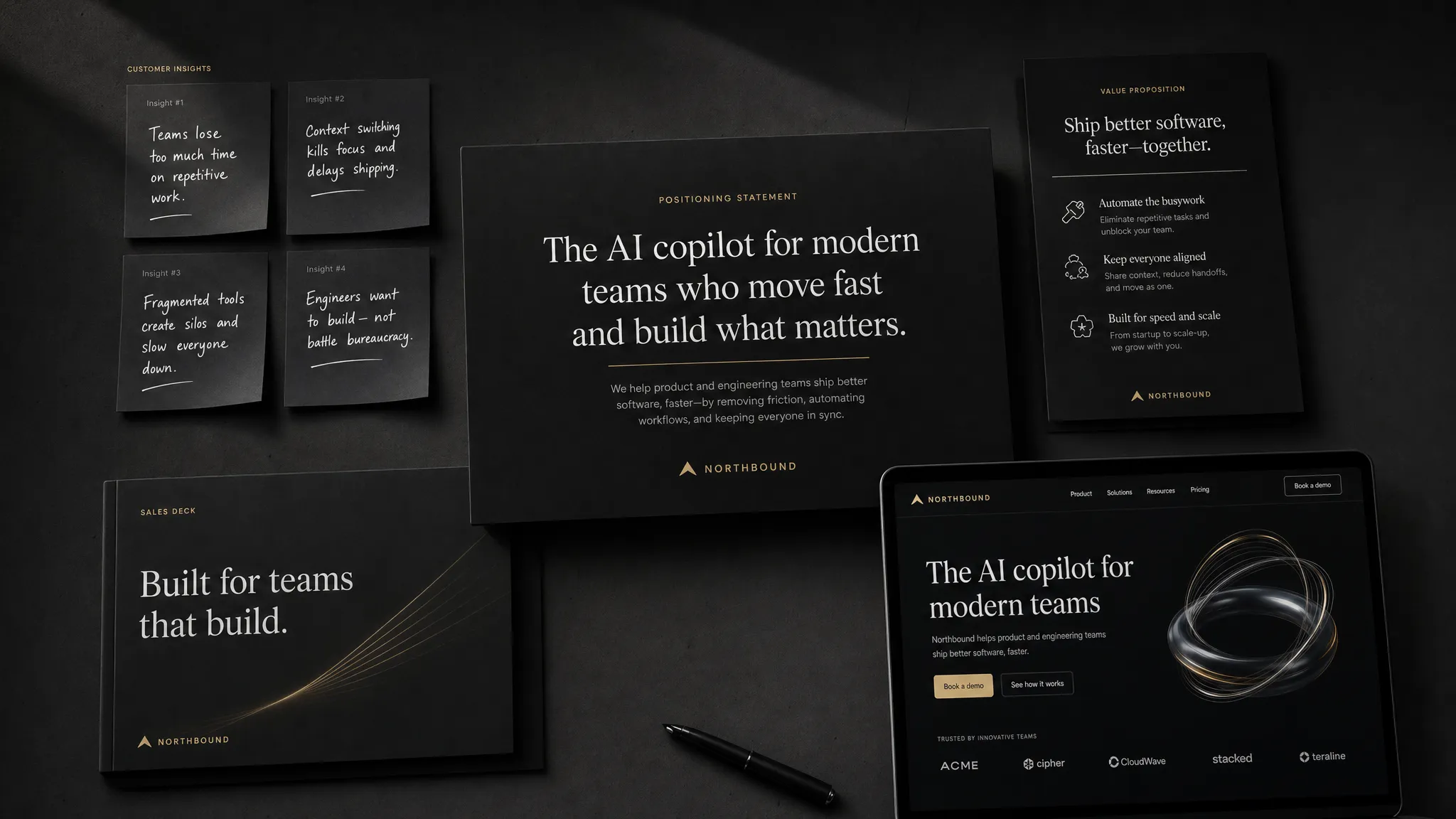
- Positioning and narrative that clarify your market, audience, promise, proof, and difference.
- Messaging foundations for your homepage, pitch deck, sales conversations, product pages, and campaigns.
- Visual identity system with rules for logo, color, typography, imagery, motion, and layout.
- Digital experience direction for your website, app, landing pages, or product interface where relevant.
- Launch toolkit for social, email, investor updates, press, sales enablement, and internal rollout.
- Brand guidelines that are practical enough for your team, freelancers, and future hires to use.
This is where startup experience becomes important. Early teams do not have unlimited time to interpret abstract guidelines. They need clarity, templates, examples, and a system that supports fast execution without turning every asset into a new creative debate.
Watch for red flags before you sign
The wrong agency can cost more than its fee. It can cost months of confusion, a weak launch, and a brand that your team quietly avoids using.
Be careful if an agency promises growth without understanding your product, audience, or acquisition model. Branding can support growth, but it is not magic. Be equally careful if the agency treats startup constraints as an inconvenience. Limited time, limited budget, changing priorities, and founder involvement are normal in early-stage companies.
Other red flags include:
- The proposal focuses heavily on aesthetics but says little about positioning or messaging.
- The agency cannot explain how it will learn your market quickly.
- The process has many rounds of subjective design feedback but few strategic checkpoints.
- The portfolio looks stylish but every client feels the same.
- The team that sells the work is not the team that will deliver it.
- The agency avoids discussing implementation, launch, or adoption.
None of these signs automatically means an agency is bad. But they do suggest a mismatch if you need a partner that can help your startup compete, not just look more polished.
Ask commercial questions before creative questions
Once you have a shortlist, shift the conversation from taste to commercial value. You are not buying creative preference. You are investing in a market asset.
Ask how the agency will help you sharpen differentiation. Ask how the brand will support acquisition, sales, hiring, fundraising, or expansion. Ask what they need from your team to do their best work. Ask what should be prioritized if budget or timeline gets tight.
You should also discuss implementation early. A startup may not need a 100-page brand book, but it does need enough structure to stay consistent. If your website, pitch deck, product, social content, and sales materials all tell slightly different stories, the brand work will not compound.
Pricing should be evaluated in context. The cheapest option may be fine for a narrow visual refresh, but risky if your positioning is unclear. The most expensive option is not automatically the best either. The right question is whether the scope matches the business problem and whether the agency has the judgment to focus on what will move the needle.
Build a shortlist that protects your time
Founders are busy, so do not run a massive agency search unless the stakes require it. A focused shortlist of three to five agencies is usually enough if each one has a credible reason to be there.
Start by writing a one-page brief. Include your business stage, product, audience, market challenge, timeline, budget range if you can share it, and the decisions you need the agency to help you make. A clear brief filters out poor-fit partners quickly.
Then compare agencies on five dimensions: strategic fit, startup experience, category understanding, creative quality, and implementation support. If an agency is weak in one area but exceptional in another, decide whether that tradeoff fits your current need.
Finally, pay attention to how the agency behaves before you hire them. Do they ask sharp questions? Do they synthesize your problem clearly? Do they challenge vague thinking respectfully? Do they make the process feel calmer and more focused? The sales process is often a preview of the working relationship.
Where Boil fits for challenger startups
Boil is a next generation branding and go-to-market agency built for ambitious brands that want to grow market share and stand out. For challenger startups, that means the work needs to combine strategic clarity, creative differentiation, and practical execution across the moments where customers, investors, and teams experience the brand.
That can include branding, rebranding, go-to-market strategy, creative design, digital experiences, web design, app development, market entry support, and digital growth consulting. The common thread is helping ambitious brands become easier to understand, harder to ignore, and better equipped to compete.
If you are choosing the best startup branding agency, look for a partner that can meet you at the level of your ambition, not just your current size.
Frequently Asked Questions
How early should a startup hire a branding agency? Hire a branding agency when your brand needs to support a meaningful business milestone, such as launch, fundraising, market entry, repositioning, or scaling. Very early startups may need a leaner scope focused on positioning, naming, messaging, and a simple identity system.
What makes a startup branding agency different from a general design agency? A startup branding agency should understand uncertainty, speed, limited resources, founder-led decision-making, and go-to-market pressure. It should help clarify the business story, not only create visual assets.
Should a startup choose a specialist agency or a broader branding partner? It depends on the bottleneck. Choose a specialist if your category, channel, or audience requires deep domain knowledge. Choose a broader branding and go-to-market partner if you need positioning, identity, messaging, and launch execution to work together.
How do I know if an agency is strategically strong? Look at the questions they ask, the way they frame your problem, and the logic behind their case studies. A strategically strong agency can explain why a brand direction is right for the audience, market, and business model, not just why it looks good.
What should be included in a startup branding project? Most startup branding projects include some mix of research, positioning, messaging, visual identity, digital experience, brand guidelines, and launch assets. The exact scope should depend on your stage, timeline, budget, and growth priorities.
Ready to choose a branding partner with confidence?
If your startup is ready for a brand that does more than decorate the business, talk to Boil. Boil helps ambitious challenger brands turn strategy, creativity, and go-to-market thinking into sharper market presence and stronger growth potential.
