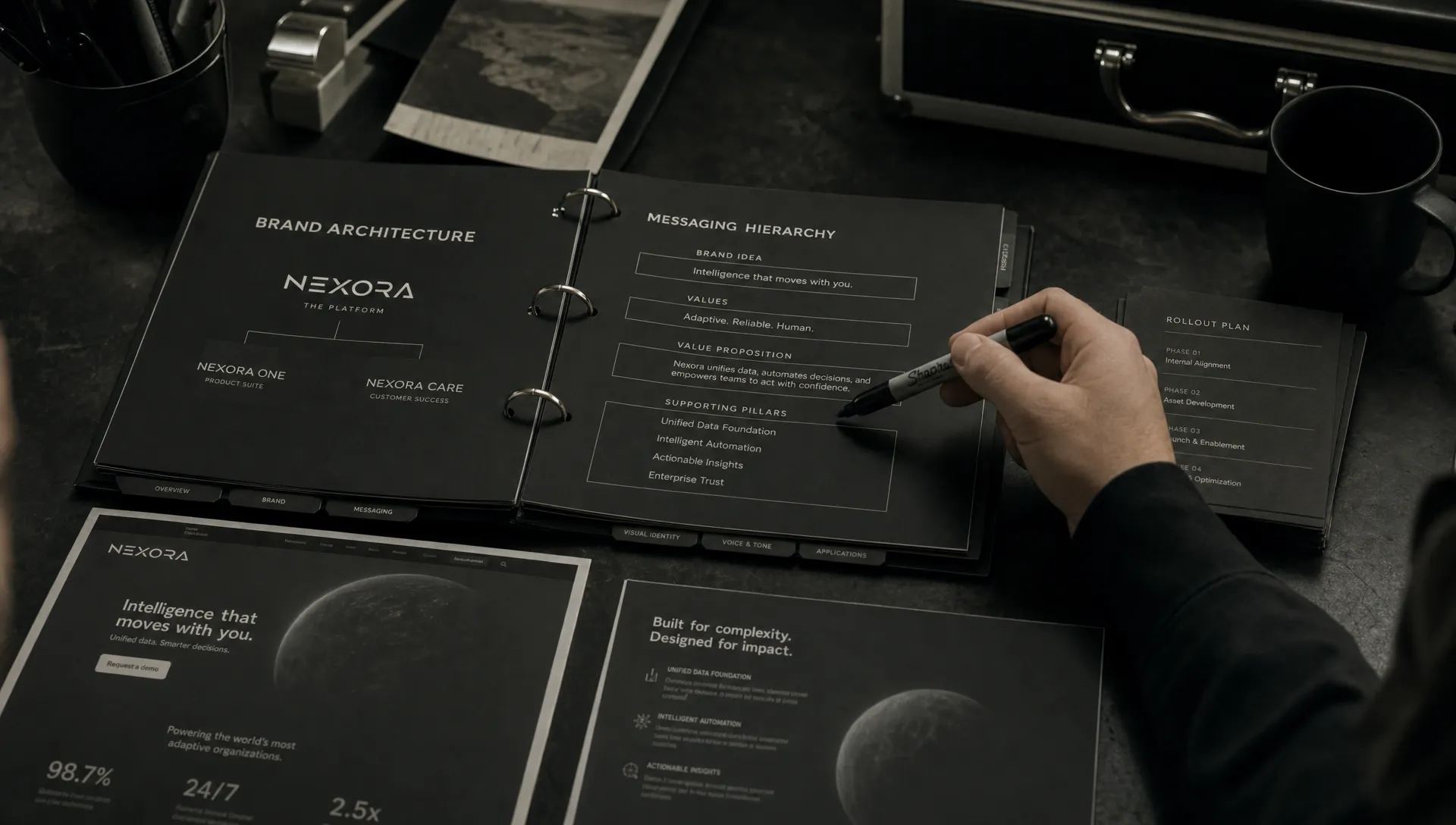
Choosing a corporate design agency is difficult when your brand is not simple. If you manage multiple products, regions, audiences, investor expectations, legacy assets or sales motions, the work cannot be judged by a polished logo presentation alone. You need a partner that can translate business complexity into a brand system people can actually use.
For complex brands, corporate design is not decoration. It shapes recognition, trust, internal alignment, customer comprehension and the speed at which teams can launch campaigns, products and market entries. The right agency should make the brand easier to manage, not add another layer of subjective debate.
What Makes a Corporate Design Agency Different for Complex Brands
A simple visual identity project can often be led by taste, speed and a small number of decision makers. Complex brand projects need more structure because every choice has consequences across sales, product, recruitment, investor communication, partner channels and digital experience.
A strong corporate design agency should understand how identity decisions affect the wider business. That includes brand architecture, naming systems, messaging hierarchy, UX patterns, presentation templates, campaign assets and governance. The work should be beautiful, but beauty is not the only test.
The core question is whether the agency can create clarity under pressure. Complex brands usually have competing priorities. A product team wants flexibility, leadership wants consistency, sales wants sharper proof, HR wants stronger employer appeal and local markets want room to adapt. Good corporate design creates a shared system that supports all of those needs without becoming chaotic.
Define Your Brand Complexity Before You Shortlist Agencies
Before you compare portfolios, define what makes your brand hard to solve. If you skip this step, you may choose an agency based on style instead of fit.
Map the business problem first
Start by writing down the business reason for the design project. Are you entering a new category, repositioning after growth, merging brands, preparing for international expansion or trying to escape a lookalike market? Each problem needs a different type of partner.
The right corporate design agency will ask for this context early. If the first conversation jumps straight into colors, moodboards and deliverables, that is a warning sign. Visual choices should follow a diagnosis of where the company is going and what is currently blocking growth.
Use a simple table to clarify the kind of complexity you are dealing with:
| Type of complexity | What it affects | What the agency must solve |
|---|---|---|
| Multiple products | Brand architecture and navigation | Clear relationships between offers |
| Multiple markets | Local relevance and consistency | Flexible rules for regional execution |
| Long sales cycles | Trust and decision support | Credible messaging and proof points |
| Legacy identity | Internal adoption and migration | Practical transition plan |
| Digital ecosystem | UX, content and conversion | Scalable design components |
Align stakeholders before the brief goes out
Complex brand projects fail when stakeholders agree on the need for change but not on the meaning of success. Before sending a brief, gather input from leadership, marketing, sales, product and customer-facing teams. Look for patterns rather than trying to satisfy every opinion.
Your brief should distinguish between fixed requirements and open questions. Fixed requirements might include legal naming constraints, investor timelines or product launch dates. Open questions might include tone of voice, architecture options or how bold the identity can become.
Evaluate Strategy Before Visual Taste
A portfolio tells you what an agency can make. It does not automatically tell you how the agency thinks. For complex brands, process matters because the work must survive beyond the launch moment.
Ask how the team moves from research to positioning, from positioning to identity and from identity to implementation. A capable corporate design agency should be able to explain its strategic logic without hiding behind jargon. You should hear how they make decisions, resolve trade-offs and bring stakeholders into alignment.
This is also where you separate visual identity vendors from growth partners. If the agency cannot connect design to market position, customer perception or go-to-market execution, the result may look premium but fail commercially. Boil has written more broadly about choosing a creative design agency that drives growth, which is especially relevant when design needs to support market share, not just recognition.
Look for strategic artifacts, not just moodboards
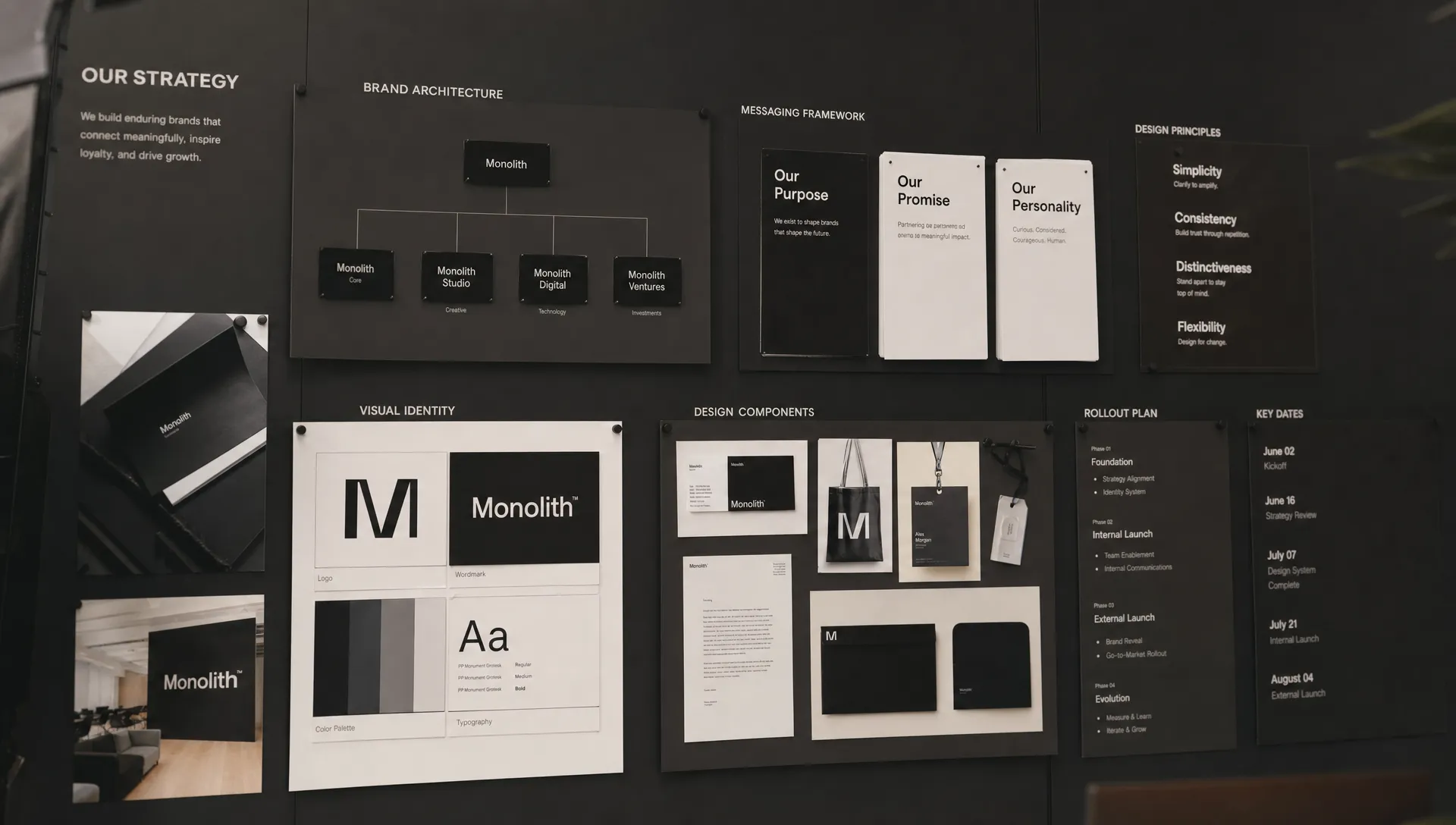
During your evaluation, ask to see anonymized examples of the thinking behind previous work. Useful artifacts include positioning summaries, brand architecture maps, messaging frameworks, design principles and rollout plans.
You are not asking for confidential client data. You are checking whether the agency has a disciplined way to make decisions. If the only evidence is a before-and-after slide, you may be looking at surface-level design rather than a system capable of handling complexity.
Check Whether the Agency Builds Systems, Not Assets
A complex brand needs more than a logo, color palette and typography set. It needs a system that helps teams make hundreds of future decisions without reopening the strategy every time.
When a corporate design agency presents its approach, listen for how it handles repeatable components. This includes templates, interaction patterns, social formats, sales materials, event environments, product screens, iconography, motion principles and tone of voice. The goal is not to control every output. The goal is to give teams enough structure to move faster with confidence.
A strong brand system usually includes:
- Strategic foundations that define positioning, audience, promise and personality
- Visual identity rules that can flex across digital, print and physical touchpoints
- Messaging guidance for different audiences, funnel stages and product lines
- Governance that explains who can adapt what, and how decisions get approved
- Launch and adoption support so internal teams understand the new system
If your main concern is scalability, Boil's article on why branding design should build a system, not just a logo expands on this exact issue.
Test for Stakeholder Management and Decision Discipline
Complex brand work is rarely blocked by a lack of design options. It is usually blocked by unclear decision rights, hidden objections or late-stage stakeholder surprises. Your agency should know how to manage that reality.
Ask each corporate design agency how it handles feedback. The answer should include more than "we do revision rounds." Strong partners define who gives input, who decides, what criteria are used and how disagreements are resolved. They also know when to involve stakeholders and when to protect the work from premature committee editing.
This kind of due diligence is common in other high-trust decisions too. For example, guidance on how to choose a cosmetic dental clinic you can trust stresses credentials, transparent planning, clear pricing and red flags. The category is different, but the evaluation principle is useful: when the stakes are high, trust should be earned through process, evidence and clarity rather than persuasion alone.
Ask about workshops and approvals
Workshops can be useful, but only when they are designed to create decisions. A good workshop has a clear purpose, the right participants and a defined output. A weak workshop becomes group therapy for unresolved opinions.
Ask how the agency structures leadership interviews, alignment sessions and concept reviews. You want a partner that can invite participation without surrendering strategic direction.
Review Portfolio Work Through a Complexity Lens
Do not only ask whether you like the work. Ask whether the work solved a comparable challenge. A minimal identity for a single-product startup may be impressive, but it does not prove the agency can handle a multi-market B2B brand with layered decision makers.
A capable corporate design agency should be able to explain the constraints behind the portfolio piece. What changed in the business? What was simplified? How did the design system scale? What trade-offs were made? What happened after launch?
Use this scorecard when reviewing case studies:
| Evaluation area | Weak signal | Strong signal |
|---|---|---|
| Business context | Focuses only on visuals | Explains the commercial or organizational challenge |
| Strategy | Uses generic brand language | Shows clear positioning and decision criteria |
| System design | Presents isolated assets | Demonstrates repeatable rules and components |
| Implementation | Stops at launch visuals | Shows rollout across teams and channels |
| Results | Makes vague claims | Connects work to adoption, clarity or market impact |
You do not need every case study to match your industry. In fact, category diversity can be valuable if the agency can show pattern recognition. What matters is whether the team has solved comparable levels of ambiguity, scale and stakeholder complexity.
Make Sure the Agency Can Move From Brand to Market
Corporate design creates the most value when it reaches the market quickly and consistently. If the work sits in a PDF brand book while teams continue using old decks, outdated web pages and improvised campaign assets, the project has not really landed.
Before hiring a corporate design agency, ask how it supports implementation. This is where branding, go-to-market strategy, web design and digital experience begin to overlap. For challenger brands in particular, the identity must help the company compete with sharper positioning, stronger conversion paths and more memorable market behavior.
Implementation questions should include:
- How will the new brand show up on the website and core digital journeys?
- What sales and investor materials need to be rebuilt first?
- Which launch assets are essential, and which can wait?
- How will internal teams learn to use the system?
- What should be measured after launch?
If the project is part of a larger repositioning, Boil's guide to choosing a rebrand studio that thinks beyond design is a useful companion because it focuses on connecting identity change to business change.
Questions to Ask Before You Hire
The best agency conversations are specific. Broad questions produce rehearsed answers, while precise questions reveal how the team works under real constraints.
Bring these questions into your selection process:
| Question | What the answer reveals |
|---|---|
| How do you diagnose the real brand problem? | Whether strategy leads the work |
| How do you handle conflicting stakeholder feedback? | Whether the team can manage complexity |
| What parts of the system will our internal team own? | Whether the agency plans for adoption |
| How do you balance consistency and flexibility? | Whether the identity can scale |
| What do you need from us to do your best work? | Whether the agency understands collaboration |
| How do you support rollout after approval? | Whether launch is treated as part of the project |
A good partner will welcome detailed questions. If the agency becomes vague, defensive or overly dependent on charisma, keep looking.
Red Flags That Should Slow the Decision Down
Some warning signs are easy to spot. Others appear only after you ask about process, ownership and implementation. Pay attention to gaps before you sign, because they become expensive once the project begins.
Be cautious if you notice these patterns:
- The proposal promises a complete transformation without explaining the diagnostic process
- The team talks about aesthetics but not positioning, architecture or adoption
- Senior people sell the work but junior people appear to do all strategic thinking
- The timeline leaves no room for stakeholder alignment or implementation planning
- The agency cannot explain how it measures success beyond subjective approval
- The deliverables are attractive but disconnected from sales, product or digital channels
Not every red flag is a dealbreaker. Sometimes it simply means you need to clarify scope. But if an agency avoids practical questions, that is a sign the relationship may become difficult when the work gets complicated.
How to Make the Final Choice
Once you have narrowed the field, compare agencies across four dimensions: strategic fit, system capability, collaboration quality and implementation relevance. The best choice is rarely the studio with the most fashionable portfolio. It is the team most likely to turn complexity into a brand your organization can use.
Use a simple scoring model, but do not let the numbers replace judgment:
| Criteria | What to look for | Weight |
|---|---|---|
| Strategic understanding | Clear grasp of business goals and market context | High |
| Design system capability | Ability to create scalable identity rules | High |
| Stakeholder management | Strong process for alignment and decisions | High |
| Implementation support | Connection to website, campaigns and go-to-market | Medium to high |
| Category experience | Relevant familiarity without narrow thinking | Medium |
| Chemistry | Productive, honest working dynamic | Medium |
The right partner should make the problem feel clearer after every conversation. You should not feel dazzled but uncertain. You should feel that the agency sees the full shape of the challenge and has a practical way to solve it.
Frequently Asked Questions
What does a corporate design agency do? A corporate design agency creates the strategic and visual system that defines how a company presents itself across touchpoints. For complex brands, this often includes positioning, brand architecture, messaging, visual identity, templates, digital design guidance and rollout support.
How is corporate design different from branding? Corporate design is often focused on the identity system and its application across the organization. Branding is broader and may include strategy, market positioning, customer experience, tone of voice, go-to-market planning and long-term brand management.
How long does a complex corporate design project take? Timelines vary based on scope, stakeholder groups, research needs and implementation requirements. A focused identity refresh may take a few months, while a full rebrand with architecture, messaging, web design and rollout can take longer.
Should we choose an agency with experience in our industry? Industry experience can help, but it should not be the only factor. For complex brands, it is often more important that the agency can handle ambiguity, stakeholder alignment, system design and market differentiation.
What should we prepare before contacting agencies? Prepare the business context, project goals, known constraints, decision makers, desired timeline, existing brand assets and the reason change is needed now. A clearer brief helps agencies respond with a more useful proposal.
Choosing the right partner is ultimately about reducing complexity without reducing ambition. If your brand needs to grow market share, enter a new market or align a fast-moving organization, look for an agency that can connect strategy, identity and execution. That is where corporate design becomes more than a visual upgrade. It becomes a working system for growth.
