
Choosing a rebrand studio is rarely about finding the team with the most beautiful logo grid. A strong identity matters, but a rebrand has to do a harder job: help your market understand why you matter now, why you are different, and why buyers should choose you.
For challenger brands, this distinction is critical. You are not rebranding to decorate the business. You are rebranding because something about the current brand is limiting momentum. The story no longer fits the product. The category has moved. Sales teams are explaining too much. The website looks credible but converts poorly. Investors, partners, candidates, or customers see less value than the company is actually creating.
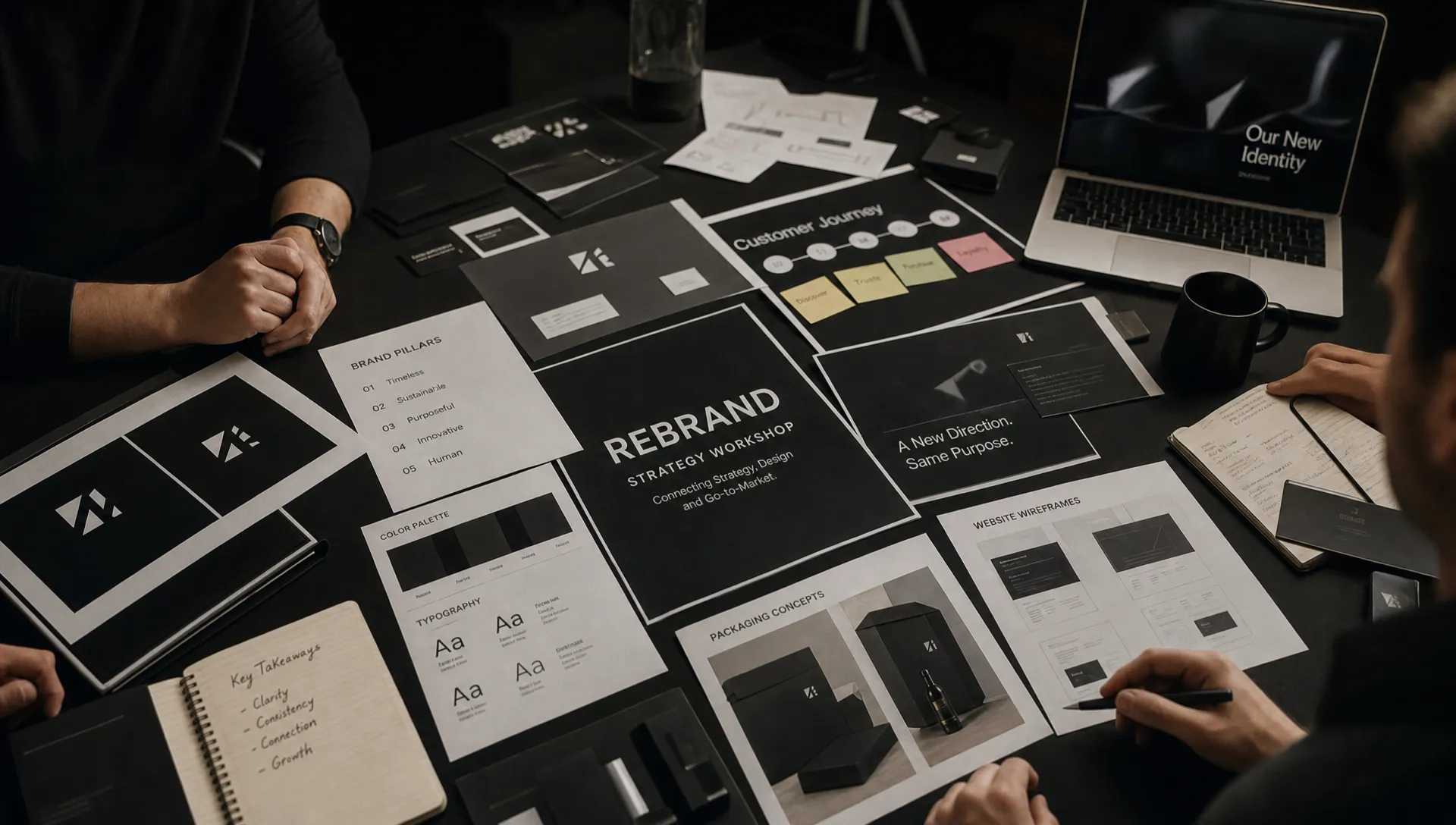
That is why the best partner is not simply a design vendor. The right rebrand studio should connect strategy, identity, messaging, digital experience, and go-to-market execution into one coherent system.
Start with the business problem, not the visual problem
A vague brief creates a vague rebrand. Before you compare studios, define the business job your rebrand needs to do.
Ask yourself what is really driving the change. Is the brand failing to differentiate? Are you moving upmarket? Are you entering a new region or vertical? Has the product evolved faster than the story? Are you carrying brand baggage from an earlier stage of the company?
A visual refresh may be enough when the fundamentals are sound and the brand simply feels dated. A deeper rebrand is needed when positioning, audience, offer, messaging, or customer experience no longer align. If you are still deciding which type of change you need, Boil’s rebranding decision guide for high-growth teams can help you separate cosmetic symptoms from strategic issues.
Strong rebrand studios will want this context before they discuss style. They will ask about market share, customer perception, buying objections, category norms, pricing pressure, competitor narratives, and the growth plan. If they only ask what colors you like, you are probably talking to a design supplier, not a strategic partner.
What beyond design actually means
Thinking beyond design does not mean design is secondary. It means design is treated as an output of sharp thinking, not a substitute for it.
A rebrand studio that thinks beyond design should be able to answer five connected questions.
First, what position should the brand own in the market? This is where competitive research, audience insight, and strategic choice matter. A brand cannot stand out if it is trying to be relevant to everyone.
Second, what story should the brand tell? Positioning only becomes useful when it is translated into messaging that customers, sales teams, investors, and employees can actually use.
Third, how should the brand feel and behave? Visual identity, tone of voice, motion, photography, interaction design, and content systems all shape perception.
Fourth, where does the brand need to perform? A rebrand must work across the website, sales decks, pitch materials, product experience, employer brand, social channels, events, and customer onboarding.
Fifth, how will the rebrand be launched and governed? Without internal adoption, templates, guidelines, and rollout planning, even a strong identity can collapse into inconsistency within months.
This is the gap many companies discover too late. They receive beautiful assets, but no strategic clarity. Or they receive a clever brand idea, but no practical system for execution. The goal is not to choose the most artistic studio. It is to choose the team most capable of turning brand into growth infrastructure.
Seven signs a rebrand studio thinks strategically
1. They diagnose before they prescribe
Be cautious of any studio that jumps to creative solutions before understanding the business. A thoughtful rebrand studio will want to examine the current brand from multiple angles: market, audience, product, sales, culture, and digital performance.
They may review customer interviews, sales calls, website analytics, competitor language, search behavior, and internal stakeholder perspectives. They will look for patterns, not just opinions. The best strategic work often begins by revealing what the company has normalized: unclear category language, inconsistent value propositions, outdated proof points, or a visual system that no longer matches the company’s ambition.
2. They challenge your assumptions
A useful partner will not simply validate what the leadership team already believes. They should be able to tell you when the problem is not the logo, when the target audience is too broad, or when the company is relying on claims that competitors can also make.
This challenge should feel constructive, not performative. You are looking for strategic tension in service of a better outcome. If a studio never pushes back, they may be optimizing for approval instead of impact.
3. They connect positioning to go-to-market
For a rebrand to improve growth, it needs to work where growth happens. That means your studio should understand how brand choices affect demand generation, sales enablement, landing pages, product messaging, partnerships, and customer retention.
A new identity can create attention, but attention alone does not build market share. The real value comes when your brand makes your offer easier to understand, easier to remember, and easier to choose. This is especially important for challenger brands competing against better-funded incumbents. Clarity, distinctiveness, and consistency are not nice-to-haves. They are advantages.
4. They build systems, not just assets
A logo, color palette, and type system are only the visible layer of a brand. A rebrand needs a repeatable system that teams can use without diluting the idea.
Look for studios that think in terms of components, templates, messaging frameworks, content patterns, and digital behaviors. Ask how the identity will flex across different contexts while still feeling recognizable. Ask how a designer, marketer, founder, or sales lead will use the system after launch.
A brand that cannot be used by the people responsible for growth is not finished.
5. They understand operational reality
A rebrand does not live in a presentation deck. It has to survive production timelines, website constraints, packaging specs, channel requirements, legal review, sales cycles, and internal adoption.
This matters even more in sectors where brand and operations are tightly connected. For example, an apparel or teamwear brand may need a rebrand studio to understand how identity choices translate into garment production, customization, labeling, and fulfillment. In that context, knowing the practical capabilities of a custom sportswear manufacturer can shape decisions about color systems, embroidery, print methods, packaging, and launch timing.
The lesson applies across categories: if the studio ignores implementation, the brand may look strong in concept but break when it meets the real world.
6. They design for the full customer journey
A rebrand studio that thinks beyond design will not stop at awareness. It will consider the entire path from first impression to purchase, onboarding, loyalty, and advocacy.
This changes the questions the studio asks. What does a buyer need to believe before booking a call? What proof reduces perceived risk? What does the product experience need to reinforce? Where does the existing brand create confusion or friction? What should customers feel after the first interaction?
When these questions guide creative work, the result is more than a new look. It is a brand experience that supports trust and momentum.
7. They plan for adoption
Launch day is not the finish line. It is the first public test of whether the rebrand can be sustained.
Ask how the studio helps teams adopt the new brand. This may include brand guidelines, messaging guidance, launch sequencing, asset handover, website recommendations, training sessions, or collaboration with internal teams. The exact deliverables will vary, but the principle is consistent: a rebrand should leave your team more capable, not more dependent.
Questions to ask before hiring a rebrand studio
The sales process should help you understand how a studio thinks, not just what it makes. Use the conversation to test depth, curiosity, and commercial awareness.
Good questions include:
- What business signals tell you a company needs a rebrand rather than a refresh?
- How do you validate positioning before moving into identity?
- How do you balance founder vision, customer reality, and market opportunity?
- What do you need from our team to make the project successful?
- How do you translate strategy into messaging, visual identity, and digital experience?
- How do you handle rollout across website, sales, social, product, and internal teams?
- Can you walk us through a project where the outcome changed the client’s market perception?
- What risks do you see in our current brand based on what you know so far?
Pay close attention to the quality of the answers. Strong studios will not respond with generic process language. They will explain tradeoffs, show how they make decisions, and ask sharper questions in return.
How to read a portfolio without being distracted by style
Portfolios are useful, but they can be misleading. The most polished case study is not always the most relevant one.
Instead of asking whether you like the work, ask what job the work was designed to do. Did the studio help a company enter a new category? Move from startup to scaleup? Rebuild trust? Simplify a complex offer? Shift from product-led messaging to enterprise credibility? Attract a different buyer?
You should also look for evidence of strategic continuity. Do the positioning, messaging, identity, website, and campaign assets feel like one system? Or does the identity look impressive while the language remains generic?
If you want a deeper evaluation framework, Boil’s guide on how to vet rebranding expertise versus hype offers a practical way to assess substance behind the pitch.
A good case study should make the logic visible. It should show the problem, the insight, the strategic choice, the creative expression, and the activation. If the studio cannot explain why a solution worked, it may not be able to repeat that quality of thinking for your brand.
Red flags that a studio may be too design-only
Beautiful design is valuable. But if your rebrand has strategic stakes, the wrong partner can create an expensive surface change without solving the underlying problem.
Watch for these warning signs:
- They lead with aesthetics before discussing positioning, audience, or growth goals.
- They cannot explain how strategy affects creative direction.
- They present a fixed style that appears across most clients.
- They treat messaging, website experience, and rollout as optional extras.
- They avoid commercial questions about sales, conversion, market share, or perception.
- They do not ask about internal stakeholders or adoption.
- They promise transformation without asking difficult questions.
A studio does not need to do everything in-house to be valuable. Some companies need a specialist team, and others need a broader agency partner. What matters is whether the studio understands how brand decisions will affect the business beyond the identity system.
What a strong rebrand process should feel like
Every studio has its own methodology, but a serious rebrand process usually moves through a few recognizable phases.
It starts with discovery and diagnosis. This is where the studio builds an understanding of the business, customers, competitors, category dynamics, and internal ambition. The output should not be a pile of research for its own sake. It should clarify the core strategic problem.
Then comes positioning and messaging. This phase defines what the brand stands for, who it serves, what makes it different, and how it should communicate value. For many companies, this is where the most important decisions are made.
Creative exploration follows. The studio should develop identity directions that express the strategy in different ways, with clear rationale behind each route. The strongest presentations do not simply ask which option you prefer. They help you understand what each direction would signal to the market.
After that, the chosen direction becomes a system. This may include visual identity, verbal identity, art direction, brand guidelines, digital design, sales materials, launch assets, or other touchpoints depending on the scope. The work should become more practical as it progresses.
Finally, the rebrand moves into implementation and rollout. This is where timelines, governance, internal communication, website updates, and campaign activation matter. If you are comparing partners on scope, Boil’s rebrand agency checklist for timeline, budget, and process can help you plan what should be included before work begins.
Choosing for fit, not fame
A famous studio is not automatically the right studio. A local specialist is not automatically too small. The best choice depends on your ambition, complexity, team capacity, timeline, and appetite for strategic work.
For challenger brands, fit often comes down to three things.
The first is strategic courage. Can the studio help you make clear choices, or will it keep the brand safe and familiar?
The second is executional range. Can the studio connect identity to the channels where your buyers actually experience the brand?
The third is collaborative chemistry. A rebrand requires trust, speed, honesty, and decision-making discipline. You do not need a partner who agrees with everything. You need one who can create momentum without losing the strategic thread.
Budget matters too, but the cheapest option is rarely cheap if the work has to be redone. A rebrand affects sales conversations, customer trust, recruitment, product perception, and market confidence. It is one of the few projects that can touch almost every part of the business.
Frequently Asked Questions
What does a rebrand studio do? A rebrand studio helps companies update or transform their brand strategy, messaging, identity, and key touchpoints. The scope can range from a visual refresh to a full repositioning, depending on the business problem.
How is a rebrand studio different from a design studio? A design studio may focus mainly on visual outputs, while a strategic rebrand studio connects design to positioning, customer perception, messaging, digital experience, and go-to-market goals.
When should a company hire a rebrand studio? Hire a rebrand studio when your current brand no longer reflects your market position, audience, product, ambition, or growth strategy. Common triggers include entering a new market, moving upmarket, merging offers, or struggling to differentiate.
How do you know if a rebrand studio is the right fit? The right fit will ask sharp business questions, explain its strategic process, show relevant case studies, understand implementation, and demonstrate how the rebrand will support measurable growth objectives.
Choose a rebrand studio built for growth
A rebrand should not simply make your company look different. It should make your value clearer, your market position sharper, and your growth efforts more coherent.
If your brand is outgrowing its current story, Boil helps ambitious challengers connect branding, rebranding, go-to-market strategy, creative design, and digital experience into work built for market share growth. Start by exploring Boil and deciding whether your next brand move needs a new look, a new position, or a stronger system for growth.
