
Rebranding is one of the highest-leverage moves a leadership team can make, and one of the easiest to get wrong. The stakes are not “does the new logo look good?” The stakes are revenue, trust, hiring, pricing power, and whether your go-to-market team can explain what you do in one breath.
The problem is that many rebranding companies sell the same thing with different packaging: shiny visuals, vague strategy language, and a portfolio that hides the messy parts (tradeoffs, constraints, internal politics, rollout risk). This guide is a practical way to vet expertise vs hype, so you can choose a partner who can actually carry a rebrand from decision to launch.
Why rebranding attracts hype (and how it shows up)
Rebrands are emotional. Leadership teams want a “new chapter,” teams want pride, and the market wants novelty. That creates fertile ground for hype.
Here are the most common forms:
If you remember one thing: a rebrand is not a deliverables project, it is a business change program with creative output. Vet accordingly.
Start by defining the job (because “rebrand” can mean four different things)
Before you evaluate rebranding companies, align internally on what you actually need. Otherwise you will compare proposals that are solving different problems.
Most rebrands fall into one (or more) of these scopes:
If you want a good internal prompt, use: “What decision do we need the market to make more easily after this rebrand?”
The Expertise Scorecard: 7 things real rebranding companies can prove
You do not need a partner who says “we do strategy.” You need a partner who can show how strategy turns into shipped assets, adoption, and measurable outcomes.
1) They can diagnose the business problem behind the brand symptoms
Strong partners can explain the difference between:
How to vet it: ask them to do a short teardown of your current brand and site. If they only comment on aesthetics, they are not doing rebranding, they are doing design.
2) They can make positioning decisions under constraints
Positioning is not a slogan. It is a set of choices, including what you will not be.
How to vet it: ask what tradeoffs they would recommend for your category. A real answer sounds like, “If you want to win with X, you must stop leading with Y because it triggers commodity comparisons.” A hype answer sounds like, “We will make you stand out.”
3) They build systems, not just assets
A scalable rebrand produces an identity system that helps teams move faster: rules, components, templates, and guidance that prevent random reinvention.
How to vet it: request examples of the actual system artifacts (brand guidelines, component libraries, messaging hierarchies). Not the “hero shots.”
4) They understand digital as a brand surface (and a conversion surface)
Your website is not a brochure. It is often your first sales call.
How to vet it: ask how they balance narrative with clarity, and how they validate information architecture. A partner who never mentions accessibility, content design, or decision paths is likely to ship a pretty site that leaks demand.
A credible reference point for accessibility basics is the WCAG overview.
5) They can connect brand to go-to-market execution
A rebrand that does not change what sales decks, outbound, onboarding, and product messaging say is usually cosmetic.
How to vet it: ask what a launch plan looks like for your situation (soft launch vs hard switch, stakeholder comms, sales enablement, content migration, SEO risk management).
6) They manage stakeholders and decision rights
Rebrands fail less from bad ideas and more from decision chaos. Who decides, when, based on what criteria?
How to vet it: ask how they run workshops, handle conflict, and prevent “design by committee.” Look for explicit governance, not vibes.
7) They define success metrics that match the scope
Not everything is measurable in a week, but the partner should propose leading and lagging indicators that make sense.
Examples of sensible rebrand metrics:
How to vet it: ask what they would measure in the first 30, 90, and 180 days.
The Proof Stack: how to verify expertise without becoming a brand detective
Great rebranding companies make it easy for you to verify. They provide receipts.
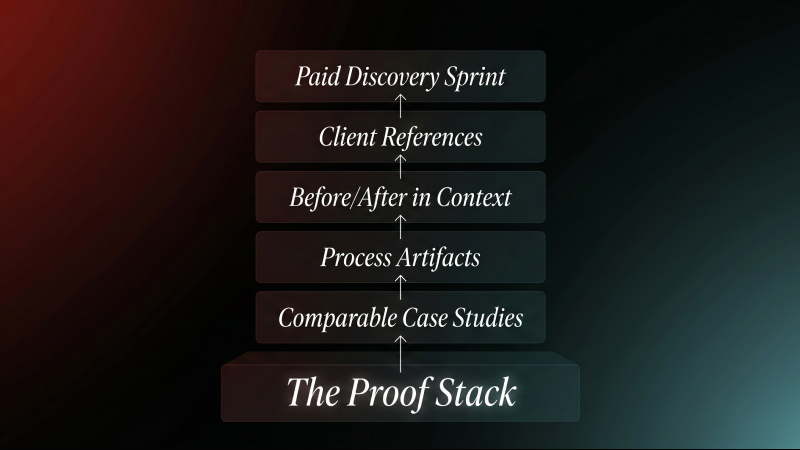
Use this “proof stack” in order, from strongest to weakest:
If a partner is allergic to showing work-in-progress thinking, you are being sold an outcome, not a method.
Pitch questions that separate experts from performers
Use these questions in interviews. The goal is not to catch anyone out, it is to reveal how they think.
Strategy and positioning
Identity system and execution
Website and digital experience
Go-to-market and adoption
Commercials and operating model
Red flags (you should treat as non-negotiable)
A few warning signs reliably predict pain:
A simple selection process that keeps you in control
If you want to choose well without dragging the process for months, run a structured selection.
Step 1: write a one-page “rebrand brief”
Include:
Step 2: shortlist based on fit, not fame
Shortlist 3 to 5 partners. Prioritize:
Step 3: run the same evaluation for everyone
Ask each partner to respond to the same prompts, and score them on the same criteria (clarity, decision quality, proof, team, rollout plan). Consistency reduces bias.
Step 4: consider a paid discovery sprint
A small paid sprint is often the cheapest way to avoid an expensive mismatch. It reveals how they collaborate, how fast they converge, and whether they can translate strategy into usable output.
What “good” looks like after you choose
Even the best rebranding company cannot save a rebrand with weak internal ownership. Before work starts, align on:
Treat the rebrand like a product launch. Because it is.
Frequently Asked Questions
What should I look for in rebranding companies beyond a strong portfolio? Look for decision-making ability under constraints, real process artifacts, comparable case studies, and a plan for rollout, adoption, and governance.
How do I know if we need a full rebrand or just a refresh? If your positioning no longer matches your buyers, market category, or offer, you likely need strategy work. If strategy is solid but execution is inconsistent or dated, a system refresh may be enough.
Should we ask rebranding companies for speculative creative in the pitch? Avoid free speculative work. It rewards surface-level concepts and punishes deep diagnosis. A better option is a paid discovery sprint with clear outputs.
How long does a rebrand usually take? It depends on scope. A focused identity refresh can be faster, while a full rebrand that includes positioning, system build, website, and launch planning typically takes longer because decisions and adoption take time.
How do we prevent brand drift after launch? Assign owners, document the system, build templates, train teams, and set up lightweight governance so new assets do not become one-off reinventions.
Want a rebrand that actually changes your market position?
If you are a challenger brand, the goal is not to look “more premium.” The goal is to win share by making your difference unmistakable and deployable across brand, go-to-market, and digital experience.
Boil is a brand growth agency built for challengers, combining creative branding with go-to-market strategy and digital execution. If you want to sanity-check your scope, vet options, or explore a rebrand path that ties to growth, start with Boil’s thinking on rebranding decisions or reach out via the agency site: boil.agency.
