A sharp logo can get attention. A smart strategy can win a boardroom. But if your brand needs to win market share, those two things cannot live in separate rooms.
That is where a branding and creative agency becomes valuable. Not because it gives you more deliverables, but because it connects the strategic choices that make a brand matter with the creative execution that makes people notice, remember, and choose it.
For challenger brands, this matters even more. You usually do not have the biggest media budget, the longest track record, or the safest position in the category. Your advantage is clarity, speed, distinctiveness, and the ability to make the market see something differently. Branding defines that difference. Creative makes it impossible to ignore.
So when do you need both? And how do you know whether you are hiring a true strategic creative partner or just adding another layer of polish?
Branding and creative are connected, but they are not the same
Branding is the strategic system behind how your company is understood. It answers questions like: What do we stand for? Who are we for? Why should anyone care? How are we different from the obvious alternatives? What language, story, and identity should we use to create recognition and trust?
Creative is the expression of that system. It turns strategic decisions into concepts, campaigns, design, copy, digital experiences, motion, content, and launch assets. Creative gives the brand energy, memorability, and cultural presence.
The problem starts when companies treat one as a substitute for the other.
A brand strategy without creative execution often becomes a beautiful document no one uses. It may contain smart positioning, audience insights, and a refined narrative, but if it does not translate into a website, sales story, campaign, product experience, or investor deck, it has limited commercial impact.
Creative without brand strategy has the opposite problem. It can look impressive, but it may not build a consistent market position. The work gets attention for a moment, then fades because the audience cannot connect it to a clear idea.
A strong branding and creative agency closes that gap. It does not ask, “What should this look like?” before answering, “What should this mean?”
When you need both branding and creative
You do not always need a combined partner. Sometimes you need a focused design sprint, a naming consultant, a campaign team, or a production partner. But there are moments when separating brand strategy from creative execution creates friction, delays, and diluted work.
Here are the clearest signals that you need both.
Your brand has become harder to explain
If your sales team needs five different slides to explain what you do, your homepage keeps changing, and your leadership team describes the company in different ways, you probably have a brand clarity problem.
This is common in fast-growing companies. The product evolves, the audience shifts, new use cases appear, and the original story starts to feel too small. At that point, you need more than new copy. You need a sharper position and a creative system that makes the new story easy to understand.
A branding partner can define the core narrative. A creative partner can turn it into the assets people actually see and use.
Your category is crowded and everyone sounds the same
Many challenger brands are not losing because their product is weak. They are losing because the market cannot tell why they matter.
If every competitor claims to be “innovative,” “seamless,” “sustainable,” “AI-powered,” or “customer-first,” those words stop doing any work. The brand needs a more specific point of view and a more distinctive way to show up.
This is where strategy and creative need to move together. The positioning should create contrast. The creative should dramatize that contrast. If one side is generic, the other side will struggle.
For more on how challengers can sharpen their position, Boil’s guide to owning your brand market position breaks down how to choose and defend a focused niche.
You are entering a new market
Market entry is not just distribution. It is translation.
A brand that works in one region, audience, or vertical may not automatically make sense in another. New buyers may have different pain points, levels of awareness, trust barriers, cultural expectations, or competitive references.
In this situation, branding helps you decide what should stay consistent and what needs to change. Creative helps you adapt the message into landing pages, launch campaigns, sales enablement, social assets, and digital experiences that feel native to the new market.
If you are moving into a market with stronger incumbents, this becomes even more important. You cannot simply announce that you exist. You need to show why the market should make room for you.
Your performance marketing is hitting a ceiling
When paid acquisition becomes more expensive, teams often try to fix the problem inside the ad account. They test more audiences, more headlines, more bidding strategies, more formats.
Sometimes that helps. But often the real issue is upstream.
The market may not understand the offer quickly enough. The creative may not create enough distinction. The landing page may not carry the same promise as the ad. The brand may not feel trustworthy enough for the price point. The message may be rationally clear but emotionally forgettable.
A branding and creative agency can look beyond campaign mechanics and ask a more useful question: Is the brand giving performance enough to work with?
Strong brand assets make demand generation more efficient because people recognize you faster, remember you longer, and understand your value with less explanation.
Your rebrand needs to change behavior, not just aesthetics
A rebrand is not successful because the logo changed. It is successful when the market, the team, and the customer experience align around a stronger idea.
That requires both strategy and creative. Strategy defines what is changing, why it matters, and how to preserve the equity you should not lose. Creative makes the change visible, credible, and exciting.
Without strategy, a rebrand can become cosmetic. Without creative, it can become invisible.
Boil’s article on rebranding decision-making for high-growth teams is a useful next read if you are trying to decide whether the timing is right.
Your content engine is producing volume without consistency
Many teams now produce more content than ever. AI tools, templates, freelancers, and internal contributors can help brands move faster, but they can also create a fragmented voice if there is no clear system.
This is not just a quality issue. It is a trust issue. If your website sounds strategic, your ads sound generic, your sales decks sound technical, and your social content sounds like a different company, buyers feel the inconsistency.
A brand system gives teams the rules, language, and narrative structure to stay coherent. Creative direction gives that system life across channels. If your team uses AI in the content workflow, resources like AI humanization and detection tools can support quality control, but they should sit underneath a stronger brand voice, not replace it.
What a branding and creative agency should deliver
The best partners do not just hand over a brand book and a folder of assets. They build a usable growth system. That means the work should help your team make better decisions faster, not depend on the agency for every small execution.
A strong engagement usually includes a few core layers.
Strategic diagnosis
Before any creative work starts, the agency should understand the business context. That includes your market, competitors, audience, growth goals, current perception, internal alignment, and commercial constraints.
For challenger brands, diagnosis should also reveal the tension in the market. What is broken, outdated, overcomplicated, overpriced, ignored, or misunderstood? What belief are you challenging? What gap can you own?
Without that diagnosis, creative becomes decoration.
Positioning and messaging
Positioning defines the space you want to own in the mind of your audience. Messaging turns that position into language people can repeat.
This should include the core promise, audience definition, value proposition, reasons to believe, proof points, objections, tone of voice, and narrative structure. The goal is not to write one perfect sentence for every situation. The goal is to create a messaging system that works across homepage copy, sales conversations, pitch decks, campaigns, product pages, and recruitment.
Visual and verbal identity
Identity is where the brand becomes recognizable. It includes elements like logo, typography, color, layout, imagery, motion principles, voice, naming conventions, and design rules.
But identity should not be judged only by whether it looks good in a presentation. It should be judged by whether it works in real conditions. Can it flex across digital channels? Can the internal team use it? Does it scale as the product or portfolio grows? Is it distinctive enough to create memory?
This is why modern branding design should be treated as a system, not a one-off logo. Boil’s guide to branding design systems explores this in more detail.
Creative platform and campaign thinking
A creative platform is the bridge between brand strategy and market activation. It gives campaigns a central idea, not just a set of assets.
For example, a company might have a clear positioning around simplifying a complex process. The creative platform could dramatize the frustration of the old way, introduce a memorable enemy, and build a campaign around the relief of switching. That is stronger than simply stating “we make things easier” in different formats.
The best creative platforms make the brand more famous for a specific idea.
Digital and go-to-market execution
A brand becomes real at the touchpoints where people make decisions. That includes your website, product experience, sales materials, onboarding, ads, email flows, investor materials, events, and social presence.
If these touchpoints are disconnected, the market receives mixed signals. If they are aligned, every interaction reinforces the same position.
For challenger brands, this alignment is a force multiplier. You do not need to be everywhere. But wherever you show up, the message and experience need to feel unmistakably yours.
The risk of hiring branding and creative separately
There are excellent strategy agencies. There are excellent creative agencies. There are also situations where using separate specialists makes sense.
The risk appears when the handoff is weak.
A strategy team may define a compelling positioning, but the creative team may interpret it too literally. A creative team may produce standout concepts, but they may drift away from the commercial strategy. An internal team may receive both, but lack the time or confidence to connect them.
The result is usually one of three problems.
First, the work slows down because every decision needs translation. Second, the brand becomes inconsistent because each team optimizes for its own output. Third, the final execution feels less sharp than the original strategic intent.
A combined branding and creative agency reduces that translation loss. The same strategic idea can be tested, expressed, challenged, and refined through execution. The creative work pressure-tests the strategy. The strategy keeps the creative work from becoming random.
How the process should work from strategy to launch
A useful process should feel structured, but not bloated. Challenger brands need momentum, not months of abstract exploration.
A typical strategy-to-launch process often moves through five stages.
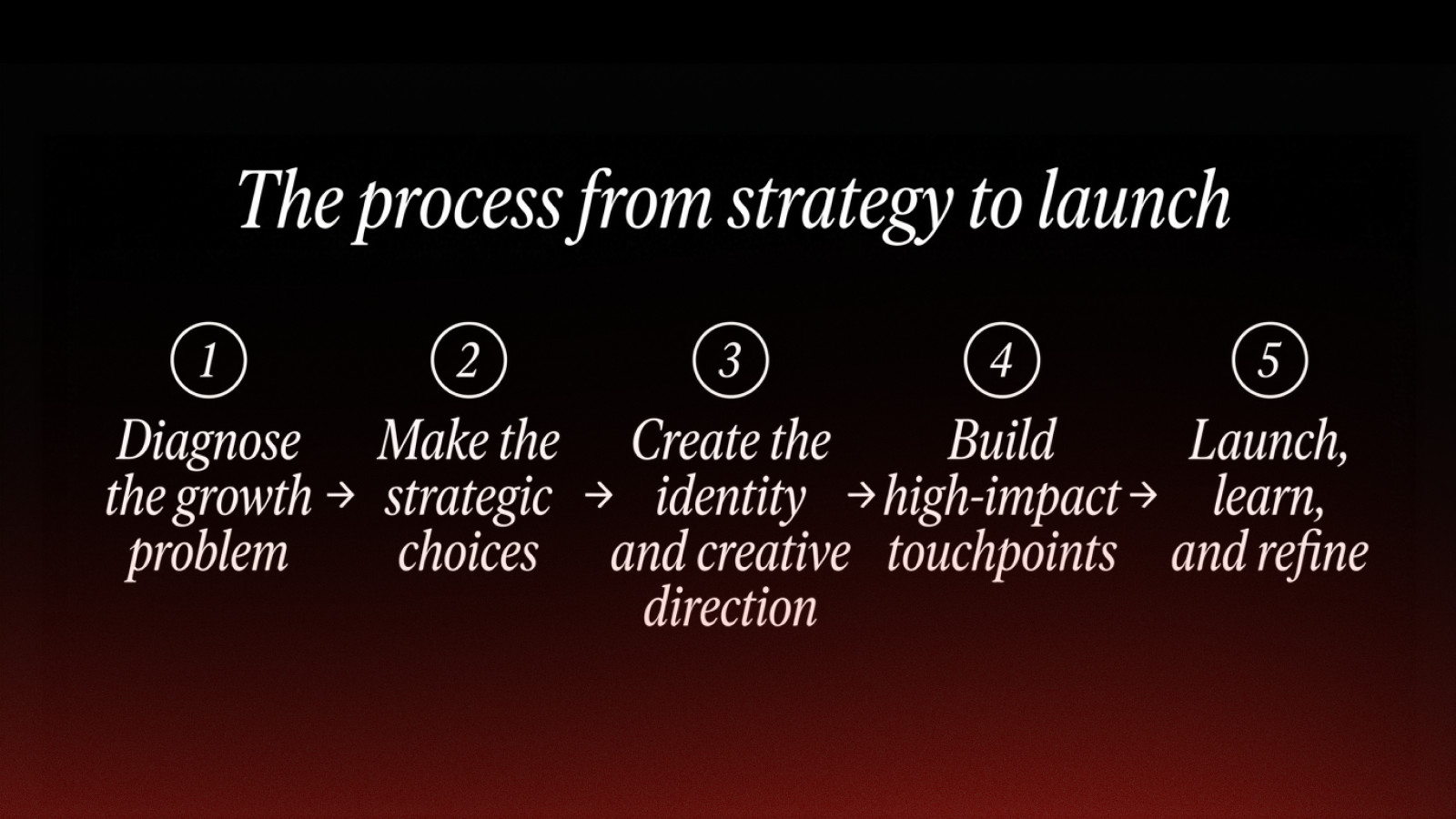
A typical strategy-to-launch process often moves through five stages.
- Diagnose the growth problem: Clarify what is actually holding the brand back, such as weak differentiation, confusing messaging, low trust, market entry risk, or inconsistent execution.
- Make the strategic choices: Define the audience, position, narrative, proof, personality, and role of the brand in the category.
- Create the identity and creative direction: Translate the strategy into visual identity, verbal identity, creative concepts, and a system that can scale.
- Build high-impact touchpoints: Prioritize the assets that will move the business first, such as the website, launch campaign, pitch deck, sales story, product pages, or paid creative.
- Launch, learn, and refine: Use market feedback, performance data, sales conversations, and customer behavior to improve the system after launch.
The fifth stage is often where brands gain the most advantage. A brand is not finished when the files are delivered. It becomes stronger when it meets the market and adapts without losing its core.
When you do not need both
Not every project requires a full branding and creative agency. Over-scoping can waste time and budget.
You may not need both if your positioning is already validated, your identity system is working, and you only need extra production capacity. In that case, a freelance designer, copywriter, or production studio may be enough.
You may not need both if the problem is limited to a single asset, such as an event booth, a landing page, or a sales deck, and there is no deeper strategic uncertainty.
You may also not need both if your internal team already has strong brand leadership and creative direction. In that case, you might only need a specialist partner for a specific gap.
The key question is simple: Is the problem one of execution, or is it a mix of meaning, differentiation, and execution?
If it is the second, separating branding and creative may create more work than it saves.
How to choose the right branding and creative agency
Choosing the right partner is not about finding the agency with the prettiest portfolio. It is about finding the team that can turn your business challenge into a brand system that performs in the real world.
Look for evidence in how they think, not only how their work looks.
Ask questions like:
Also watch for red flags. If an agency jumps straight into visuals before understanding the market, be careful. If they talk only about purpose but never about growth, be careful. If they promise a complete transformation without asking about internal adoption, be careful. If every case study looks the same, be very careful.
The right agency should bring taste, but taste alone is not enough. You need strategic courage, creative range, and operational realism.
Why this matters most for challenger brands
Challenger brands cannot afford vague branding. They need every touchpoint to work harder.
A market leader can often survive inconsistency because it already has awareness, distribution, and habit on its side. A challenger does not have that luxury. Every unclear message, generic design choice, or disconnected campaign makes the climb steeper.
But the opposite is also true. When a challenger brand is strategically clear and creatively distinctive, it can look bigger than it is. It can create momentum faster. It can make customers feel like switching is not risky, but obvious.
That is the real value of a branding and creative agency. It helps you turn difference into demand.
Frequently Asked Questions
What is a branding and creative agency? A branding and creative agency combines brand strategy with creative execution. It helps define your positioning, story, identity, and messaging, then turns those decisions into market-facing assets such as websites, campaigns, content, sales materials, and launch systems.
How is it different from a branding agency? A branding agency may focus mainly on strategy, identity, and guidelines. A branding and creative agency goes further by translating that foundation into creative concepts and execution across real customer touchpoints.
How is it different from a creative agency? A creative agency often focuses on campaigns, content, design, or advertising. A branding and creative agency starts with the underlying brand position, then uses creative work to build recognition, trust, and market differentiation.
When should a startup hire one? A startup should consider hiring one when it has enough market insight to make strategic choices, but needs help clarifying its position, building a credible identity, launching into market, or preparing for scale. Very early teams may only need a lean brand sprint before investing in a larger system.
Can one agency really do both strategy and creative well? Yes, but not every agency can. Look for proof that the agency can diagnose business problems, make strategic choices, and deliver creative work that performs beyond presentation slides. Case studies should show the link between thinking and execution.
What should we prepare before contacting an agency? Bring your business goals, current challenges, audience insights, competitive context, existing brand assets, growth targets, and internal decision process. You do not need all the answers, but you should be clear about the problem you want the agency to help solve.
Ready to connect strategy and creative?
If your brand has ambition, but your positioning, identity, website, campaigns, or go-to-market story are not working together, it may be time to bring branding and creative into the same conversation.
Boil helps ambitious challenger brands stand out and grow market share through branding, rebranding, go-to-market strategy, creative design, web, app, and digital growth work.
If you are ready to turn a sharper brand idea into a market-ready growth system, challenge your brand with Boil.
