Growing companies often use brand and branding interchangeably. That sounds harmless until it starts creating expensive problems: a new logo that does not change buyer perception, a campaign that looks polished but lacks a clear point of view, or a rebrand that fixes the website while the sales story stays confusing.
The difference between brand and branding matters because growth puts pressure on meaning. As your company enters new markets, hires faster, raises capital, launches products, or competes against bigger players, people need to understand why you exist, what you stand for, and why you are the better choice.
Brand is the meaning people attach to your company. Branding is the work you do to shape that meaning.
For challenger companies, that distinction is not theoretical. It is the difference between looking different and being easier to choose.
Brand vs branding: the simple distinction
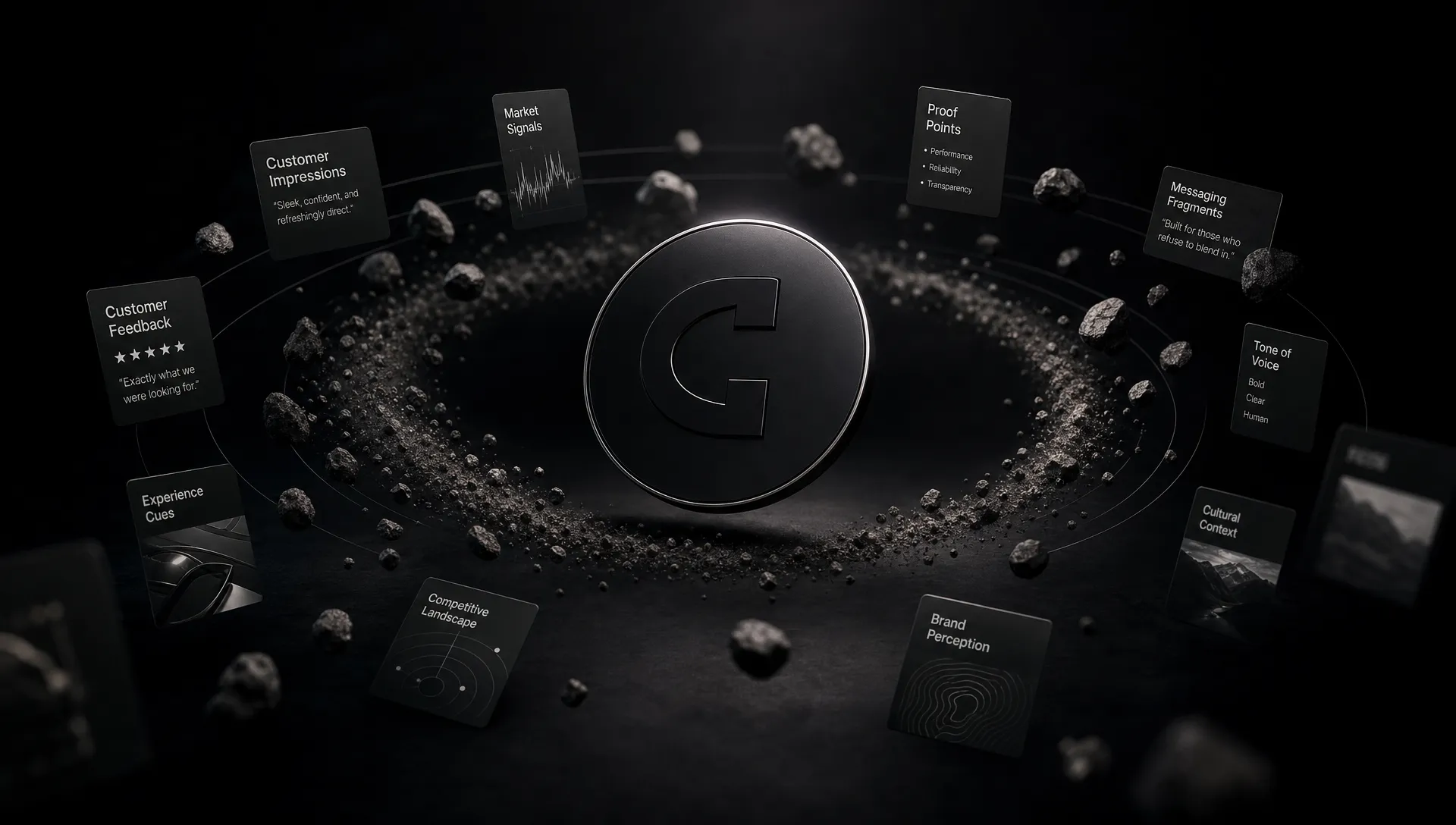
Your brand is the set of associations, expectations, memories, and beliefs people hold about your company. It lives in the market, not just inside your marketing team. You can influence it, but you do not fully own it.
Your branding is the intentional system of decisions, assets, behaviors, and experiences you use to influence that perception. It includes positioning, messaging, identity, design, tone of voice, campaigns, customer experience, product cues, and go-to-market execution.
Here is the distinction in practical terms:
Concept  | What it means                                                 | Where it lives                                                        | What it affects
Brand    | The perception and meaning people attach to your company      | In the minds of customers, prospects, talent, partners, and investors | Trust, preference, memory, pricing power, loyalty
Branding | The strategic and creative work used to shape that perception | In your decisions, systems, communications, design, and experiences | Recognition, clarity, consistency, differentiation, conversionThat is why a logo is not your brand. A logo is one brand asset. It can help people recognize you, but it cannot carry the full weight of positioning, reputation, product experience, customer proof, and market behavior.
Why growing companies confuse brand and branding
Early-stage companies often survive on founder charisma, product urgency, and sales hustle. The brand may be implicit rather than defined. Everyone close to the company understands the story because they helped build it.
Then growth changes the game.
More people start explaining the company. More channels carry the message. More customers compare you against alternatives. More internal teams make decisions that affect how the company is experienced. What once felt obvious becomes inconsistent.
This is where companies start asking for “better branding” when the real issue may be a weak brand foundation. Or they ask for a “brand strategy” when they mainly need stronger execution across touchpoints.
Common symptoms include:
- Sales teams describing the company in different ways.
- The website explaining features but not communicating a clear market position.
- Visual identity feeling generic in a crowded category.
- Campaigns generating attention but not strengthening recognition or trust.
- New hires struggling to understand the company’s voice, values, or audience.
- Customers loving the product but using language the company does not own or amplify.
These are not just marketing inconveniences. They can slow sales cycles, weaken launch performance, dilute category differentiation, and make it harder to compete with better-known incumbents.
A brand is not what you say. It is what the market remembers
Growing companies need to shift from self-expression to market memory.
You might say you are innovative, human, premium, disruptive, simple, or trusted. But if the market does not remember you for a specific problem, outcome, belief, or advantage, those words remain internal aspirations.
A strong brand makes your company easier to recognize, understand, and recall. It gives people mental shortcuts. In competitive markets, that matters because buyers rarely evaluate every option from scratch. They rely on familiarity, proof, reputation, category cues, and emotional confidence.
This is why brand building and performance marketing should not be treated as enemies. The IPA’s well-known work by Les Binet and Peter Field on balancing long-term brand building with short-term activation argues that sustainable growth depends on both creating future demand and converting existing demand.
For growing companies, branding should support both. It should make short-term campaigns clearer and make the company more memorable over time.
Branding is the operating system for consistent growth
Branding is often misunderstood as a cosmetic layer applied after strategy is complete. In reality, effective branding connects strategy with execution.
It translates commercial choices into market-facing behavior. Who are we for? What problem are we solving? What do we want to be known for? What should people feel after interacting with us? What proof makes our claim believable? What visual and verbal patterns make us recognizable?
Think of it like a physical renovation. A homeowner may want a calmer, more functional space, but the renovation work has to translate that goal into layouts, materials, workflows, and details. The same is true in business, whether you are hiring specialists for home renovation in Dubai or a brand team for a market-entry push: the outcome and the process are related, but they are not the same.
A growing company needs the same discipline. The desired brand perception has to be translated into messaging, identity, product experience, sales enablement, launch plans, and digital journeys.
That is why branding should not stop at a logo file or a slide deck. It should become a practical system people can use.
If you are deciding what support you need, Boil’s guide to branding services at each stage breaks down how priorities shift from pre-launch to scaling and expansion.
What branding should define for a growing company
Good branding creates clarity before creativity. The creative work becomes stronger because it is anchored in strategic choices.
At a minimum, your branding work should help define:
Branding component      | The question it answers                                       | Why it matters for growth
Positioning             | Why should this audience choose us over alternatives?         | Sharpens differentiation and sales relevance
Audience insight        | Who matters most, and what do they already believe?           | Prevents generic messaging and wasted spend
Messaging               | What should we say consistently across teams and channels?    | Improves conversion, onboarding, and campaign clarity
Verbal identity         | How should we sound?                                          | Builds recognition beyond visuals
Visual identity         | How should we look and be recognized?                         | Creates distinctiveness and memory structures
Experience principles   | How should the brand behave in product, service, and support? | Makes the brand credible through action
Go-to-market expression | How does the brand show up in launches and demand generation? | Connects brand strategy to revenue activity That becomes especially important as companies add new products, channels, regions, or customer segments. Without a system, each new initiative becomes a one-off interpretation of the brand.

The practical difference in business decisions
The brand vs branding distinction becomes clearer when you apply it to real growth decisions.
If sales conversations are inconsistent
The brand problem may be unclear positioning. The branding solution may include a sharper narrative, message hierarchy, proof points, sales decks, website copy, and objection-handling language.
The goal is not just to sound better. It is to help buyers understand value faster.
If the company looks generic
The brand problem may be weak distinctiveness. The branding solution may include a more ownable visual identity, stronger category cues, a clearer tone of voice, and creative patterns that build recognition over time.
This is where companies need to move beyond “make it modern” and ask what visual and verbal system will help them be remembered. Boil’s article on building a branding design system, not just a logo, goes deeper into this idea.
If campaigns do not compound
The brand problem may be that each campaign communicates something different. The branding solution may include a campaign platform, clearer messaging pillars, stronger creative guidelines, and a repeatable go-to-market framework.
Campaigns should not only generate short-term responses. They should also add to the company’s long-term memory in the market.
If the company has outgrown its original story
The brand problem may be strategic misalignment. Perhaps the company has moved upmarket, expanded internationally, changed its product, or entered a new category.
In that case, branding may not be enough as a surface refresh. You may need a rebrand that rethinks positioning, identity, messaging, and experience around the next stage of growth. If that sounds familiar, use Boil’s rebranding decision guide for high-growth teams to pressure-test whether the need is strategic or cosmetic.
What growing companies should avoid
The biggest mistake is treating branding as decoration after the important business decisions have been made.
If positioning is vague, better design will only make the vagueness look more polished. If the product experience contradicts the promise, stronger messaging will increase the gap between expectation and reality. If the sales team cannot explain the value clearly, a new visual identity will not solve the commercial friction.
Growing companies should also avoid the opposite mistake: endless strategy without execution. A brand strategy that never becomes a website, campaign, pitch, product experience, hiring story, or customer journey is not doing its job.
The purpose of branding is to make the brand usable.
How to know whether your brand is strong enough for the next stage
A brand is strong when it creates useful shortcuts for the people you need to influence. Prospects understand you faster. Customers can explain your value to others. Employees make more consistent decisions. Investors and partners see a clearer growth story.
Ask these questions before your next launch, fundraise, expansion, or rebrand:
- Can your leadership team explain the company’s position in one clear sentence?
- Can your sales team describe the value proposition without improvising each time?
- Can your website communicate who you are for and why you matter within a few seconds?
- Can customers repeat your core value in language that matches your intended positioning?
- Can your design system flex across campaigns, product, social, events, and sales materials?
- Can new hires understand how the brand should behave, not just how it should look?
If the answer is no to several of these, you do not just have a design issue. You have a brand system issue.
Brand and branding should work together
The best growing companies do not separate brand from business strategy. They use branding to make strategic choices visible, memorable, and actionable.
Your brand gives people a reason to care. Your branding gives teams the tools to express that reason consistently.
Your brand creates meaning. Your branding shapes the signals that build that meaning.
Your brand lives in the market. Your branding is how you influence the market with discipline.
This is especially important for challengers. Larger incumbents often have awareness, distribution, and legacy trust on their side. Challenger brands need sharper positioning, more distinctive expression, and more intentional go-to-market behavior to earn attention and preference.
The goal is not to look bigger than you are. The goal is to become easier to understand, easier to remember, and easier to choose.
Frequently Asked Questions
What is the difference between brand and branding? A brand is the perception, meaning, and reputation people associate with your company. Branding is the strategic and creative work used to shape that perception, including positioning, messaging, identity, design, and experience.
Is a logo a brand or branding? A logo is part of branding. It is a visual asset that can help people recognize the company, but the brand itself includes broader associations such as trust, relevance, differentiation, and customer experience.
When should a growing company invest in branding? A growing company should invest in branding when its story, identity, messaging, or customer experience is no longer supporting the next stage of growth. Common triggers include market expansion, new product launches, fundraising, hiring, category repositioning, or declining differentiation.
Can branding improve sales performance? Yes, when it clarifies positioning, strengthens buyer confidence, improves message consistency, and makes the company easier to remember. Branding does not replace sales execution, but it can make sales conversations more focused and credible.
How do you measure whether branding is working? Look at both qualitative and commercial signals: message recall, brand recognition, website conversion, sales cycle quality, customer feedback, win-loss insights, employee alignment, campaign consistency, and the ability to command attention in your category.
Build a brand that can carry your next stage of growth
If your company is growing but your story, identity, or go-to-market experience no longer reflects where you are headed, the issue may not be “more marketing.” It may be a brand system that has not caught up with the business.
Boil helps ambitious challenger brands grow market share through branding, rebranding, go-to-market strategy, creative design, and digital experiences. If you are ready to turn your brand into a clearer growth advantage, explore how Boil can help shape what your market remembers next.
