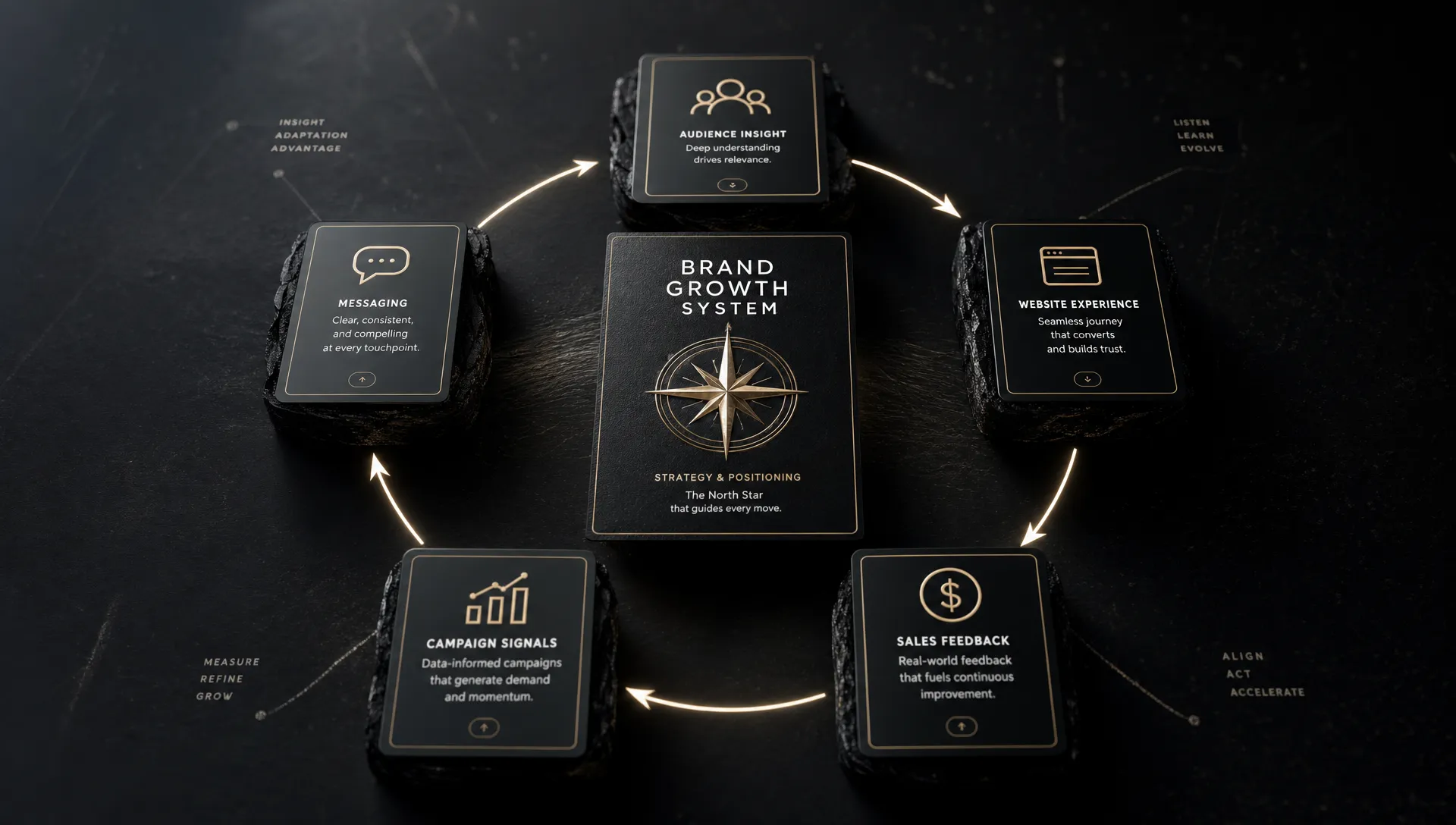
One-off brand projects can feel reassuring. You set a scope, agree on deliverables, launch the new identity or website, and move on. For a moment, everything looks finished.
But growth rarely works like that.
Markets shift. Competitors reposition. Customers start using different language. Sales teams discover new objections. A product gains traction with an audience you did not originally prioritize. The brand that felt complete at launch can start to feel misaligned months later.
That is where a brand growth agency beats a one-off brand project. Not because every company needs an agency forever, but because ambitious brands need more than a polished output. They need a living system that keeps strategy, creative, go-to-market, and digital experience moving in the same direction.
The issue with treating branding as a one-time project
A one-off brand project is usually built around a defined moment: a launch, a funding round, a merger, a new website, or a visual refresh. That clarity is useful. It creates momentum and forces decisions.
The problem appears when the project is treated as the whole solution.
Branding is not just the identity you publish. It is the ongoing work of shaping how the market understands, remembers, and chooses you. A project can define the starting point, but it cannot fully control what happens after your brand meets real buyers, real competitors, and real commercial pressure.
A one-off project often freezes the brand at a single point in time. The brief captures what the business knows today, but growth reveals what the business needs tomorrow. After launch, teams often face questions the original project was not designed to answer:
- Which messages are actually converting in sales conversations?
- Which audiences understand the offer fastest?
- Which parts of the website are underperforming?
- Which proof points are missing from campaigns?
- Which visual or verbal patterns are being applied inconsistently?
If there is no ongoing growth partner, the brand can start drifting. Marketing improvises. Sales rewrites the pitch. Product teams create their own decks. External freelancers interpret the guidelines differently. Over time, the brand becomes a collection of assets rather than a commercial system.
What a brand growth agency does differently
A brand growth agency is not simply a branding agency on a retainer. The difference is in the operating model.
Instead of delivering a fixed package and disappearing, a growth-focused partner connects brand strategy to market performance over time. It looks at how the brand is expressed across positioning, messaging, design, website experience, campaigns, content, sales enablement, and launch activity.
That ongoing view matters because brand growth is cumulative. Each touchpoint either strengthens the same market memory or introduces noise. Each campaign either builds on the strategic idea or pulls the company in a new direction. Each website update either clarifies the buyer journey or adds friction.
For challenger brands, that compounding effect is especially important. If you are not the biggest player in the category, you cannot afford to be vague, inconsistent, or slow to adapt. You need your brand to sharpen the commercial argument every time it appears.
Boil has written more about the role of a growth-focused agency in its guide to how a brand growth agency supports challenger brands, but the short version is this: the work does not stop at looking different. It has to help the business win more of the right market.
Why ongoing brand work compounds faster than isolated deliverables
The strongest brands are not built through isolated bursts of creativity. They are built through repeated, recognizable, commercially useful signals.
That does not mean a brand should never change. It means change needs to be directed. A brand growth agency helps a business learn from the market without becoming reactive. It creates a rhythm where insight informs execution, execution creates feedback, and feedback sharpens the next move.
Strategy stays connected to execution
In a one-off model, strategy often lives in the early phase of the project. It appears in workshops, decks, and messaging frameworks, then slowly fades as teams start producing real-world assets under pressure.
A brand growth agency keeps strategy present during execution. The question is not only, “Does this look on-brand?” It is also, “Does this help the buyer understand why we matter?”
That shift changes the quality of decisions. A homepage is not judged only by aesthetics. A campaign concept is not judged only by originality. A pitch deck is not judged only by polish. Each asset is assessed by how well it advances the market position the company is trying to own.
Creative decisions become easier
One of the hidden benefits of an ongoing agency relationship is decision speed. When a team understands your strategy, audience, category pressures, and commercial goals, every new piece of work starts from a stronger baseline.
You spend less time re-explaining the business. You avoid repeating old debates. You reduce the risk of creative work that looks good but misses the point.
This is especially valuable when a company is moving quickly. Product launches, investor updates, hiring campaigns, market entry plans, and website improvements rarely arrive in a neat sequence. A partner with context can help the brand respond without losing coherence.
The market teaches the brand
A brand project is based on research, interviews, and strategic assumptions. Those inputs matter, but they are still pre-launch or early-stage signals.
Once the brand is active, the market starts giving better feedback. Buyers reveal what they understand, what they ignore, what they repeat, and what they challenge. A brand growth agency can help translate those signals into better messaging, sharper content, stronger conversion paths, and clearer proof.
That learning loop is where one-off projects often fall short. By the time meaningful feedback arrives, the original team may be gone, the budget may be closed, and the internal team may be left to interpret results alone.
Challenger brands need consistency and adaptation
There is a tension at the heart of brand building: consistency creates recognition, but adaptation creates relevance.
A one-off project tends to over-index on consistency. It produces the system, documents the rules, and assumes the organization will apply them. A fragmented project model tends to over-index on adaptation. Different teams and vendors solve immediate problems, but the brand becomes inconsistent.
A brand growth agency helps balance both.
Consistency does not mean repeating the same headline forever. It means making sure every expression of the brand reinforces the same strategic idea. Adaptation does not mean chasing every trend. It means evolving the brand in response to real growth opportunities.
This applies to companies of every size. A scaleup entering a new market needs a clear narrative that can travel across sales and marketing. A B2B company expanding from founder-led sales needs messaging that others can repeat. Even a local service business, such as a painter in North Zealand and Greater Copenhagen, depends on repeated trust signals across its website, local presence, customer proof, and quote process.
The category changes, but the principle holds: growth comes from a brand that people can understand, remember, and trust consistently.
The hidden costs of one-off brand projects
One-off projects can look efficient because the scope is contained. But the visible cost is not always the full cost.
The expensive part often comes later, when the organization has to bridge the gaps between strategy, execution, and performance. Common hidden costs include duplicated onboarding, inconsistent vendor interpretation, slow internal decision-making, and assets that need to be redone because they were created without enough strategic context.
A project-by-project approach can also create strategic drift. Each new initiative has its own brief, its own timeline, and sometimes its own creative logic. None of those decisions may be wrong in isolation, but together they can weaken the brand’s ability to stand for something clear.
The result is familiar: a strong launch followed by scattered execution. The company has guidelines, but not enough governance. It has messaging, but not enough market learning. It has a website, but not enough optimization. It has a campaign idea, but not enough connection to the broader brand system.

What an ongoing brand growth partnership can include
The exact shape of a partnership should depend on the company’s stage, goals, and internal capabilities. A startup preparing for market entry does not need the same support as a scaleup repositioning for enterprise buyers.
Still, strong brand growth partnerships tend to cover a few connected areas.
Brand strategy and positioning
This is the foundation: who the brand is for, what it should be known for, why it is different, and how it should frame value in the market. For high-growth teams, this often means translating ambition into a position that buyers can understand quickly.
If the business has outgrown its original identity, a deeper rebrand may be needed. In that case, it helps to approach the work as a growth move rather than a cosmetic refresh. Boil’s article on corporate rebranding strategy for high-growth teams explores that shift in more detail.
Messaging and narrative development
Positioning becomes useful when teams can express it. A growth agency helps turn strategy into language that works across the website, sales conversations, investor materials, campaigns, product launches, and employer brand moments.
This is not about writing one perfect tagline. It is about building a verbal system that can flex without losing meaning.
Creative identity and digital experience
Design still matters enormously. Distinctive visual identity helps a brand become recognizable, but design should also guide attention, clarify value, and make the buyer journey easier.
The same is true for digital experience. A website is often where brand, demand, proof, and conversion meet. Treating it as a static brochure limits its value. Treating it as part of the growth system makes it a place to test, learn, and improve.
Go-to-market alignment
A brand that cannot support go-to-market activity is unfinished. Growth depends on whether the brand can help teams launch, sell, recruit, expand, and enter new markets with confidence.
That is why the best agency relationships connect creative work to commercial context. If you are comparing partners, it is worth looking beyond style and asking how they connect strategy to business outcomes. Boil’s guide on choosing a creative design agency that drives growth offers a useful lens for that evaluation.
When a one-off brand project still makes sense
A one-off project is not always the wrong choice. It can be exactly right when the need is narrow, the business context is stable, and the team has the internal capability to carry the brand forward.
For example, a one-off engagement may work well when you need a specific campaign identity, a limited landing page, a set of launch assets, or a focused visual refresh within an already strong brand system.
The risk increases when the project is expected to solve a broader growth challenge. If the company is repositioning, entering a new category, shifting audience, scaling sales, or trying to become more distinctive in a crowded market, a one-time deliverable is rarely enough.
In those situations, the question is not, “Can an agency produce the assets?” Many can. The better question is, “Who will help us make the brand work harder after launch?”
How to know you need a brand growth agency
You may be ready for a brand growth agency if your brand problems keep showing up as business problems.
Maybe your sales team struggles to explain the value quickly. Maybe prospects compare you to the wrong competitors. Maybe your website looks professional but does not communicate a sharp point of view. Maybe every campaign feels like it starts from zero. Maybe your company has grown, but the brand still reflects an earlier stage.
These signs suggest that the issue is not just design. It is alignment.
A brand growth agency becomes valuable when you need a partner to help connect the dots between market position, creative expression, go-to-market execution, and ongoing learning. That connection is what turns brand from an output into an advantage.
How to get more value from an agency relationship
Whether you choose a one-off project or an ongoing partnership, the outcome improves when the relationship is set up correctly.
Start by defining the business job clearly. Are you trying to increase market share, enter a new segment, raise perceived value, improve conversion, attract talent, support sales, or make the company easier to understand? A vague ambition leads to vague creative work.
Then, give the agency access to real context. Strong brand decisions come from customer insight, sales conversations, product direction, competitor movement, and internal ambition. The more clearly those inputs are shared, the more commercially useful the work becomes.
Finally, judge the work beyond the launch moment. A new brand should be evaluated by how well it helps the organization act, communicate, and grow. The launch is only the first proof point.
Frequently Asked Questions
What is a brand growth agency? A brand growth agency helps companies use brand strategy, creative, digital experience, and go-to-market thinking to support business growth. The focus is not only on making the brand look better, but on making it clearer, more distinctive, and more useful commercially.
Is a brand growth agency the same as a branding agency? Not always. A traditional branding agency may focus on identity, positioning, and launch assets. A brand growth agency typically takes a more ongoing view, connecting brand decisions to market performance, campaign activity, website experience, and business goals.
Are one-off brand projects a waste of money? No. One-off projects can be valuable when the goal is specific and the company already has a strong brand system. They become risky when they are expected to solve ongoing growth, positioning, or go-to-market challenges without continued support.
When should a company move from project work to an ongoing agency relationship? It usually makes sense when the brand is central to a growth challenge, such as entering a new market, repositioning, scaling sales, launching new offers, or improving how the company is understood by buyers.
How should you measure the value of brand growth work? Measurement should combine qualitative and commercial signals. Look at message clarity, sales confidence, audience understanding, website engagement, campaign performance, lead quality, conversion paths, and whether teams are applying the brand consistently.
Build a brand that keeps growing after launch
A one-off brand project can give you a new identity, a sharper message, or a better website. But if your ambition is to grow market share, the real advantage comes from what happens next.
A brand growth agency helps make that next phase intentional. It keeps strategy connected to execution. It helps the brand learn from the market. It gives creative work a commercial role. Most importantly, it turns branding from a moment in time into a system for growth.
If your brand has outgrown one-off fixes, Boil helps ambitious challengers connect branding, go-to-market strategy, creative design, and digital experience so they can stand out and grow with purpose.
