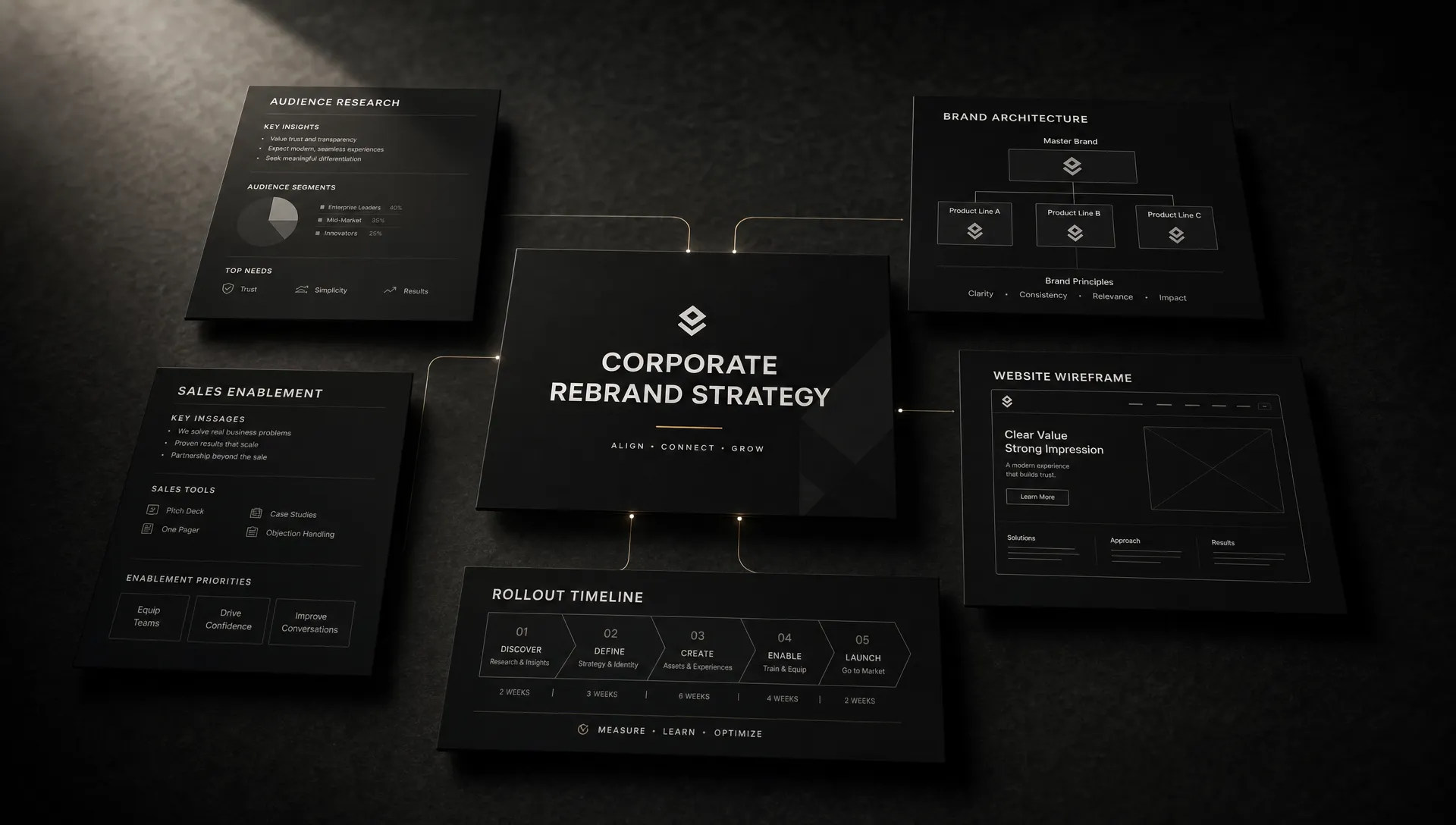
High-growth companies rarely rebrand because they are bored with their logo. They rebrand because the business has changed faster than the brand can explain.
The product has expanded. The sales motion is more complex. New markets are opening. Talent expectations are higher. Investors want a sharper story. Enterprise buyers need more trust. Suddenly, the brand that helped you win your first category foothold starts creating friction.
That is when a corporate rebranding strategy becomes a growth tool, not a design project. For high-growth teams, the goal is not to look different for the sake of it. The goal is to make the company easier to understand, easier to buy from, easier to join, and harder to ignore.
Why high-growth teams outgrow their brand
Growth creates brand debt. At the start, a challenger brand can often rely on founder energy, product novelty, and a small group of early adopters. The brand can be scrappy because the market is forgiving.
As the company scales, the audience gets broader and less patient. Buyers compare you against established players. Partners evaluate risk. Candidates judge the maturity of your culture. Internal teams need shared language to sell, hire, build, and launch consistently.
Common signs that your brand has fallen behind include inconsistent sales narratives, unclear category positioning, a visual identity that no longer matches the price point, or product lines that feel disconnected from the company story. Another signal is internal confusion: different teams describe the business in different ways, even when they are trying to sell the same vision.
If you are still debating whether the issue is a rebrand, a repositioning, or a lighter refresh, Boil’s decision guide for high-growth teams is a useful place to pressure-test the need before you commit resources.
Start with the business case, not the logo
A strong corporate rebranding strategy begins with the commercial reason for change. Before discussing color, typography, naming, or campaign concepts, leadership should define what the current brand is preventing the company from achieving.
For a high-growth team, the business case often sits in one or more of these areas:
- Market expansion: The company is entering new geographies, verticals, or buyer segments and the existing brand feels too narrow.
- Category repositioning: The company needs to shift from a feature-led story to a broader strategic category or platform narrative.
- Enterprise readiness: The offer has matured, but the brand still feels early-stage or risky to larger buyers.
- M&A or portfolio complexity: Multiple products, acquisitions, or sub-brands need a clearer architecture.
- Talent and culture: The company needs an employer brand that matches its next stage of ambition.
- Trust recovery or reputation shift: The company needs to rebuild confidence after market confusion, leadership change, or strategic pivot.
The tighter the business case, the easier it becomes to make decisions later. Without it, rebranding turns into subjective debate. With it, every choice can be evaluated against a clear growth objective.
A practical test is to finish this sentence: Our rebrand must help us grow by making it easier to ______. If the answer is not specific, the strategy is not ready.
Define what must change and what must stay recognizable
High-growth teams often assume a rebrand means total reinvention. In reality, the smartest corporate rebrands protect the equity that already works while removing the elements that hold the business back.
Start by auditing the brand across four layers. The first is strategic equity: the beliefs, promises, and associations customers already value. The second is verbal equity: names, phrases, narratives, and proof points that help people understand you. The third is visual equity: recognizable assets such as color, symbol, interface style, photography, packaging, or motion. The fourth is experiential equity: the way customers feel when they interact with your people, product, content, and service.
This audit should not be limited to internal opinions. Interview customers, lost prospects, sales teams, customer success, recruiters, partners, and investors. Look for repeated language. The goal is to understand which parts of the brand create momentum and which create drag.
For example, a SaaS company may discover that customers love the product promise and founder story, but find the website vague and the pricing page hard to trust. A consumer brand may learn that its community loves the name and tone of voice, but the identity no longer stands out on shelf or social. In both cases, the rebrand should sharpen the brand rather than erase it.
Build the strategic core before the identity system
The strategic core is the spine of the rebrand. If this work is weak, the identity will be forced to compensate for unclear thinking. If it is strong, the creative work becomes more decisive.
Your strategic core should define the company’s position in the market, the audience it is built to win, the problem it solves, the reason it should be believed, and the behavior it should inspire. This does not need to become a 70-page brand book. In fact, high-growth teams need something sharper: a working system that leaders and teams can actually use.
At minimum, align on these elements:
- Positioning: What space do you want to own in the mind of the market?
- Audience priority: Which buyers, users, partners, and candidates matter most for the next growth stage?
- Value proposition: What outcome do you help them achieve better than alternatives?
- Brand promise: What commitment can the company credibly stand behind?
- Proof system: What evidence, product capabilities, customer outcomes, or operational strengths support the claim?
- Personality and voice: How should the company sound and behave when expressing that strategy?
For high-growth teams, the challenge is usually not a lack of ideas. It is too many competing ideas. The rebrand must create focus. If the strategy cannot help a sales leader, product marketer, designer, and founder make the same decision independently, it is not yet operational.

Create a rebrand operating model
A rebrand touches almost every function, which means the process needs governance. Without a clear operating model, speed creates chaos. Too many stakeholders get involved too late, feedback becomes personal, and the launch date slips.
Start by assigning decision rights. The CEO or founder should usually own the strategic mandate, especially when the rebrand changes positioning or company narrative. Marketing or brand leadership should own the day-to-day process. Product, sales, customer success, people, legal, and finance should be consulted at defined moments, not pulled into every creative review.
The operating model should include a small core team, a wider advisory group, and a final approval path. It should also define what kind of feedback is useful at each stage. Early feedback should focus on strategic accuracy. Mid-stage feedback should focus on usability across touchpoints. Late-stage feedback should focus on errors, risks, and implementation issues, not reopening the strategy.
High-growth teams should also protect the timeline by separating exploration from production. Exploration is where you test directions, challenge assumptions, and compare strategic choices. Production is where you build the system, create assets, migrate touchpoints, and prepare launch. Mixing the two is one of the fastest ways to slow a rebrand down.
Translate strategy into a complete brand system
Once the strategic core is approved, the brand system needs to make it tangible. This is where many corporate rebrands either become powerful or fall apart.
A brand system is more than a logo suite. It includes messaging, narrative, naming logic, visual identity, design principles, digital experience, sales enablement, recruitment materials, internal communications, and launch assets. For some companies, it may also include packaging, uniforms, signage, event booths, investor materials, or product UI.
The best systems are distinctive but usable. They give teams enough structure to stay consistent and enough flexibility to move fast. A beautiful identity that only a small design team can execute will not survive a high-growth environment. The system must work for a sales deck created under pressure, a product launch campaign, a hiring event, a customer webinar, and a homepage refresh.
Physical touchpoints matter too, especially for apparel, retail, hospitality, sports, and consumer goods. If your rebrand appears on merchandise, packaging, tags, or uniforms, production quality becomes part of the brand experience. Partners such as custom woven labels, patches, and ribbons suppliers can help teams translate a refreshed identity into tangible branded details that customers actually touch.
Digital experience is equally important. A corporate rebrand that stops at identity but ignores the website, product onboarding, or conversion journey will underperform. The website in particular should not simply wear the new brand. It should express the new strategy through clearer information architecture, stronger proof, sharper calls to action, and a journey that matches the company’s growth motion.
Protect your audience during the transition
A high-growth company cannot disappear for months and return with a new identity as if customers will automatically understand. Rebranding is a change management exercise for the market.
The transition plan should explain what is changing, why it is changing, and what is not changing. Customers need to know that the value they trusted is still present, even if the company is evolving. Employees need to feel equipped to explain the change before the public launch. Sales teams need updated language for active deals. Customer success teams need answers for existing accounts.
If the company has strong recognition in its current market, avoid creating unnecessary discontinuity. This may mean preserving a known name, maintaining certain color cues, evolving a symbol instead of replacing it, or explicitly connecting the old story to the new one. The art is to signal progress without making loyal audiences feel abandoned.
For a deeper look at this risk, Boil’s guide to rebranding without losing your audience covers practical ways to bring customers with you rather than surprising them at launch.
Plan the rollout in phases
The rebrand rollout should be treated like a go-to-market launch. It needs sequencing, message discipline, internal readiness, and measurable goals.
A useful rollout often includes three phases. The first is internal launch. This is where leadership explains the strategic reason for the rebrand, introduces the new system, and gives teams the tools to use it. The second is controlled external transition. This may include key customer briefings, partner updates, investor communications, sales enablement, and migration of priority touchpoints. The third is public launch, where the new brand is expressed through the website, social channels, PR, campaign creative, product updates, events, and other market-facing assets.
Not every asset needs to change on day one. High-growth teams should prioritize the touchpoints that influence trust, conversion, and comprehension. The homepage, sales deck, pitch narrative, customer emails, product entry points, LinkedIn presence, hiring pages, and paid campaigns often matter more than low-traffic legacy PDFs.
A phased rollout also reduces operational strain. It gives teams time to fix issues, gather feedback, and maintain momentum after the initial announcement. The launch moment matters, but the first 90 days after launch are where the rebrand becomes real.
Measure the rebrand like a growth initiative
A corporate rebranding strategy should have success metrics. Some metrics will be brand-led, while others should connect to commercial performance.
Before launch, establish a baseline. Track how prospects describe the company, where deals stall, how candidates perceive the employer brand, how the website converts, how sales teams use the existing narrative, and how often teams create off-brand materials because the current system is not useful.
After launch, measure both adoption and impact. Adoption shows whether the organization is using the new brand correctly. Impact shows whether the market is responding.
Useful indicators include direct traffic, branded search, conversion rates on priority pages, sales cycle feedback, win-loss insights, candidate quality, social sentiment, press clarity, partner response, customer retention signals, and internal asset usage. For B2B teams, qualitative sales feedback is especially valuable. If prospects understand the offer faster, repeat the new language back to sales, or show fewer trust objections, the rebrand is doing more than changing appearances.
Do not judge success only by launch-day engagement. A high-growth rebrand should keep compounding through better messaging, stronger campaigns, clearer sales conversations, and a more consistent customer experience.
Common mistakes high-growth teams should avoid
The most common mistake is treating the rebrand as a marketing department project when the underlying problem is strategic. If the company is changing category, audience, price point, or business model, leadership has to be deeply involved.
Another mistake is optimizing for internal taste. A rebrand is not a popularity contest. Personal preferences matter far less than market relevance, distinctiveness, credibility, and usability. The right question is not whether every stakeholder likes the direction. The right question is whether it helps the company win the next stage of growth.
Teams also underestimate implementation. The visible creative work may be exciting, but the operational work determines whether the rebrand lands. Asset migration, domain and SEO planning, CRM templates, product UI updates, legal checks, partner communications, and employee training all need ownership.
Finally, avoid launching without a clear story. If the market sees a new identity but does not understand the strategic shift behind it, the rebrand can feel cosmetic. Explain the change in plain language. Make the new direction obvious. Give people a reason to care.
Frequently Asked Questions
What is a corporate rebranding strategy? A corporate rebranding strategy is a plan for changing how a company is positioned, expressed, and experienced across the market. It connects business goals to brand decisions, including messaging, identity, architecture, digital experience, rollout, and measurement.
When should a high-growth company consider rebranding? A high-growth company should consider rebranding when its current brand creates friction for expansion, sales, hiring, fundraising, customer trust, or category leadership. The trigger should be strategic, not simply aesthetic.
How long does a corporate rebrand take? Timelines vary depending on company size, approval complexity, and the number of touchpoints involved. A focused refresh can move quickly, while a full corporate rebrand with positioning, identity, website, internal rollout, and market launch usually requires more planning and cross-functional coordination.
How do you rebrand without losing brand equity? Start by identifying what customers already value and recognize. Preserve the assets, language, or associations that still support growth, then change the parts that create confusion or limit ambition. The goal is evolution with purpose, not unnecessary erasure.
Who should be involved in a corporate rebrand? Leadership, marketing, brand, sales, product, customer success, people, and legal should all have defined roles. The core team should stay small, but the process should include enough stakeholder input to make the rebrand accurate, usable, and launch-ready.
Build a rebrand that accelerates growth
For high-growth teams, rebranding is not about looking more polished. It is about creating the clarity, confidence, and momentum needed for the next stage of the company.
A strong corporate rebranding strategy aligns the business case, market position, brand system, rollout plan, and measurement framework. It protects what customers already trust while giving the company a sharper way to compete.
If your brand is struggling to keep pace with your ambition, Boil helps challenger brands grow through branding, go-to-market strategy, creative design, digital experiences, and rebranding expertise built for teams that need to move with purpose.
