An attractive logo can still arrive with the wrong files, unclear ownership and no evidence that it works where customers will encounter it. If you’re hiring a brand logo design agency, the purchase should include more than a polished presentation. You need a clear design rationale, usable assets and an agreed path from approval to launch.
For challenger brands, those details matter because budget spent fixing preventable problems is budget unavailable for market entry or customer acquisition. The right scope protects both the creative work and your ability to use it.
Here’s what to request, how to evaluate it and where to draw the line between a focused logo project and a broader branding engagement.
Start with a written job for the logo
Before anyone sketches, agree on what the logo needs to accomplish. “Make us look modern” is a preference, not a brief. “Help buyers recognize us across distributor listings, product packaging and our website” gives the agency something concrete to design against.
A useful brief identifies the audience, competitive context and priority applications. It also records what should remain recognizable if you’re replacing an existing mark. That might be a familiar color, a distinctive letterform or the name itself.
A brand logo design agency should turn that discussion into a short document you can approve before concept development begins. At minimum, it should cover:
- Business context: What is changing, and why does the current identity no longer fit?
- Audience: Who needs to recognize the brand, and in what buying situation?
- Design criteria: What should the logo communicate without relying on a lengthy explanation?
- Priority applications: Where must it work first?
- Constraints: Which names, existing assets, production requirements or launch dates are fixed?
Not every logo project needs a new positioning platform. If your strategy is settled, the agency should work from it rather than sell you unnecessary discovery. If positioning is unresolved, identify that dependency explicitly.
Boil’s guide to building a brand system rather than just a logo explains the wider identity work. Your proposal should distinguish that broader scope from the logo deliverables you’re buying now.
A brand logo design agency should explain its design decisions
Concept presentations should help you choose, not simply impress you. Each direction needs a rationale tied to the approved brief: why this structure, why these visual cues and why this approach fits your audience better than the alternatives.
Ask to see genuinely different directions, if multiple concepts are included. Several color variations of the same idea do not constitute different strategic routes. Equally, more concepts are not automatically better. The proposal should explain how many directions you’ll review and how the agency will develop the selected one.
Evaluate each concept in three ways: what it communicates, how it differs from relevant competitors and how it behaves in ordinary use. A full-screen logo on an elegant mockup can hide weaknesses that become obvious in a website header or on a small label.
The presentation should also explain trade-offs. A detailed symbol may suit large-format applications but need simplification at small sizes. A wordmark may communicate the name clearly but require a separate compact asset for an app icon.
You should leave the review knowing why one direction is recommended. Personal preference still matters, but it should not be the only basis for approval.
Require proof in the places customers will see it
A brand logo design agency should demonstrate the selected direction in your actual priority environments, not only in generic mockups. These are practical acceptance checks, not proof that the logo will increase sales.
Agree on the tests before final refinement so the agency can resolve problems while changes are still manageable.
| Application | What to check | Evidence to request |
|---|---|---|
| Small digital placement | The name and essential shapes remain distinguishable | Export at the intended display size |
| Light and dark backgrounds | The mark stays clear without improvised effects | Approved positive and reversed versions |
| One-color reproduction | The identity survives without its color palette | Solid black and white versions |
| Print or physical production | Fine details survive the chosen process | Supplier review or a production proof where needed |
| Competitive context | The direction is not confusingly similar to nearby brands | A relevant category comparison |
A business such as A&V Drain, a Toronto plumbing and waterproofing provider, illustrates how application priorities change with the buying situation. A hypothetical brief for that category could prioritize a vehicle graphic, a uniform and a mobile emergency-service page. Those contexts demand different checks from a luxury brand’s packaging. Choose applications because customers encounter them, not because they make attractive presentation slides.
Accessibility needs a precise distinction. WCAG’s text contrast guidance exempts text that is part of a logo from its minimum contrast requirement. That exemption does not make low-contrast branding useful, nor does it exempt surrounding navigation, buttons or body text. Ask for usable logo versions while checking the wider interface separately.
Get an asset package your team can actually use
The handoff from a brand logo design agency should remove guesswork for your designer, web developer and production suppliers. A folder full of unnamed exports is not a finished delivery.
Request an asset inventory tied to your applications. It will usually include vector artwork for scalable use, transparent raster exports for everyday tools and versions prepared for the relevant digital and print workflows. SVG can serve many web applications, while vector PDF or another supplier-approved format may be appropriate for print. The right package depends on your production environment.
Color specifications should distinguish screen use from print use. RGB or HEX values do not guarantee an identical printed result, and a CMYK conversion is not a substitute for agreeing on a print process or reviewing a proof when color matters.
Variations also need a purpose. A horizontal lockup, stacked version or compact symbol should be supplied where the application calls for it, not added merely to inflate the deliverable count.
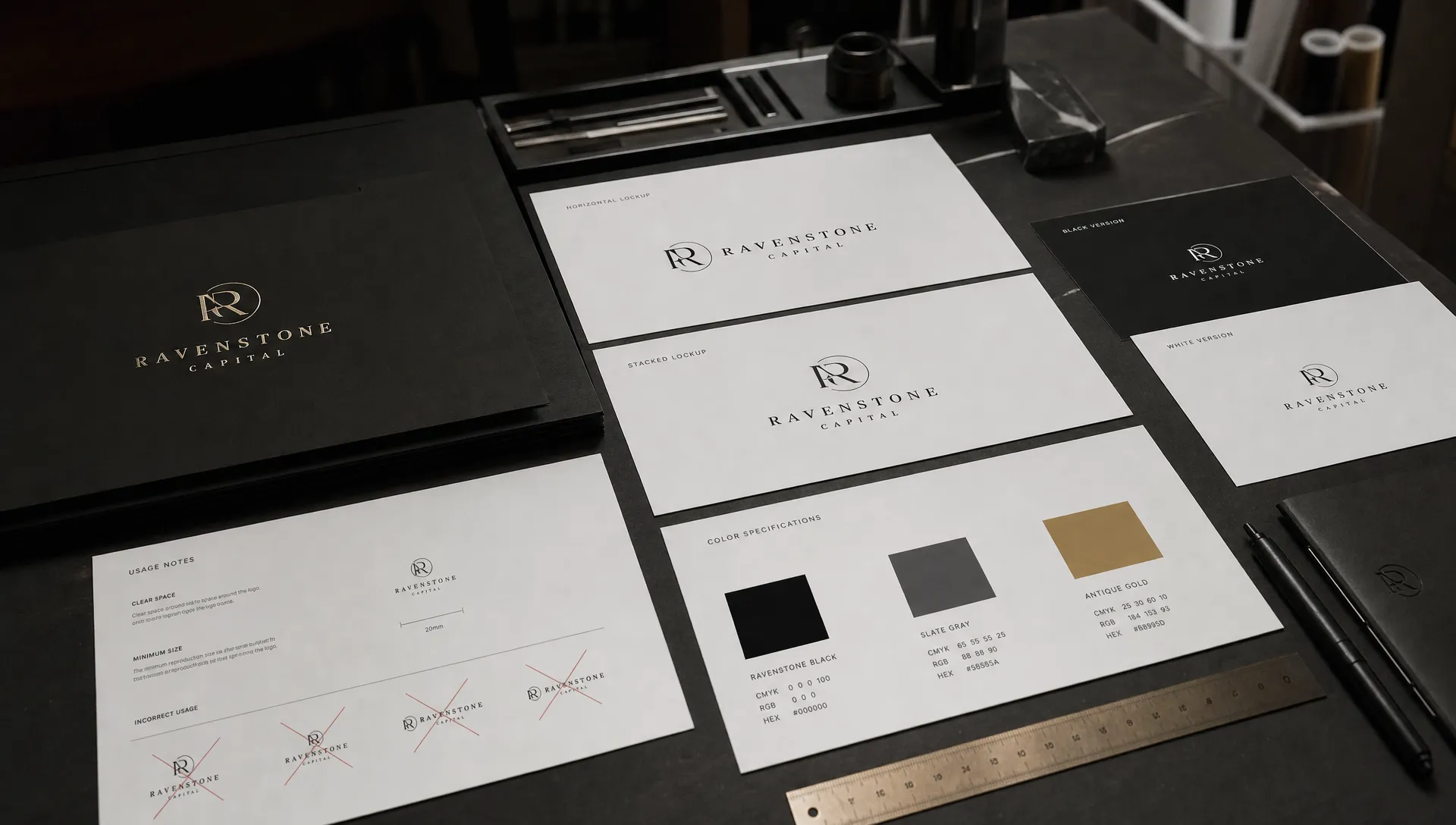
Finally, request a concise usage guide covering minimum sizes established through testing, clear space, approved backgrounds and common misuse. Minimum-size recommendations should reflect the actual artwork and output method rather than a universal number copied from another project. A teammate who missed the design presentations should still be able to select the correct file and use it confidently.
Settle ownership, licenses and originality before approval
Ask your brand logo design agency to explain what rights you receive, when they transfer and which assets remain subject to third-party licenses. Put the answer in the contract rather than relying on an email after launch.
Distinguish ownership of the final custom artwork from access to working files, font software and unused concepts. These are separate questions. Receiving an editable file does not automatically grant a license to every component inside it.
Fonts deserve particular attention. A logo may contain outlined lettering, while your broader identity uses a licensed typeface. Confirm whether your team needs separate licenses for desktop design, website use or other applications. Do not assume the agency can transfer its own font license to you.
Ask about the origin of the work too. Stock elements, commissioned illustration and generative tools can raise different usage questions. If generated material contributes to the final mark, request a clear explanation of what was used and which rights the agency can warrant.
Trademark clearance is a separate legal task. A competitor review or reverse image search can surface concerns, but neither establishes that a mark is legally available. Agree on who coordinates appropriate clearance, in which markets and at what stage, before investing heavily in rollout.

Make feedback and acceptance part of the agreement
Creative projects become expensive when the decision process is vague. Define who approves the work, how feedback is consolidated and what happens if the brief changes after a direction has been selected.
One accountable decision-maker can gather input from sales, marketing and leadership without asking the agency to resolve contradictory instructions. “Make it bolder” and “make it more understated” are not actionable together. Feedback should explain the concern and connect it to an agreed criterion.
The proposal should distinguish concept selection from refinement. Changing the spacing of a selected wordmark is different from abandoning that direction and requesting an entirely new route. State the included revision rounds and the process for approving additional work.
Acceptance should cover both creative approval and delivery completeness. Before closing the project, confirm that the agreed variants exist, files open correctly, production requirements have been addressed and usage documentation is included.
A brand logo design agency should also define support after handoff. That could be a scheduled walkthrough or an agreed period for correcting export errors. Whatever is included, document its scope and duration rather than assuming unlimited availability.
These terms do not remove creative judgment. They give both sides a shared definition of completion and keep administrative disputes from undermining otherwise strong work.
Connect the handoff to a realistic rollout
A new logo does not update every customer touchpoint by itself. Decide who will replace website assets, social avatars, sales documents, packaging and physical signage. Separate design delivery from implementation so there are no hidden responsibilities.
For a rebrand, sequence changes around exposure and cost. Update prominent digital placements promptly, then plan physical stock replacement around operational constraints. Some businesses need an immediate coordinated switch; others can manage a staged transition. The agency should understand which approach your launch requires.
Measurement should match the purpose of the project. You can check whether teams use the approved assets, whether customers recognize the revised identity and whether recurring application errors have disappeared. Broader changes in conversion or market share involve pricing, distribution, messaging and other factors, so they should not be attributed to the logo alone.
If you expect a brand logo design agency to support implementation or evaluate results, name those tasks in the scope. Boil’s explanation of branding impact beyond a new identity provides a useful distinction between improving visual consistency and evaluating wider business outcomes.
Compare proposals by evidence, not presentation polish
Two proposals can both promise “a logo and brand guidelines” while covering very different work. Normalize their scope before comparing fees. Look for specific outputs, decision points and responsibilities rather than the number of pages in the presentation.
| Proposal area | A useful commitment | A reason to ask more questions |
|---|---|---|
| Brief | Written criteria approved before design | Only a mood board or aesthetic preferences |
| Concepts | Defined directions with a rationale | An unspecified number of “options” |
| Validation | Checks in agreed applications | Generic mockups only |
| Handoff | Named formats, variants and documentation | “All necessary files” without an inventory |
| Rights | Explicit ownership and licensing terms | Ownership left unstated |
| Completion | Clear approval and support conditions | No definition of final delivery |
Also check exclusions. Naming, trademark advice, website implementation, packaging production and launch campaigns may sit outside a focused logo engagement. Exclusions are not a weakness when they are clear. They become a problem when essential dependencies appear only after you have committed.
Frequently asked questions
What should a brand logo design agency deliver besides the logo? Expect an approved brief, explained design directions, application checks, a defined asset package, usage guidance and clear rights. Rollout support and broader strategy may also be included, but they should be explicitly scoped.
Do we need a complete rebrand to replace our logo? Not necessarily. If your positioning, messaging and wider identity still work, a focused logo project may be enough. A larger engagement becomes relevant when the business has changed or the existing brand no longer communicates the right offer.
How should we compare logo design prices? Compare the same scope: strategic input, concept development, revisions, testing, file delivery, licensing and implementation support. A lower fee may reflect a narrower service rather than better value. Ask each agency to clarify what is included and excluded.
Can an agency guarantee trademark registration? Logo design and trademark registration are different services. Ask who handles clearance and legal advice, and avoid treating an agency’s originality review as a registration guarantee. Qualified trademark counsel should address legal availability in the relevant jurisdictions.
Define the outcome before commissioning the mark
A worthwhile logo project ends with more than something you like. It ends with a mark you can explain, reproduce and deploy, supported by clear ownership and a manageable handoff.
Talk to Boil about your branding needs if you’re weighing a focused identity update against a wider rebrand. Boil’s branding, rebranding and go-to-market services can help you frame that decision around where your business needs to go, not just how the next logo should look.
