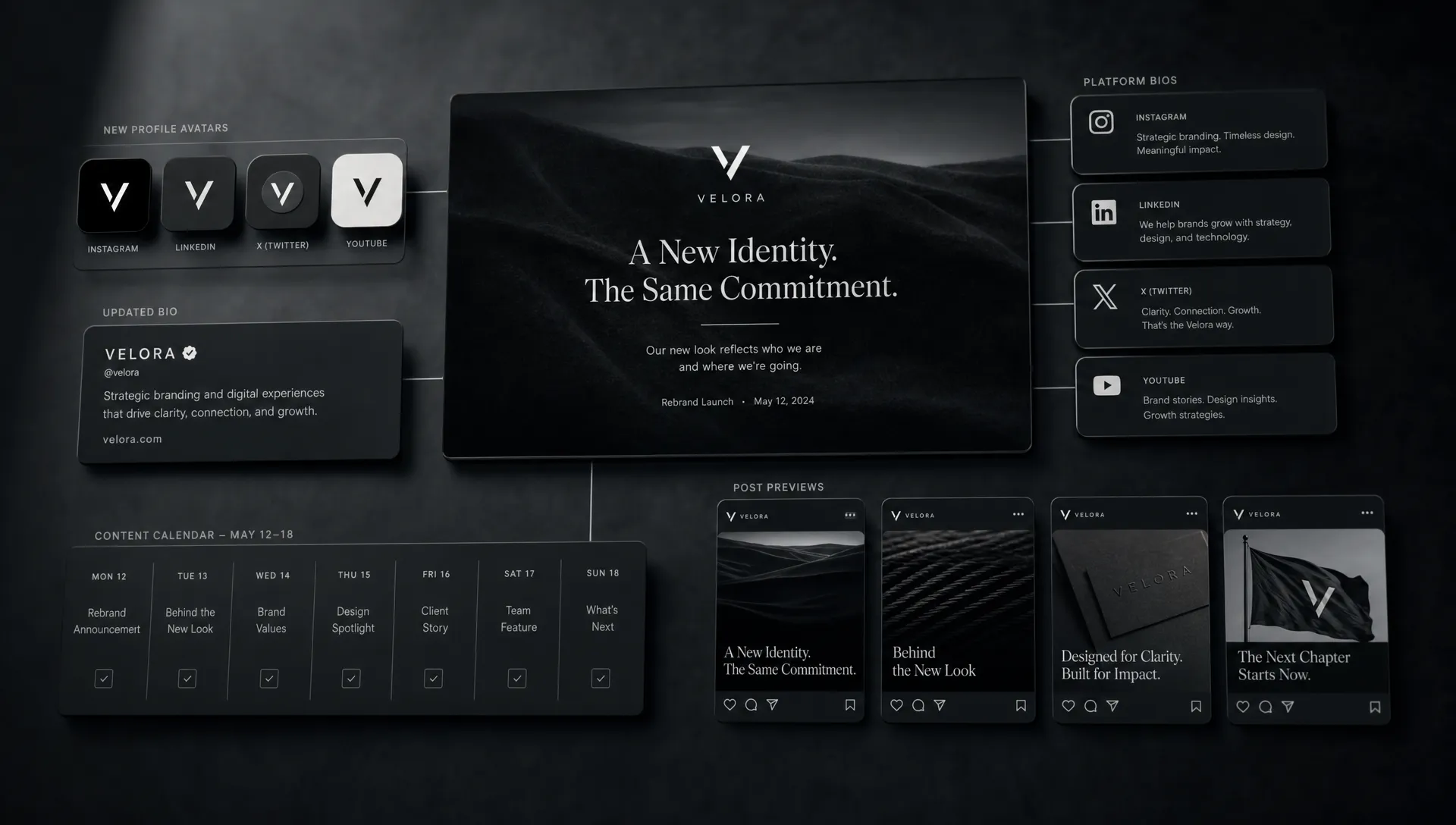
Social media is where a rebrand becomes real. Your audience may not see the strategy deck, the positioning work, or the stakeholder workshops, but they will see the new profile image, the changed bio, the unfamiliar tone, and the first post announcing that something has shifted.
That is why a social media rebranding strategy should never be treated as a last-minute upload task. A clean brand reset is not only about making your channels look updated. It is about helping the right people understand what changed, why it matters, and why they should still trust you.
For challenger brands, the stakes are even higher. You are often fighting larger competitors with more recognition, bigger media budgets, and longer market memory. A messy social rollout can create confusion. A clean reset can create momentum.
What a clean brand reset actually means
A clean brand reset gives your audience a clear bridge from the old brand to the new one. It does not force them to guess whether they are in the right place, whether the company has been acquired, whether the offer has changed, or whether the brand they followed still exists.
In practical terms, a clean reset should do four things at once. It should preserve useful recognition, introduce the new identity, explain the strategic reason for the change, and give your audience repeated proof that the new brand is more relevant than the old one.
This matters because people rarely process rebrands in a neat, linear way. Some will see the announcement post. Others will notice the new avatar three weeks later. Some will encounter an old shared post, a founder profile, a paid ad, or a customer comment before they ever visit your refreshed website.
Your job is to make every one of those touchpoints feel coherent.
Start with strategy before changing the visuals
The biggest mistake brands make on social is treating the rebrand as a design reveal. New logo. New colors. New templates. New copy style. Then a caption that says the brand is entering a new chapter.
That may look polished, but it often leaves the audience asking a basic question: why should I care?
Before you touch any profile, answer the strategic questions that will shape the rollout:
- Who are we trying to be known by now?
- What market, category, or audience shift does this rebrand support?
- Which parts of our existing reputation should we carry forward?
- What must our audience believe after seeing the new brand?
- Which proof points show that this is more than a cosmetic change?
A social rebrand should be grounded in business movement. Maybe you are moving upmarket. Maybe your offer has matured. Maybe your audience has changed. Maybe the brand needs to match a stronger product, sharper point of view, or bigger ambition.
If you cannot explain the strategic reason simply, social media will expose that weakness quickly. Followers do not need the full internal story, but they do need a clear public reason to accept the change.
Audit your current social footprint
A clean reset starts with knowing exactly what already exists. Most brands think about the main company accounts first, but the real footprint is usually wider and messier.
Audit every visible brand asset across your social ecosystem:
- Profile names, handles, bios, banners, avatars, and links
- Pinned posts, highlights, playlists, reels, and featured content
- Old campaign hashtags, branded graphics, and recurring content formats
- Founder, executive, sales, recruitment, and community profiles
- Paid ads, dark posts, retargeting creative, and lead forms
- Partner pages, marketplace listings, creator content, and affiliate assets
- Social preview images attached to website pages and blog posts
The goal is not to erase your history. In many cases, deleting too much content can remove credibility, customer proof, and useful search visibility inside the platforms. The goal is to decide what should be updated, archived, reframed, or left as historical context.
This is also the moment to identify risk. Which posts could create confusion after the rebrand? Which offers, screenshots, or claims are out of date? Which high-performing pieces should be rebuilt in the new identity instead of discarded?
If retaining audience trust is a major concern, Boil’s guide to rebranding without losing your audience is a useful companion to this planning stage.
Define the rebrand narrative in plain English
Your rebrand narrative should be easy enough for a customer, employee, investor, or casual follower to repeat. If it depends on abstract language, it will not travel well on social.
A practical narrative can follow this shape:
We started with a clear mission. Our market, customers, and ambitions have evolved. The new brand reflects where we are going, while keeping the core promise people already trusted.
That simple structure helps you avoid two common extremes. The first is pretending nothing has changed, which makes the rebrand feel superficial. The second is overdramatising the change, which can make loyal followers feel left behind.
Your announcement content should clarify:
- Why the rebrand is happening now
- What is changing visually, verbally, or strategically
- What is not changing, especially service quality, values, or commitments
- What the audience gains from the new direction
- Where people can learn more or ask questions
The more practical the narrative, the better. Social media rewards clarity, not internal brand language.
Build the rollout in three phases
A clean social media rebranding strategy works best when it is sequenced. Instead of dropping everything at once and hoping people understand, plan the reset as a transition.
Phase 1: Prepare the ground
Before launch, align the people who will shape public perception. That includes leadership, sales, customer support, recruitment, community managers, agency partners, and any creators or ambassadors representing the brand.
Give them a short explanation of the rebrand, approved language, updated visual assets, and guidance on how to answer common questions. Internal confusion becomes external confusion fast.
You can also begin soft signaling. This might include content about your evolved point of view, customer problems you are now better positioned to solve, or behind-the-scenes momentum. The key is to make the rebrand feel like the natural result of a journey, not a sudden costume change.
Phase 2: Launch with one clear anchor
On launch day, publish one primary announcement that becomes the source of truth. This could be a LinkedIn post, a short launch video, a carousel, a founder note, a landing page, or a press-style announcement, depending on your audience.
Then adapt that message per platform instead of copy-pasting the same caption everywhere. LinkedIn may need more strategy and business context. Instagram may need stronger visual storytelling. TikTok or Reels may need a faster, more human explanation. X, Threads, or similar channels may need a concise thread with clear before-and-after context.
For the broader communications sequence beyond social, follow a plan for announcing a rebrand without losing brand equity so your launch does not depend on one post doing all the work.
Phase 3: Prove the change after launch
Launch week creates attention. The following weeks create belief.
Many brands overinvest in the reveal and underinvest in reinforcement. The audience sees the new identity, then the content goes back to the same generic posts as before. That is how a rebrand becomes wallpaper.
For at least 30 to 60 days after launch, build content that proves the new direction. Show sharper customer outcomes, stronger opinions, new product or service clarity, improved experience, better use cases, or more confident thought leadership. Make the audience feel the strategic shift, not just see it.
Update profiles in an order that reduces confusion
The technical rollout matters. Social platforms cache images, display names, previews, and metadata in inconsistent ways. If your updates happen randomly, your audience may see mismatched assets for days.
Create a channel-by-channel launch checklist and update the most visible identity markers first:
- Secure or update handles before announcing the change
- Change avatars and banners in the same launch window
- Rewrite bios to explain the new positioning clearly
- Update link-in-bio destinations and tracking links
- Replace pinned posts with the rebrand announcement or explainer
- Refresh highlights, featured sections, and saved story covers
- Pause or update paid campaigns using the old identity
Also check founder and employee profiles. For challenger brands, people often trust the humans behind the business before they fully trust the corporate account. If those profiles still use outdated descriptions, banners, or messaging, the reset feels unfinished.

Create content that makes the new brand feel earned
The best rebrand content does not simply announce the change. It makes the change feel inevitable.
Start with an anchor post that explains the shift in human language. Then surround it with supporting content that answers the questions people are likely to have. This can include a founder perspective, a short visual evolution story, customer-focused proof, a product or service explainer, and a practical FAQ post.
A strong launch content mix might include:
- A concise announcement post that names the change and explains why it matters
- A visual identity post that shows the system, not just the logo
- A customer value post that explains what the new brand helps people do better
- A founder or leadership post that adds credibility and intent
- A proof post showing work, results, product improvements, or market insight
- A community post inviting questions and acknowledging loyal followers
Notice that only one or two of these posts are truly about the brand itself. The rest are about relevance. That distinction is important. Your audience does not need to admire your rebrand as much as they need to understand why it makes you more useful, credible, or distinctive.
Keep platform behavior consistent, not identical
Consistency does not mean every platform should behave the same way. A clean reset needs one brand idea expressed through native platform behavior.
On LinkedIn, your audience may expect the commercial reason for the rebrand. Talk about the market shift, your sharpened positioning, and what this means for customers or partners.
On Instagram, the reset may need to be more visual and sequential. Use profile highlights, carousels, pinned posts, and reels to help people absorb the new identity quickly.
On short-form video platforms, avoid overproduced brand monologues. A direct explanation from a founder, designer, strategist, or team member can feel more credible than a cinematic reveal with little substance.
On community-led platforms, expect questions and skepticism. Do not disappear after posting. The comment section is part of the rebrand experience.
The goal is not to make every channel match perfectly. The goal is to make every channel feel like it belongs to the same strategic brand.
Protect trust with proof, especially in high-stakes categories
The more trust your category requires, the more proof your social reset needs. A playful consumer brand may be able to rely on mood, design, and cultural energy. A financial, healthcare, mobility, legal, B2B, or regulated service brand needs signals that reduce perceived risk.
Trust signals can include certifications, transparent processes, customer reviews, guarantees, security messages, expert credentials, case studies, or clear support information. For example, a service offering official EU Certificate of Conformity ordering builds confidence through compliance, documentation, transparent pricing, and secure checkout cues. The lesson for any brand reset is simple: if your audience needs reassurance before they buy, your rebrand content must make that reassurance visible.
This is especially important for challenger brands because unfamiliarity already creates friction. If you are changing your look, name, messaging, or market position, you need to replace lost familiarity with stronger evidence.
Use paid social to stabilize recognition
Organic reach alone is rarely enough for a clean reset. Even engaged followers may miss the announcement, and platform algorithms will not guarantee that the right people see the context.
Paid social can help you stabilize recognition if it is used carefully. Promote the announcement to existing followers, website visitors, email subscribers, and warm audiences first. Then use separate campaigns for new prospects once the core audience has had time to understand the change.
Avoid pushing cold audiences to a rebrand announcement that only makes sense to people who knew the old brand. For new prospects, lead with the new positioning and customer value. They do not need a history lesson. They need a clear reason to care now.
Also monitor comments closely on paid posts. A confused comment under a boosted announcement can travel further than expected. Prepare short, friendly responses that clarify the change without sounding defensive.
Measure whether the reset is working
A rebrand launch can generate a temporary engagement spike, but that does not always mean the strategy is working. People may react because the change is surprising, not because the new brand is landing.
Measure both attention and understanding.
Useful social rebrand metrics include:
- Profile visits, follower churn, reach among existing followers, and direct traffic from social
- Comment sentiment, question patterns, saves, shares, and quality of inbound messages
- Click-through rates to the new website, landing page engagement, and branded search movement
- Performance of new content pillars compared with old ones
- Sales, recruitment, partnership, or community signals influenced by social touchpoints
Qualitative feedback matters too. Are customers using the new language? Are sales conversations easier? Are recruits describing the company more accurately? Are partners sharing the new identity without needing heavy explanation?
A clean brand reset should make your market position easier to understand, not just your feed easier to look at.
Common mistakes that make a social rebrand feel messy
Even strong brands can lose momentum when execution is fragmented. Watch for these pitfalls before launch.
Do not change the visuals without explaining the strategic reason. People may notice the new look, but they will not automatically understand the new meaning.
Do not delete your entire history unless there is a serious legal, reputational, or strategic reason. Old content can provide continuity and proof.
Do not let different teams improvise different versions of the announcement. Social, sales, support, recruitment, and leadership should all work from the same narrative.
Do not make the rebrand all about the company. Your audience cares most about what the change improves for them.
Do not stop too soon. The reveal is only the start. Repetition, proof, and consistent behavior turn the reset into recognition.
Frequently Asked Questions
What is a social media rebranding strategy? A social media rebranding strategy is the plan for updating your brand identity, messaging, profiles, content, and audience communication across social channels. It explains what changes, why it changes, how the rollout happens, and how trust will be protected.
Should we delete old social media posts during a rebrand? Not always. Archive or update posts that are inaccurate, off-brand, or confusing, but keep useful content that supports credibility, customer proof, or brand history. A clean reset should preserve valuable equity where possible.
How long should a social media rebrand rollout take? The visible launch may happen in a day, but the full rollout usually needs several weeks of preparation and at least 30 to 60 days of reinforcement content. Complex brands, regulated categories, or major name changes may need longer.
How do you announce a rebrand on social media? Start with one clear anchor announcement that explains what changed, why it changed, what stays the same, and what the audience gains. Then adapt supporting content for each platform and respond actively to questions.
What if engagement drops after the rebrand? A short-term dip can happen as platforms and followers adjust. Focus on whether the right audience understands the new positioning, whether profile actions improve, and whether comments or inbound conversations become more relevant.
Ready for a cleaner brand reset?
A rebrand should not feel like a leap into the unknown. It should feel like a sharper expression of where your brand is already going.
Boil helps ambitious challenger brands grow market share through branding, go-to-market strategy, and digital experiences. If your brand is ready for a reset that looks clear, sounds credible, and lands with the right audience, start with the strategy before the reveal.
