
Real estate is one of the few categories where trust is both deeply emotional and intensely practical. People are not just choosing a property, an agent, a developer or a workspace. They are choosing a neighborhood, a commute, a financial commitment and often a future version of their life or business.
That makes branding in real estate different from branding in many other sectors. A sharper logo or more polished color palette can help, but it will not carry the weight on its own. Local trust comes from repeated proof: that you know the area, understand the buyer’s risk, respect the community and can guide people through a decision that feels big.
For challenger brands in real estate, this is the opportunity. Large incumbents often rely on awareness and legacy. A more focused brand can win by being clearer, more useful and more locally credible at every touchpoint.
Why local trust matters more in real estate
Real estate decisions are high-stakes, place-specific and slow-moving. A buyer might browse listings for months before contacting an agent. A tenant might compare locations, transport links, amenities and lease terms before scheduling a viewing. A developer might need to convince residents, planners and investors long before the first unit is sold.
In each case, the brand is being judged before a conversation starts. People look for cues that answer questions like:
- Do they understand this local market?
- Can I trust their guidance, not just their sales pitch?
- Are they transparent about the process, costs and tradeoffs?
- Do they have proof beyond attractive renders and polished copy?
This is why a real estate branding agency should not begin with decoration. It should begin with trust architecture: the strategic work of deciding what people need to believe, what evidence will make that believable and how that belief should show up across identity, messaging, digital experience and go-to-market.
Start with a local trust position, not a generic promise
Many real estate brands sound interchangeable. They promise “premium properties,” “expert advice,” “exceptional service” and “local knowledge.” None of these claims are wrong, but they are too expected to build preference.
A stronger brand position makes a specific trust promise to a specific audience in a specific context. That could mean helping first-time buyers understand an overheated neighborhood, helping international companies navigate commercial property in a new country or helping local residents see how a new development improves the area rather than simply occupying it.
To find that position, start with three questions:
- What local tension are we helping people resolve?
- What do people currently mistrust about this category or market?
- What can we credibly prove better than competitors?
The answer should create a sharper strategic role for the brand. A brokerage might become the calm guide in a confusing market. A developer might become the custodian of neighborhood continuity. A commercial real estate platform might become the transparent way to compare options without hidden friction.
| Weak brand claim | Stronger trust position | Evidence needed |
|---|---|---|
| We know the local market | We help families choose the right street, school catchment and commute tradeoff | Neighborhood guides, local data, buyer stories |
| We offer premium homes | We design homes that fit how people in this area actually live | Floorplan rationale, resident interviews, amenity choices |
| We make office search easy | We help companies compare workspaces with transparent location, size and cost filters | Verified listings, pricing guidance, comparison tools |
| We are community-focused | We protect what locals value while improving what is missing | Consultation summaries, local partnerships, planning context |
The point is not to sound clever. The point is to make trust concrete.
Turn local insight into brand identity
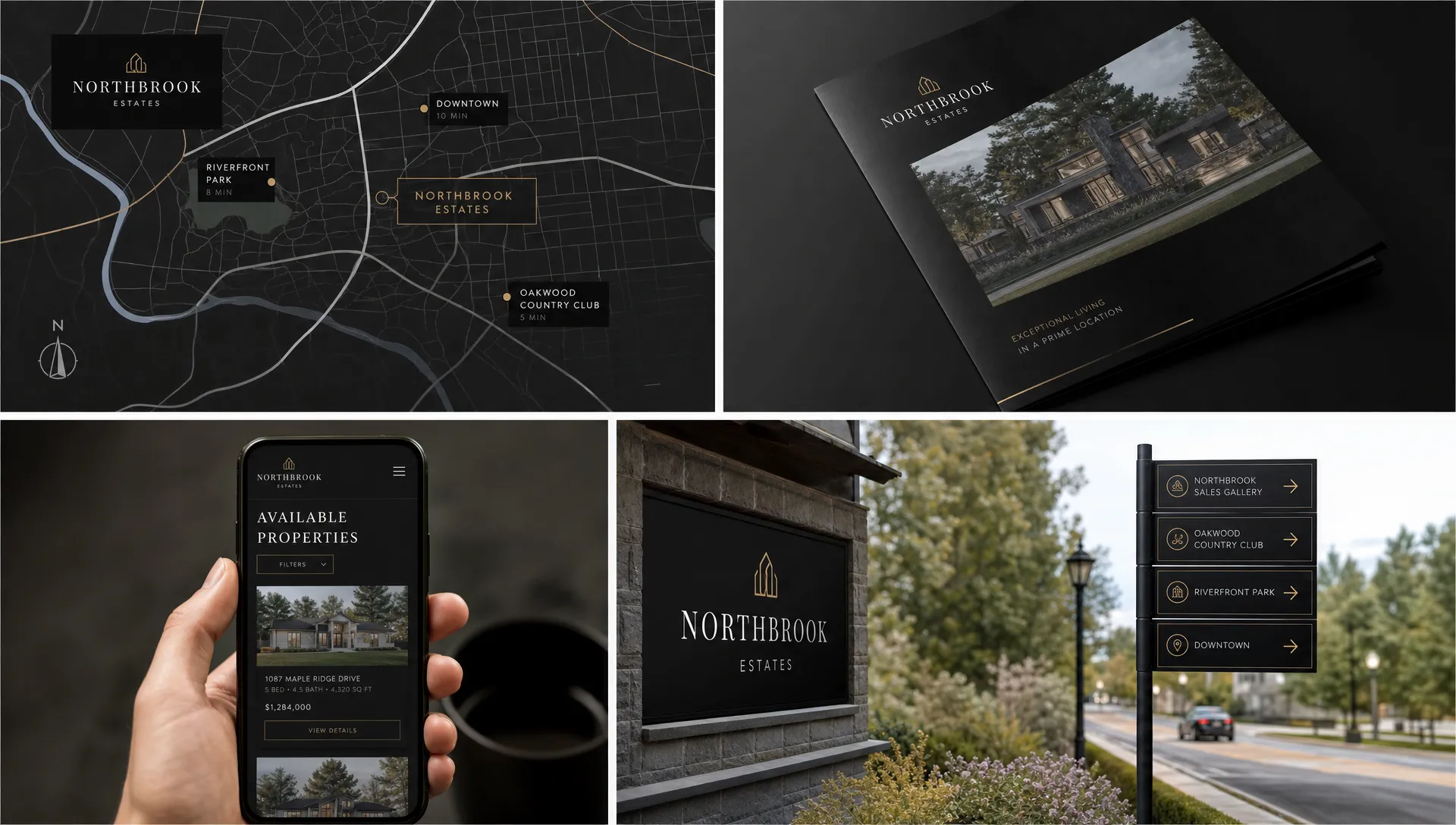
A real estate identity should feel rooted without becoming a postcard cliché. Too many brands lean on the same visual shortcuts: skyline silhouettes, roof icons, gold accents, aerial drone shots and vague lifestyle imagery. These elements can look professional, but they rarely create distinction.
A stronger identity system translates local insight into choices people can feel. Typography, color, photography, motion, signage and layout should all support the same strategic idea.
For example, a developer restoring historic buildings might use a restrained identity that respects existing architectural detail. A brokerage focused on young urban buyers might choose a more editorial system that feels clear, direct and mobile-first. A commercial property brand serving relocating companies might prioritize utility, maps, comparison tables and practical clarity over emotional lifestyle imagery.
Good real estate branding balances aspiration with reassurance. If everything looks too luxurious, some audiences assume the brand is inaccessible. If everything looks too functional, the offer may feel commoditized. The right balance depends on the decision being made and the anxiety behind it.
Build messaging that reduces uncertainty
In real estate, confusion erodes trust quickly. People worry about hidden costs, overpromising, local fit, legal complexity, timing, financing and whether they are being pressured into the wrong choice.
Brand messaging should reduce that uncertainty before a sales conversation. This means writing in a way that is specific, plainspoken and useful. Avoid copy that only sells the dream. People also need the route to the dream.
Strong messaging often includes:
- Clear explanations of how the process works
- Honest descriptions of who the property, service or location is best for
- Neighborhood-specific benefits and tradeoffs
- Proof points that support claims without overwhelming the reader
- Consistent language across ads, listings, brochures, websites and sales decks
This is where the brand voice matters. A luxury residential development may need a calm and refined tone, but that does not mean vague. A commercial real estate advisor may need authority, but that does not mean jargon. A property technology platform may need simplicity, but that does not mean sounding generic.
If your brand is already visible across multiple channels, Boil’s perspective on how brands can build trust across every customer touchpoint is especially relevant. In real estate, those touchpoints are not separate moments. They become one continuous trust test.
Make digital experience part of the brand
A real estate website is often the first serious proof of competence. If the experience is slow, confusing or thin on useful detail, the brand promise weakens immediately.
Trust-building digital experiences help people answer practical questions faster. For residential audiences, that may mean filtering by lifestyle needs, explaining local amenities and presenting floorplans with clarity. For commercial audiences, it may mean searchable listings, transparent location details, size filters, pricing context and help comparing options.
For example, businesses exploring workspaces in Malta can use platforms like OfficeSpace.Rent’s office space listings in Malta to compare locations, office types and rental options more efficiently. The lesson for real estate brands is simple: when people can understand their options with less friction, the brand earns credibility before direct contact.
Digital trust also depends on consistency. If the ad promises local expertise but the landing page is generic, confidence drops. If the brochure feels premium but the mobile listing page is awkward, the brand feels less reliable. If the sales deck says “transparent” but pricing guidance is missing, the claim becomes fragile.
Use local proof, not performative localism
Local trust cannot be faked for long. Audiences can tell when a brand has only borrowed the language of the neighborhood without understanding its texture.
Performative localism looks like generic community phrases, stock photography and shallow references to landmarks. Real local proof is more grounded. It shows how the brand understands the rhythms, concerns and ambitions of the area.
For a residential project, proof might include how the design responds to surrounding streets, local transport, green space or the needs of families, renters or downsizers. For a brokerage, it might include neighborhood guides written from real transaction experience, not keyword templates. For a commercial property brand, it might include guidance on business districts, commuting patterns, parking, building classes and lease considerations.
The strongest proof often comes from showing your work. Explain why a site was chosen. Explain who a property is not right for. Explain what buyers should compare before deciding. This kind of honesty can feel commercially risky, but it builds the trust that leads to better-fit inquiries.
Align the brand with the sales experience
A real estate brand can lose credibility at the handoff from marketing to sales. The website may feel polished, the campaign may be compelling and the brochure may be beautifully designed, but if the first call feels pushy or uninformed, the brand promise collapses.
Sales teams need more than a logo deck. They need messaging tools, objection handling, proof points and a shared understanding of what the brand stands for. If the brand position is “clear guidance in a complex market,” every sales conversation should feel clear and helpful. If the position is “deep local expertise,” the team should be able to speak in specifics, not generalities.
This alignment is especially important for challenger brands. You may not have the biggest media budget or the longest history in the area, so every interaction has to work harder. Consistency becomes a growth asset.
Adapt the strategy by real estate business model
“Real estate brand” can mean many things. A developer, brokerage, property manager, commercial advisor and proptech platform all need trust, but they earn it in different ways.
| Business type | Main trust barrier | Branding focus |
|---|---|---|
| Residential developer | Fear of overpromising, disruption or poor delivery | Vision, planning context, delivery credibility, community benefit |
| Brokerage or agency | Skepticism about advice, fees and incentives | Local expertise, advisor credibility, transparent process |
| Commercial real estate firm | Complexity, cost uncertainty and location risk | Market guidance, comparison clarity, negotiation support |
| Property management company | Concern about responsiveness and accountability | Service standards, resident experience, issue resolution |
| Proptech platform | Doubt about accuracy, adoption and usefulness | Product clarity, data quality, user confidence, support |
A brand strategy that ignores these differences will become too broad. The right work begins by identifying the decision-maker, the risk they feel and the proof they need to move forward.
Measure whether your brand is earning trust
Trust can feel intangible, but there are signals that show whether the brand is becoming more credible in the market. These signals should be reviewed alongside sales metrics, not separately from them.
| Trust signal | What it may indicate |
|---|---|
| More branded search | People remember the brand and seek it directly |
| Higher inquiry quality | Messaging is attracting better-fit prospects |
| Stronger local page engagement | Neighborhood content is answering real questions |
| Better review sentiment | The experience matches the promise |
| More referrals | Customers are confident recommending the brand |
| Shorter sales conversations on basics | Digital content is reducing uncertainty earlier |
Do not measure brand only by awareness. A real estate brand can be known and still not trusted. The more useful question is whether the right people believe you can help them make a better property decision.
Know when a rebrand is the right move
Not every real estate company needs a full rebrand. Sometimes the problem is a weak website, unclear messaging or inconsistent sales materials. But a deeper brand shift may be needed when the business has outgrown its original market position.
Common triggers include entering a new region, moving from small projects to larger developments, shifting from residential to mixed-use or commercial, consolidating multiple brands after growth or needing to repair trust after a period of poor perception.
In those moments, the work should not start with “what should we look like?” It should start with diagnosis. What has changed in the business? What does the market currently believe? Which audiences matter most now? What should remain familiar and what needs to change? Boil’s view of the creative branding agency process is built around that movement from insight to identity, which is especially important in trust-sensitive categories like real estate.
What to look for in a real estate branding partner
Real estate branding needs a mix of strategic, commercial and creative judgment. The right partner should understand that a brand has to perform in investor decks, planning conversations, listing pages, signage, social content, sales scripts and post-inquiry follow-up.
Look for a partner that can connect positioning to go-to-market, not just identity design. Ask how they uncover local insight, how they define trust barriers, how they pressure-test messaging and how they help internal teams use the brand after launch.
If you are comparing agencies, the broader guidance in Boil’s article on what growing companies prioritize in a business branding agency can help you separate strategic value from surface-level polish.
Frequently Asked Questions
What is real estate branding? Real estate branding is the strategic and creative system that shapes how a property company, developer, brokerage or platform is recognized and trusted. It includes positioning, messaging, identity, digital experience, sales materials and the proof used to support claims.
Why is local trust so important in real estate? Real estate decisions involve location, money, risk and long-term consequences. People need to believe a brand understands the local market and will guide them honestly through tradeoffs, not just sell them an attractive property.
How can a real estate brand stand out in a crowded market? The strongest way to stand out is to own a specific trust position. Instead of making generic claims about expertise or quality, define the audience you serve, the local problem you solve and the evidence that proves your value.
When should a real estate company hire a branding agency? A real estate company should consider hiring a branding agency when entering a new market, launching a major project, repositioning after growth, improving inconsistent touchpoints or trying to build stronger trust with buyers, tenants, investors or communities.
Build a real estate brand people trust before they inquire
Local trust is not created by one campaign or one visual identity. It is built through clear positioning, useful information, consistent experiences and proof that your brand understands the decisions people are trying to make.
Boil helps ambitious brands grow through branding, go-to-market strategy and digital experiences designed for challengers. If your real estate brand needs to earn trust in a competitive local market, start the conversation with Boil.
