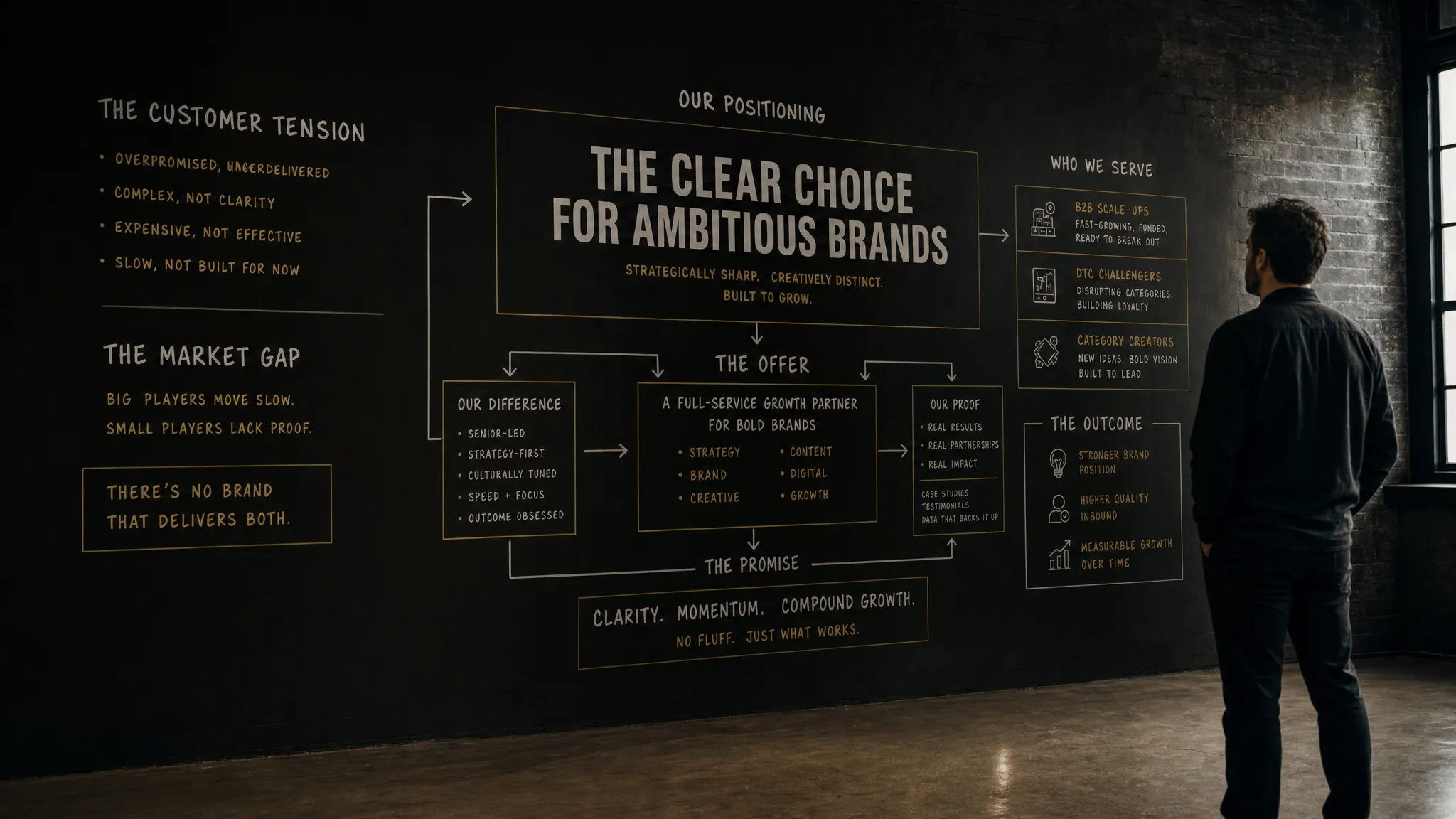
Branding your business for growth does not start with a logo, a color palette, or a clever tagline. Those things matter, but only after you know what your brand needs to do commercially.
For a challenger brand, branding has a job: make the business easier to understand, easier to remember, and easier to choose. If your audience cannot quickly explain who you are for, what you help them overcome, and why you are the better bet, your brand is slowing growth instead of supporting it.
The best place to start is not with aesthetics. It is with focus. Focus on the market you want to win first. Focus on the customer tension you can own. Focus on the proof that makes your promise believable. From there, identity, messaging, website, and go-to-market activity can work as one system.
Start with the growth problem, not the brand assets
Before you brief a designer, workshop a name, or rewrite your homepage, define the growth problem you are trying to solve. Different business problems require different branding decisions.
A startup preparing for launch needs clarity, credibility, and a brand that can make a new offer understandable fast. A scale-up entering a new market may need sharper positioning and a more mature identity to win bigger customers. An established business losing relevance may need a refresh or rebrand to reconnect with the market.
Ask one simple question first: what should branding help us achieve in the next 12 to 24 months?
Your answer might be:
- Increase conversion on the website by making the offer clearer.
- Move upmarket and build trust with larger buyers.
- Enter a new category or geography with confidence.
- Differentiate from competitors that all sound the same.
- Align internal teams around one story, one promise, and one direction.
- Improve pricing power by shifting perception from commodity to specialist.
This prevents branding from becoming a subjective taste exercise. The question is not “Do we like it?” The question is “Will this help the business grow in the direction we have chosen?”
Diagnose what the market already believes
Branding your business without understanding current perception is risky. You may throw away valuable equity, double down on a message nobody cares about, or solve a problem that only exists internally.
A useful diagnosis does not need to take months. Start by gathering evidence from the places where the market already speaks:
- Sales calls and lost-deal notes.
- Customer interviews and onboarding conversations.
- Website analytics and search queries.
- Reviews, testimonials, and support tickets.
- Competitor websites, ads, and category language.
- Internal interviews with leadership, sales, marketing, product, and customer success.
Look for patterns. What do customers thank you for? What do prospects misunderstand? Where do competitors all use the same claims? Which words do customers use that your brand never uses? Which objections appear again and again?
Strong brands are built on market truth, not internal assumptions. That is especially important for challengers, because they often cannot outspend larger competitors. They need to out-position them.

Choose the customer you need to win first
One of the biggest branding mistakes is trying to appeal to everyone. It feels safer, but it usually creates a brand nobody remembers.
Growth starts with a sharper audience. Not every possible customer. Not every segment that could buy. The first audience should be the group where three things overlap: the problem is urgent, your solution is credible, and the commercial opportunity is meaningful.
This is where many challenger brands have an advantage. They can choose a beachhead that incumbents ignore, underserve, or treat as too small. A focused brand can speak with more relevance, build faster proof, and win trust before expanding.
For example, a technical B2B company does not need to sound like every industrial supplier in its category. A specialist such as a custom shafts and rollers manufacturer can build a stronger growth story by making its precision, quality controls, repair expertise, and industry-specific know-how easier for the right buyers to recognize.
That same principle applies across sectors. If you are a fintech, health brand, SaaS platform, construction firm, or consumer challenger, your first brand decision is not visual. It is strategic: who are we trying to become the obvious choice for?
Define the position you want to own
Positioning is the strategic core of branding your business for growth. It defines the space you want to occupy in the customer’s mind, relative to alternatives.
A good position is not just a category label. “We are a software platform,” “we are a design studio,” or “we are a sustainable product brand” is rarely enough. A growth-ready position should make a choice clear.
At minimum, it should answer:
- Who are we for?
- What urgent problem or ambition do we address?
- What do we believe that others in the market overlook?
- What makes our approach meaningfully different?
- What proof makes that difference believable?
This is where challenger brands can create momentum. Instead of claiming to be “better,” they can frame the market differently. They can challenge an outdated habit, expose a hidden cost, or name a new way forward.
For a deeper dive into this specific layer, Boil’s guide to brand market position explains how to own a niche before trying to broaden your reach.
Turn strategy into a message people can repeat
A brand strategy only creates growth if people can understand it and repeat it. That includes customers, sales teams, investors, partners, employees, and the market at large.
Your messaging should translate the strategy into clear, usable language. Avoid turning it into a deck that sits in a folder. Build a message system your team can actually deploy.
A practical message system includes:
- A one-line explanation of what you do.
- A sharp promise that connects to customer value.
- A point of view on what is broken or changing in the market.
- Three to five proof points that support the promise.
- A small set of signature phrases your brand can consistently own.
- Clear language for different audience segments, use cases, or buying stages.
The best test is simple: can someone outside your company explain your brand after 30 seconds on your website? If not, the message is still too complex.
Clarity does not mean being boring. In fact, clear brands have more room to be distinctive because the audience understands the idea quickly. Once the idea lands, your tone, story, and design can make it memorable.
Build proof before you over-polish
Many companies try to look bigger before they have made their promise believable. The result is a polished brand that feels generic, vague, or overproduced.
Growth branding needs proof. Proof reduces perceived risk. It helps buyers believe that the promise is not just marketing language.
Proof can take many forms:
- Customer results and measurable outcomes.
- Case studies and before-after examples.
- Product demonstrations or interactive experiences.
- Certifications, patents, partnerships, or expert credentials.
- Founder expertise or team credibility.
- Clear explanations of your process, methodology, or standards.
For challenger brands, proof is often more powerful than big-budget awareness. A smaller brand can win serious consideration if it shows why its approach works, who it works for, and what changes because of it.
This is also where brand and go-to-market should meet. If sales needs trust signals, the website should surface them. If paid media needs a stronger hook, messaging should sharpen it. If investors need a category story, positioning should support it.
Create a distinctive identity system, not just a logo
Visual identity matters, but not because a logo alone will drive growth. It matters because people need consistent signals to recognize and remember you across touchpoints.
A useful identity system includes more than the mark. It covers typography, color, imagery, layout, motion, iconography, data visualization, UI patterns, presentation templates, social assets, and campaign rules. The goal is to create a system that can scale without becoming chaotic.
Distinctiveness is the key. If your brand could swap colors and fonts with three competitors and nobody would notice, your identity is not working hard enough.
At the same time, distinctiveness must serve the strategy. A bold identity for the sake of boldness can become noise. A minimal identity for the sake of looking premium can become invisible. The best design choices express the position you want to own.
This is why branding your business for growth requires strategy and creativity together. Strategy decides what needs to be remembered. Design makes it impossible to ignore.
Make your website the central brand experience
For many growing companies, the website is the place where brand strategy either becomes useful or falls apart. It is where positioning, story, proof, UX, and conversion meet.
A growth-ready website should quickly answer four questions:
- Am I in the right place?
- Do they understand my problem or ambition?
- Why should I believe this brand over alternatives?
- What should I do next?
This is not just a copywriting issue. It affects page structure, navigation, calls to action, product explanation, case study hierarchy, visual proof, and performance. A beautiful website that hides the offer is not a growth asset. A conversion-focused website with no distinctive brand memory is also incomplete.
Think of the website as your brand’s operating environment. It should help buyers move from attention to understanding, from understanding to trust, and from trust to action.
Connect branding to go-to-market from day one
Branding and go-to-market should not happen in separate rooms. If brand strategy says one thing and campaigns say another, the market receives noise.
Your brand should shape your go-to-market choices, including which audiences you prioritize, which channels you test, which messages you lead with, and which proof points you bring forward. In return, go-to-market data should improve the brand by revealing what people actually respond to.
This feedback loop is essential. Brand strategy gives your team a clear hypothesis about how you should win. Go-to-market activity tests that hypothesis in the real world.
Useful signals include:
- Which homepage messages increase engagement or conversion.
- Which campaign hooks attract qualified leads rather than empty traffic.
- Which sales narratives create faster understanding.
- Which objections keep appearing despite the new message.
- Which proof points are most often mentioned by customers.
If you are planning a launch or market entry, read Boil’s guide to go-to-market mistakes to avoid treating launch as a one-time announcement instead of a learning system.
Measure brand growth with practical signals
Not every brand metric needs an expensive tracker from day one. Start with signals that connect brand work to commercial behavior.
For early-stage and scaling teams, useful metrics include direct traffic, branded search, conversion rate, sales cycle quality, demo-to-close rate, qualified pipeline, win-loss themes, referral volume, share of search, customer recall, and consistency of message adoption across the team.
You can also track internal alignment. Can sales explain the position clearly? Can leadership use the same story in investor conversations? Can marketing produce content faster because the message system is defined? Can product teams make better experience decisions because the brand promise is clear?
Branding drives growth when it reduces friction. It reduces friction in understanding, trust, choice, sales, hiring, and expansion. Measure those areas, and branding becomes far easier to defend as a business investment.
A simple starting framework for branding your business
If you are unsure where to begin, build a one-page brand growth brief. Keep it practical. It should be clear enough for leadership to approve and useful enough for marketing, sales, design, and product teams to apply.
Include these elements:
- Growth objective: What commercial result should the brand support?
- Priority audience: Who must we win first?
- Customer tension: What problem, frustration, or ambition creates urgency?
- Market belief: What does the category assume that we challenge?
- Brand promise: What valuable outcome do we help customers achieve?
- Differentiation: What makes our approach meaningfully different?
- Proof: What evidence makes the promise credible?
- Personality: How should the brand sound and feel?
- Activation: Where must the brand show up first to influence growth?
This brief does not replace a full brand strategy, but it gives you a strong starting point. More importantly, it forces the right conversations before your team jumps into design execution.
Common mistakes to avoid
The fastest way to waste a branding investment is to treat it as decoration. The second fastest is to chase consensus until the brand becomes safe, broad, and forgettable.
Watch for these traps:
- Starting with visual preferences instead of business needs.
- Targeting too many audiences at once.
- Copying category language because it feels familiar.
- Making bold claims without proof.
- Building a beautiful identity that teams cannot use.
- Launching the brand without aligning sales, marketing, product, and leadership.
- Measuring only awareness while ignoring conversion, trust, and message adoption.
Branding your business for growth means making choices. You will not be equally relevant to everyone. You will not sound like every competitor. You will not keep every legacy asset if it no longer supports the future. That is the point.
Frequently Asked Questions
What is the first step in branding your business? The first step is defining the growth problem your brand needs to solve. Before designing assets, clarify your target audience, positioning, promise, differentiation, and proof.
Do I need a full rebrand or just better messaging? Not always. If your strategy is still strong but your communication is unclear, messaging and website improvements may be enough. If your audience, market, offer, or business direction has changed, a deeper rebrand may be needed.
How long does business branding take? It depends on scope. A focused positioning and messaging sprint can happen quickly, while a full brand strategy, identity system, website, and launch plan usually takes longer because it involves more decisions and implementation.
Can branding help sales performance? Yes, when it improves clarity, trust, and differentiation. Strong branding can help prospects understand the offer faster, reduce perceived risk, and give sales teams a more compelling story to use in conversations.
Should branding come before go-to-market? Branding and go-to-market should be developed together. Brand defines the promise and position, while go-to-market tests how that promise performs with real audiences, channels, and buying situations.
Ready to turn brand into growth?
If your brand feels unclear, inconsistent, or too similar to the competition, the answer is not more noise. It is sharper strategy, stronger creative expression, and a go-to-market plan that turns the brand into commercial momentum.
Boil helps ambitious challenger brands grow market share through branding, rebranding, go-to-market strategy, creative design, web experiences, and digital growth support. If you are ready to make your business easier to understand, remember, and choose, start by challenging what your brand is really built to do next.
