
Most challenger brands don’t fail because their product is weak. They fail because the market never quite “gets it” fast enough, or they look interchangeable next to an incumbent with bigger budgets and more shelf space.
That’s why the “branding firms vs in-house” question is not a resourcing debate, it’s a growth decision. Your choice affects how quickly you can sharpen positioning, translate it into a distinctive identity, and ship a go-to-market that actually lands.
Below is a practical guide to choosing the right model for challenger brands, including the hidden tradeoffs most teams only discover mid-project.
Why this decision is different for challenger brands
Challengers operate with constraints incumbents rarely feel:
- Speed matters more than perfection. You often need a credible market narrative now, not after three quarters of internal alignment.
- Distinctiveness is the whole game. If you are not meaningfully different, you are cheaper, louder, or ignored.
- Focus is fragile. A small leadership team already owns product, fundraising, hiring, sales, and partnerships. Branding work competes with everything.
Boil’s own framing of the challenger mindset centers on boldness, clarity of “why,” and a willingness to take calculated risks. If you want a quick reset on that mental model, start with The Challenger Mindset.
What you are actually “buying” with branding work
Whether you hire a team internally or partner with branding firms, the outputs tend to cluster into a few workstreams:
1) Strategy (the decisions)
Positioning, category point of view, narrative, messaging architecture, brand architecture, and the choices about what you will not be.
2) Identity system (the assets plus rules)
Visual identity, verbal identity, design system, guidelines, templates, and guardrails that help the brand scale without constant debate.
3) Go-to-market translation (the execution)
Website and landing experiences, launch campaigns, sales enablement, product marketing surfaces, and creative that converts.
The best model depends on which of these is your bottleneck right now.
When in-house branding is the better move
In-house tends to win when brand work is ongoing, tightly coupled to product, and requires constant iteration.
In-house is usually best if:
You already have strategic clarity, but you need volume and velocity. For example, your positioning is solid, and the gap is producing consistent, high-quality assets across channels.
You have high brand “throughput.” If your roadmap demands weekly shipping (new pages, lifecycle campaigns, product launches), utilization will be high and an in-house team becomes economical.
Your differentiator lives in deep domain nuance. Some categories have complex language, compliance constraints, or technical truth that is hard to learn quickly from the outside.
You need tight feedback loops with product and sales. In-house teams can sit in the same meetings, hear objections live, and adjust messaging in days, not weeks.
What in-house requires (and many challengers underestimate)
In-house branding is not “hire a designer.” It needs:
- A decision-maker for strategy (brand lead, head of marketing, or founder with real time allocated)
- A system to maintain consistency (templates, guidelines, approvals)
- Cross-functional alignment (sales, product, CS all speak the same story)
Without those, in-house teams often become a production desk, constantly reacting, rarely shaping.
When branding firms are the better move
Branding firms are strongest when you need a step-change, not incremental output.
Branding firms are usually best if:
You are (re)positioning to win a fight you cannot outspend. Challengers often need a sharper “why us, why now” narrative and a clearer opponent (even if you never name them).
You are entering a new market or segment. Market entry is a story problem as much as a distribution problem. You need to quickly learn what people believe today, then reframe it.
You are doing a rebrand with real risk. If you have existing customers, reputation, or SEO equity, the cost of a sloppy rebrand is high. If you are considering it, Boil’s Rebranding Complete Guide is a helpful reference point for scope and pitfalls.
You need objectivity, not internal politics. External teams can say what internal teams cannot, especially when founders disagree or when legacy assumptions have calcified.
You need a multidisciplinary “pod” quickly. Great branding execution today often spans brand strategy, naming, identity, content, web, and go-to-market creative. Building that breadth internally can take months of recruiting.
You want senior pattern recognition. A good firm has seen where positioning fails, where launches stall, and where design systems break under scale.
From an evidence standpoint, design quality is not cosmetic. McKinsey’s research on the “business value of design” links strong design practices with stronger performance and growth outcomes across industries (McKinsey Design). A challenger does not need “pretty,” it needs design that earns attention and reduces friction.
The hidden tradeoffs most teams miss
The biggest mistakes in this decision come from comparing visible costs (agency fee vs salary) instead of total system cost.
The hidden costs of in-house
- Time to hire and ramp (and the opportunity cost of waiting)
- Management overhead (creative direction, reviews, prioritization)
- Gaps in capability (you still outsource naming, motion, web build, or strategy)
- Quality ceiling if you hire too junior too early
The hidden costs of branding firms
- Context load (you must teach the firm your category, product truth, constraints)
- Decision bottlenecks (if your team cannot make calls, the firm cannot move)
- Handover risk if the output is not systematized (guidelines, templates, governance)
The truth for most challengers: the wrong model is the one that creates delays and indecision, because delay is expensive in a market-share race.
The 3 operating models that work best for challengers
You do not have to choose a pure “agency vs in-house” extreme. In practice, these are the models that tend to perform.
1) Firm-led step change, then in-house scale
Use branding firms to define positioning, identity, core messaging, and key experiences. Then transition production and ongoing optimization in-house.
Best for: new category moves, high-stakes rebrands, market entry.
2) In-house core team, firm for specialist spikes
Keep a brand lead and production capability internal, but bring in a firm for a defined spike (naming, repositioning sprint, website overhaul).
Best for: teams shipping constantly that still need occasional senior firepower.
3) Embedded hybrid pod (co-creation)
A firm works alongside your team with shared rituals, shared docs, and fast iteration, rather than “big reveal” presentations.
Best for: challengers who need speed, alignment, and learning loops.
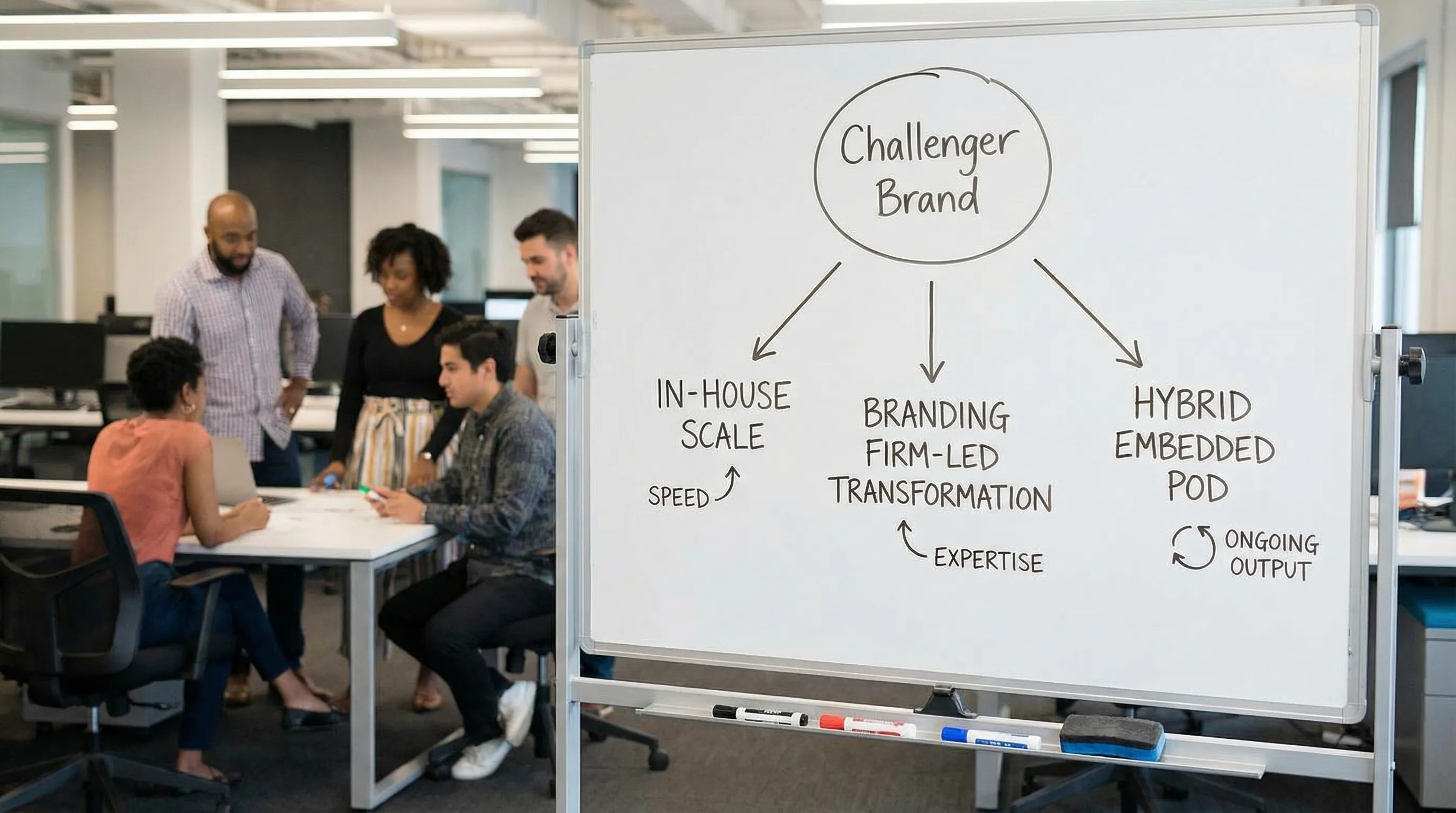
A challenger-grade decision framework (7 questions)
If you want a fast, practical way to decide, answer these honestly.
1) Are you solving for transformation or throughput?
If you need a new story, new category framing, or a new identity, that is transformation. If you need to ship assets weekly, that is throughput.
2) How costly is “getting it wrong”?
If you are changing name, positioning, pricing narrative, or entering a regulated market, the downside risk is higher. That often favors experienced external help.
3) What is your deadline, really?
If you have a funding event, product launch, partnership, or market window, delays can be existential. Firms can compress timelines if you can make decisions quickly.
4) Where is your scarcest leadership attention?
Brand work needs founder and exec time. If leadership bandwidth is low, an in-house team can drift, and a firm can stall. The answer tells you what operating model will actually move.
5) Do you need category design or just better branding?
If you are trying to create a new mental model in the market, you are closer to category design than brand refresh. If that’s your situation, read What is category design? and be realistic about the ambition and effort required.
6) Can you clearly articulate your current assumptions?
Challengers often build on untested beliefs about who will buy, why they will care, and what language will resonate. If assumptions are fuzzy, you need a process that surfaces and tests them. Boil calls this out directly in Avoiding the Assumption Trap.
7) What must be true in 90 days?
Define success as outcomes, not deliverables. Examples:
- Sales calls become easier because prospects understand you in 30 seconds.
- Your conversion rate improves because the website tells a clearer story.
- Your team stops improvising messaging in decks and outbound.
If you cannot define a 90-day “must be true,” do that before choosing a model.
If you choose branding firms: how to pick the right one (without wasting a quarter)
Not all branding firms are built for challengers. Many are optimized for incumbents who need safe consensus and polished identity systems.
Look for these signals.
They can connect brand to go-to-market
Challengers need branding that performs in-market, not branding that wins internal applause. Ask how the firm translates strategy into launch assets, site experiences, and growth execution.
(If you want a deeper breakdown of what a branding agency does and how to evaluate one, see Boil’s Ultimate Creative Branding Agency Guide.)
They show their thinking, not just their portfolio
A portfolio is necessary, but the differentiator is process quality:
- How do they get to positioning decisions?
- How do they handle stakeholder misalignment?
- How do they validate language and creative before a full roll-out?
They are comfortable with boldness and constraint
Challengers need distinctiveness under budget, time, and attention constraints. The firm should be able to explain how they build standout work when you cannot brute-force awareness with media spend.
They set governance up front
Ask what you will receive beyond logos and pages:
- Messaging architecture and usage rules
- Brand guidelines and templates
- A rollout plan with sequencing
Without governance, brand consistency collapses the moment your team gets busy.
If you choose in-house: what to build first
If your conclusion is “we should own this internally,” start by building the capability in the right order.
Start with one accountable owner
A brand cannot be run by committee. Assign an owner who can make calls across strategy, messaging, and identity.
Build a minimum viable brand system
Before hiring five people, lock the foundations:
- Positioning and proof points
- Core story and messaging hierarchy
- Simple design rules and templates
Then hire for momentum, not perfection
Early in-house teams often benefit from:
- A senior brand generalist who can do strategy and direction
- A designer who can ship across web and marketing surfaces
- Flexible specialist support (freelance motion, copy, dev) as needed
Make either model work: a simple execution playbook
Most “agency failures” and “in-house failures” are the same failure: unclear decisions and untested assumptions.
Align on decisions, not deliverables
Define what must be decided in the project:
- Category frame and point of view
- Primary audience and beachhead
- Positioning statement and key claims
- Tone of voice and proof
Build feedback loops that reduce opinion
Brand is emotional, but you can still reduce subjectivity:
- Use customer conversations and sales call insights
- Run small-scale message tests before scaling
- Track what objections disappear after new messaging lands
Boil’s go-to-market mistakes guide is a good checklist for avoiding launch activities that look busy but do not create traction.
Plan the rollout like a product launch
Even a brilliant rebrand can fail if the rollout is confusing. Sequence it, communicate it, and ensure your team can explain the change simply.
The decision in one sentence
- Choose in-house when brand is an always-on production and iteration engine.
- Choose branding firms when you need a step-change in positioning, identity, or market entry speed.
- Choose a hybrid when you need both.
If you’re a challenger brand and you want a clear recommendation based on your stage, market, and growth goals, explore Boil’s approach to brand and go-to-market work at boil.agency and decide which model will get you to market with clarity fastest.
