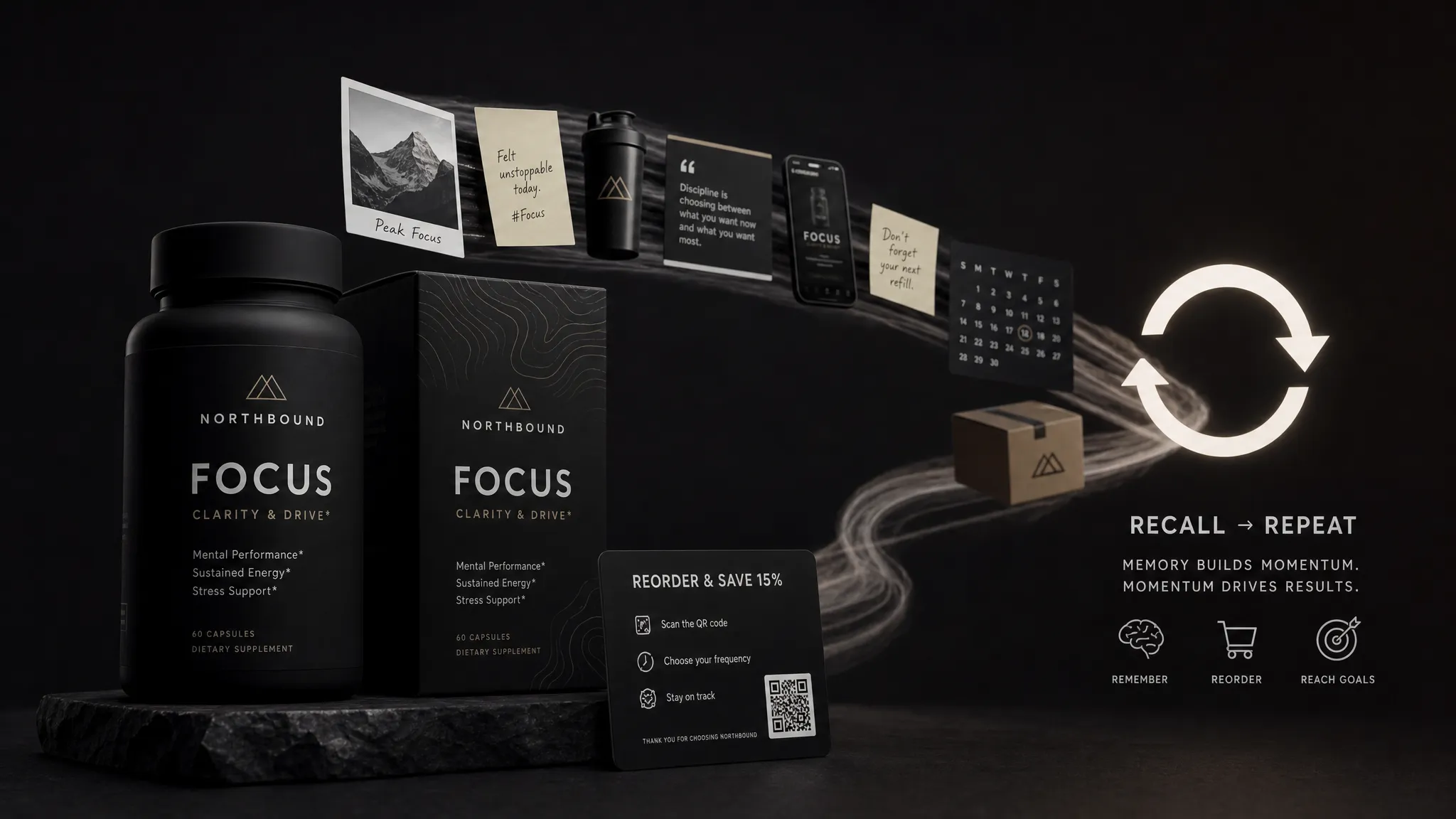
Most B2C brands are not ignored because consumers have carefully rejected them. They are ignored because people are busy, categories are crowded, and buying moments arrive before a brand has earned a place in memory.
That is the real job of B2C branding: make a brand easier to notice, easier to remember, easier to trust, and easier to choose again. For challenger brands, this matters more than ever. You rarely have the media budget of the market leader, so your brand has to work harder at every touchpoint.
Strong B2C branding does not stop at awareness. Awareness can create a first purchase, but repeat purchase is where brand equity turns into growth. If people remember you but do not return, the promise is broken. If people return but nobody new remembers you, growth hits a ceiling.
Why recall and repeat purchase belong together
B2C teams often separate brand and retention. Brand teams worry about recognition, emotion, identity and fame. Growth teams worry about conversion, repeat purchase, lifecycle flows and CAC. Customers do not experience those things separately.
A buyer sees an ad, notices the pack, visits the website, reads a review, makes a purchase, opens the product, receives an email and decides whether to come back. Every one of those moments either strengthens the same memory or weakens it.
Brand recall gives you a chance to be considered when a buying need appears. Repeat purchase proves that the experience was worth remembering. Together, they create a compounding loop: memory drives trial, trial confirms meaning, meaning makes the next choice easier.
This is especially important in consumer categories where switching costs are low. A shopper can choose another drink, app, supplement, skincare product, pet food, training program or fintech tool in seconds. B2C branding has to reduce that friction by making the brand feel familiar and the next purchase feel obvious.
The real competitor is forgetting
Your direct competitors are only part of the battle. The larger threat is that buyers do not think of you at all.
Most consumer decisions are not deep research projects. People rely on shortcuts: colors, names, remembered phrases, packaging shapes, recommendations, habits and past experiences. Brand growth research often describes this as mental availability, the likelihood that a brand comes to mind in relevant buying situations.
For B2C brands, mental availability is built by connecting your brand to category entry points. These are the real-life moments that trigger demand. A person does not wake up wanting a brand strategy. They want to feed the dog before a hike, fix dry skin before a meeting, send money faster, find a healthier lunch, or buy a gift that does not feel generic.
If your brand is not linked to those moments, it may be admired but not chosen.

Start with category entry points, not generic awareness
A vague goal like build more awareness is not enough. Awareness of what? For whom? In which situation? Against which alternative?
The sharper your answer, the more efficient your brand becomes. Challenger brands should begin with a small number of high-value category entry points, then build memory around those moments before expanding.
Useful questions include:
- When does the customer realize they need a solution?
- What frustration, aspiration or trigger starts the buying journey?
- What would they search, say or ask a friend in that moment?
- What current alternative are they most likely to default to?
- What proof would make switching feel safe?
This is where positioning matters. If your category entry point is too broad, your message becomes generic. If it is too narrow, your growth potential may be limited. The goal is to find a beachhead that is specific enough to win and meaningful enough to scale.
For a deeper positioning lens, Boil's guide to owning your niche with brand market position explains how challenger brands can choose a space where they can become easier to understand, remember and choose.
Build distinctive assets buyers can recognize in seconds
Distinctiveness is not decoration. It is memory infrastructure.
A distinctive asset is any brand cue that helps people recognize you before they have processed the full message. It can be visual, verbal, sonic, behavioral or experiential. Over time, these cues become shortcuts. The buyer does not need to re-evaluate from zero because the brand already feels known.
Common distinctive assets include:
- A recognizable color combination or visual world
- A packaging shape, layout or product form
- A memorable name, tagline or phrase
- A character, founder, mascot or spokesperson
- A repeatable social content format
- A sound, motion style or interaction pattern
- A ritual around use, unboxing, onboarding or replenishment
The mistake many B2C brands make is refreshing these assets too often. They get bored internally before the market has even noticed. For a small brand, repetition can feel uncomfortable. For the buyer, repetition is how memory forms.
Before changing a brand asset, ask three questions. Do people notice it? Do they correctly attribute it to us? Does it link to a buying moment we want to own? If the answer is yes, protect it. If the answer is no, improve or replace it with discipline.
Make the promise simple enough to repeat
A B2C brand promise should pass the friend test. Can a customer explain what you do and why it matters in one sentence?
Simple does not mean shallow. It means the brand has translated complexity into an idea people can carry. Strong consumer promises usually connect three things: a recognizable tension, a desired outcome and a credible reason to believe.
A skincare brand might not simply sell ingredients. It helps sensitive skin feel calm before the moments when confidence matters. A dog food brand might not simply sell protein. It helps adventurous owners feed dogs in a way that matches their values. A savings app might not simply offer features. It helps people feel in control of money without becoming finance experts.
A useful example comes from fitness and nutrition, where a broad promise like get healthier is easy to ignore. A service can become more memorable by sharpening the value around expert guidance and access, as Kickoff does with personal training and nutrition coaching covered by insurance. The point is not that every brand needs an insurance angle. It is that the promise connects a desired outcome with a concrete barrier removed.
For challenger brands, this is often the unlock. You do not need to describe everything you do. You need to make the most valuable part of your difference easy to remember and easy to repeat.
Translate recall into repeat purchase
Recall creates the opportunity. Experience earns the second purchase.
Many consumer brands overinvest in the first transaction and underinvest in what happens next. They optimize ads, landing pages and launch campaigns, but the post-purchase experience feels disconnected from the promise that won the customer in the first place.
Repeat purchase is not only a retention tactic. It is a brand outcome. People come back when the experience confirms the story they bought into.
That means the brand must show up after conversion in practical ways:
- The onboarding should remind customers why they made the choice.
- The product experience should deliver the promised feeling quickly.
- Packaging and instructions should reduce effort, not add confusion.
- Lifecycle messages should reinforce value, not only push discounts.
- Support should sound like the brand, especially when something goes wrong.
- Replenishment or upgrade moments should feel helpful, not manipulative.
Do not confuse repeat purchase with lock-in. A subscription that is hard to cancel may improve short-term numbers, but it does not create genuine loyalty. Real repeat purchase happens when customers feel that coming back is the easiest way to get the outcome they wanted.
Design the second purchase before the first campaign
If repeat purchase matters, it should be designed before acquisition spend scales.
The best time to plan for the second purchase is not after you have thousands of first-time customers. It is when you are defining the brand experience. What should a customer understand within the first minute, first day, first week and first reorder window? What behavior signals that they are getting value? What message helps them move from trial to habit?
For a consumable brand, the second purchase may depend on timing, reminders and proof that the product has become part of a routine. For an app, it may depend on activation moments and useful nudges. For a service, it may depend on visible progress and confidence that the customer is not alone.
Your brand identity should support these moments. The tone of voice, visual system and messaging hierarchy should make continuity feel natural. A customer should not feel like they bought from one brand and then received emails from another.
This is why branding and marketing alignment matters. If the acquisition promise, website experience and retention flow do not reinforce each other, you are paying to create memory and then paying again to repair it. Boil's branding and marketing alignment framework is built around this exact challenge: connecting promise, proof, path and performance.
A practical framework: recall, reassure, repeat
B2C branding becomes easier to manage when you treat it as an operating system, not a campaign. A simple way to structure the work is recall, reassure, repeat.
Recall
Recall is about becoming easy to think of in the right moments. This starts with positioning, category entry points and distinctive assets. The brand needs consistent cues that appear across paid media, organic content, packaging, website, retail, product and post-purchase communication.
The goal is not to make every touchpoint identical. It is to make every touchpoint recognizably yours.
Reassure
Reassurance is what helps someone move from memory to action. In B2C, the buyer may not need a complex sales process, but they still need confidence. That confidence comes from proof: reviews, transparent claims, product demonstrations, founder credibility, guarantees, certifications, user stories and clear pricing.
Reassurance is especially important for challenger brands because the buyer may be asking an invisible question: why should I choose you instead of the brand I already know?
Repeat
Repeat is where brand meaning becomes behavior. This includes the product experience, customer service, lifecycle communication, community, loyalty mechanics and the small rituals that make usage stick.
A good repeat system does not rely only on promotions. Discounts may trigger another purchase, but they rarely build brand preference by themselves. The stronger play is to reinforce the value customers already experienced and make the next step feel timely, useful and on-brand.
How digital B2C brands build memory across touchpoints
For digital-first B2C brands, the website, app, paid ads, social content, emails and support experience are all part of the brand. Customers do not care which team owns which channel. They only notice whether the experience feels coherent.
Paid social should encode distinctive assets quickly. The first seconds need to signal the brand, the buying situation and the core promise before the viewer scrolls. Your homepage should then repeat that promise with more proof, not introduce an entirely different story.
Email and SMS should not become a separate discount channel with a different personality. They should extend the same brand voice into useful reminders, progress cues, replenishment moments and customer education. If the brand is confident and simple in ads but cluttered and desperate in retention flows, the memory fragments.
Digital product experiences matter too. A consumer app, booking journey or account area can either strengthen trust or erode it. For challenger brands, trust is often won through small acts of clarity: fast loading pages, transparent claims, accessible design, clean navigation and language that respects the user's time.
Boil's article on how a digital branding agency builds trust across touchpoints explores this in more detail for teams trying to turn digital consistency into growth.
What challenger brands should do differently
Market leaders can afford a certain amount of waste. Challenger brands cannot. That does not mean challengers should play small. It means they should make sharper choices.
A challenger B2C brand should not try to be remembered for everything. It should aim to be unforgettable for something specific. That might be a belief, a use case, a design cue, a customer identity, a distribution model, a product ritual or a category point of view.
The advantage of a challenger is focus. You can choose a customer tension the incumbent underestimates. You can create a more human experience. You can use language the category avoids. You can make the buyer feel seen before the bigger brand has even noticed the shift.
This is also where category thinking can help, when appropriate. Not every consumer brand needs to create a new category, but many need to reframe the buying choice. If the market compares you on the wrong terms, your brand has to teach people what to value.
The practical challenge is to turn that point of view into assets, messages and experiences that repeat. A bold manifesto is not enough. Memory is built when the same strategic idea appears in the product name, packaging, website, ads, onboarding, support and repeat purchase journey.
Metrics that show B2C branding is working
Brand performance should not be measured only by campaign reach or social engagement. Those can be useful signals, but they do not prove that the brand is becoming easier to buy or easier to buy again.
A healthier measurement system combines brand, behavior and commercial metrics. Track the signals that show whether people remember you, trust you and return.
Useful metrics include:
- Unaided recall for the category entry points you want to own
- Aided awareness and consideration among priority segments
- Distinctive asset recognition and correct brand attribution
- Branded search volume and direct traffic quality
- Conversion rate from first visit to first purchase
- First-to-second purchase conversion
- Repeat purchase rate and returning customer revenue share
- Time between purchases or replenishment cycles
- Review language, referral reasons and customer support themes
The most important point is not to treat brand metrics and revenue metrics as enemies. Brand creates future demand. Performance captures available demand. Retention proves the experience has value. If you only optimize for last-click sales, you may miss the memory system that makes future sales cheaper and more resilient.
Common mistakes that weaken recall and repeat purchase
Many B2C brands do not fail because their ideas are weak. They fail because the brand system is inconsistent, overcomplicated or disconnected from the customer experience.
Watch for these mistakes:
- Changing visual assets before the market has learned them
- Using a broad purpose statement instead of a clear buying promise
- Treating packaging, website, social and lifecycle as separate worlds
- Building loyalty around discounts rather than value and identity
- Measuring awareness without linking it to category entry points
- Overloading customers with product features instead of memorable meaning
- Letting performance marketing rewrite the brand voice every month
The cure is not rigid consistency for its own sake. The cure is disciplined coherence. Every expression should feel alive in its channel, but rooted in the same strategic idea.
A 90-day plan to improve B2C recall and repeat
You do not need to rebuild the entire brand to start improving recall and repeat purchase. A focused 90-day sprint can reveal where memory is being built, where it is leaking and which changes matter most.
- Weeks 1 to 2: Audit the current memory system. Review ads, website, packaging, product, emails, social content and support scripts. Identify which cues repeat, which promises conflict and which assets are not distinctive enough.
- Weeks 3 to 4: Define priority category entry points. Choose the buying situations you want to own first. Use customer interviews, reviews, search data, sales feedback and social listening to understand how people describe the need.
- Weeks 5 to 7: Sharpen the promise and asset system. Simplify the core message, decide which distinctive assets to protect, and create rules for how they show up across acquisition and retention.
- Weeks 8 to 10: Redesign the post-purchase journey. Improve onboarding, first-use communication, support language, replenishment prompts and second-purchase triggers so they reinforce the same promise.
- Weeks 11 to 12: Measure and iterate. Track asset recognition, conversion, repeat purchase, review language and branded demand. Keep what strengthens memory and remove what creates friction or confusion.
This sprint can be run inside a larger rebrand, but it is also useful for brands that are not ready for a full reset. Sometimes the fastest growth comes from making the existing brand easier to remember and easier to buy again.
Frequently Asked Questions
What is B2C branding? B2C branding is the strategy and system that makes a consumer brand recognizable, meaningful and easier to choose. It includes positioning, messaging, visual identity, tone of voice, packaging, digital experience and post-purchase communication.
How does B2C branding improve repeat purchase? It sets a clear expectation before purchase, then reinforces that expectation through the customer experience. When the product, service and communication consistently deliver the promised value, customers have a stronger reason to return.
Which matters more: brand recall or customer loyalty? They work together. Recall helps new and occasional buyers think of you in buying moments. Loyalty and repeat purchase help turn first-time customers into returning revenue. A brand that wants market share needs both.
Can a challenger brand build recall without a huge media budget? Yes, but it needs focus. Challenger brands can build memory by owning specific category entry points, repeating distinctive assets, using sharper language and making every touchpoint reinforce the same idea.
How long does B2C branding take to affect sales? Some effects can appear quickly, such as higher conversion from clearer messaging. Deeper effects like brand recall, branded search and repeat purchase usually build over multiple buying cycles, which is why measurement should include both short-term and long-term signals.
Build a B2C brand people remember and choose again
The strongest B2C brands are not simply seen more often. They are remembered in the right moments and trusted enough to be chosen again.
For challenger brands, that requires more than a good-looking identity. It requires a connected system: sharper positioning, distinctive assets, a repeatable promise, a coherent digital experience and a go-to-market plan that turns memory into behavior.
Boil helps ambitious brands connect branding, rebranding, creative design, digital experience and go-to-market strategy so they can stand out and grow market share. If your brand is being noticed but not remembered, or bought once but not chosen again, it may be time to challenge the system behind it.
Explore how Boil helps challenger brands grow and start building a consumer brand that earns both recall and repeat purchase.
