
A creative agency for startups is worth the investment when unclear positioning, weak execution or an unconvincing customer experience is holding back a credible growth opportunity. It is harder to justify when the business is still guessing who its customers are or needs a better product more than a better presentation.
The decision is not simply whether your startup can afford an agency. It is whether a defined project can remove a commercial bottleneck at a cost your business can absorb. That means looking beyond the portfolio to the opportunity, the alternatives and the conditions under which the investment would pay back.
When a creative agency for startups becomes a sensible investment
Funding rounds and launch dates can create urgency, but neither automatically makes creative work a good investment. The stronger trigger is a gap between what your business can deliver and what prospective customers understand or believe.
Customers want the product, but struggle to understand the offer
You have evidence of interest: customers buy, pilots progress or qualified prospects engage. Yet sales conversations repeatedly begin with a lengthy explanation of what you do. Your homepage describes features without making the value clear, and different team members tell different stories.
That is a plausible positioning and messaging problem. An agency can help translate customer insight into a sharper proposition and carry it through the website, sales materials and launch creative.
Hiring a creative agency for startups makes more sense here than commissioning disconnected assets, because the problem affects several customer touchpoints. First, check that confusion really is blocking progress. Lost-deal notes, customer interviews and recorded sales calls are more useful evidence than an internal dislike of the current design.
A launch or market entry needs coordinated execution
Entering a new market often creates several connected demands: adapting the proposition, explaining an unfamiliar product and delivering a credible digital experience. If separate freelancers receive separate briefs, the resulting work can pull in different directions.
An agency becomes valuable when coordination is part of the job, not just production. A positioning decision should inform the landing page, which should support the campaign promise and the sales conversation.
The case is weaker if you only need one clearly specified deliverable. A freelance designer or copywriter may solve that problem with less overhead. Pay for strategic integration only when there is something meaningful to integrate.
Trust is limiting the next customer action
Some purchases require customers to assess risk before they inquire or buy. They need to understand the offer, see relevant evidence and know what happens next. Attractive visuals alone do not answer those questions.
For a cross-category example, Creative Smiles’ cosmetic dentistry website brings treatment information, before-and-after examples and consultation calls to action into the same customer journey. The useful lesson is the relationship between explanation, evidence and a clear next step, not the visual style or any assumed conversion result.
A creative agency for startups can address a similar trust gap by making genuine proof easier to find and the buying process easier to understand. It cannot manufacture credibility that the business has not earned. Customer evidence, accurate claims and a reliable service still need to come from you.
When the investment should wait
Creative work can improve how a proposition reaches the market, but it cannot establish demand on its own. If customer interviews keep overturning your assumptions, a comprehensive identity and website project may lock you into decisions that will soon change.
You do not need to wait for perfect product-market fit. You do need a sufficiently clear hypothesis to brief the work and learn from it. A focused landing page for testing one audience and offer is a different investment from a full brand rollout.
Before hiring a creative agency for startups, identify whether your immediate constraint is communication, product performance, distribution or cash. Spending on the wrong constraint can make the company look more mature without making it more viable.
| Current situation | More proportionate next step |
|---|---|
| The audience and offer change frequently | Customer discovery and lightweight message tests |
| The positioning is clear, but one asset is missing | A specialist freelancer with a defined brief |
| Several launch assets need a shared strategy | A coordinated agency project |
| Creative production is continuous and priorities shift daily | Consider an in-house hire or ongoing external support |
| Customers leave because the product disappoints | Address the product or service problem first |
Runway is a separate test. Even a promising project may be badly timed if paying for it leaves too little cash to launch, distribute and improve the work afterward.
Build the investment case around contribution, not revenue
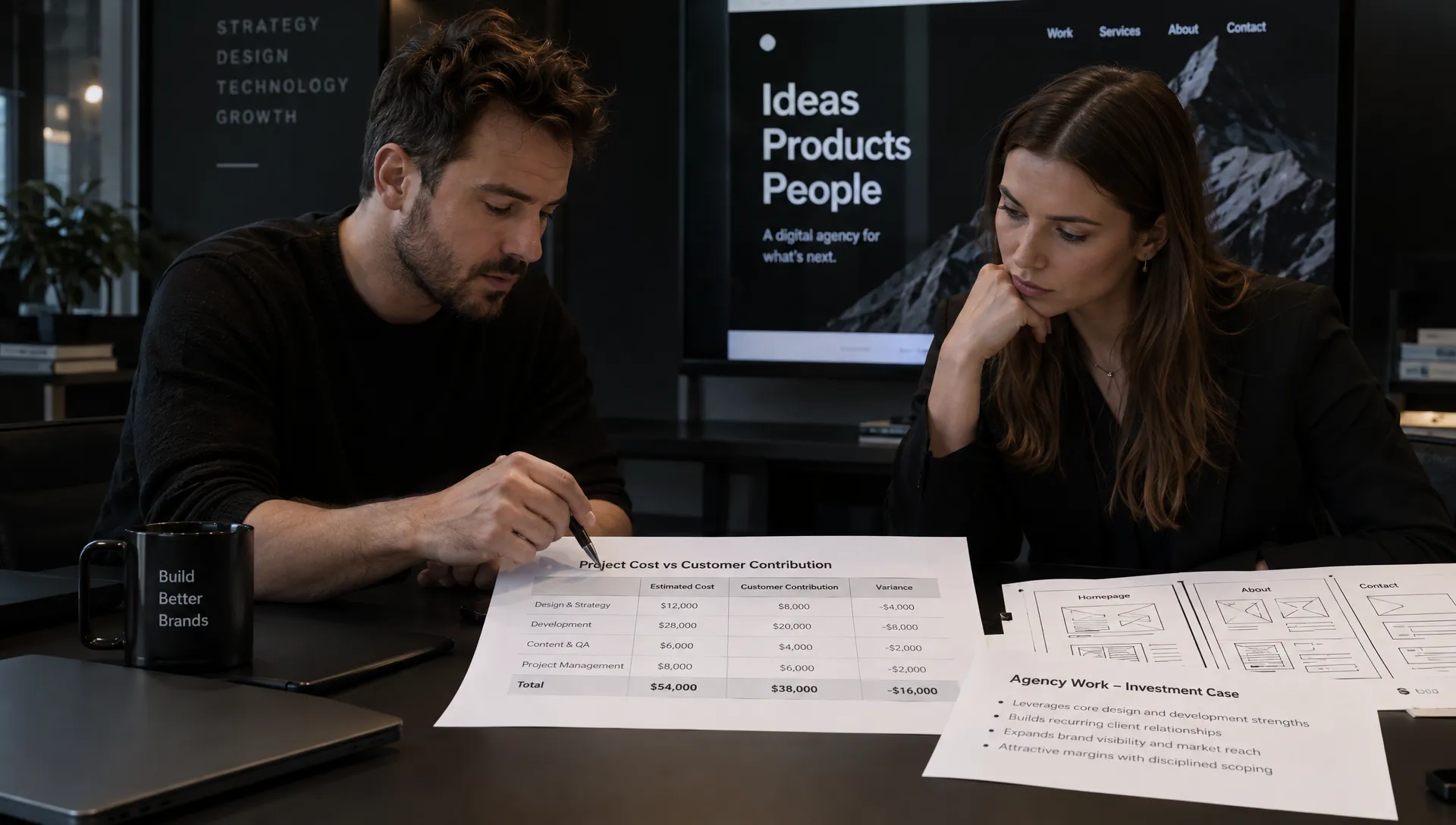
Revenue alone can make a project look more profitable than it is. The relevant question is how much additional contribution the work could generate after the variable costs of serving those customers.
Use a defined period, such as the first 12 months, rather than an optimistic lifetime-value estimate. For a subscription business, account for churn and delivery costs. For a service business, include the labor required to fulfill additional sales.
The investment case for a creative agency for startups should include the agency fee, internal implementation time and any additional launch spending required to make the work useful. Do not count the same expense twice.
Break-even incremental customers = total project cost ÷ contribution per additional customer.
Here is an illustrative calculation, not an agency price quote or performance forecast:
| Input | Illustrative amount |
|---|---|
| Agency project fee | $24,000 |
| Internal implementation and additional rollout costs | $6,000 |
| Total investment | $30,000 |
| First-year contribution per additional customer | $1,500 |
| Additional customers required to break even | 20 |
Under those assumptions, 25 additional customers would generate $37,500 in contribution. After the $30,000 investment, the net contribution would be $7,500, equivalent to a 25% return on the project cost.
The word additional matters. Customers who would have purchased anyway do not belong in the return calculation.
Stress-test the assumptions before approving the budget
Model a downside case as well as the expected case. Reduce the assumed improvement, delay the launch or lower the contribution per customer. Ask whether the business could tolerate that outcome without compromising essential operations.
Where practical, compare new work with a control, phased rollout or comparable customer cohort. A before-and-after increase is useful evidence, but pricing changes, seasonality and higher advertising spend can also explain it.
Treat the calculation as a decision tool, not a promise. Its purpose is to expose the assumptions that must hold for the project to be worthwhile.
Buy the smallest scope that can remove the bottleneck
A good investment does not necessarily mean a large engagement. It means a scope that is complete enough to solve the chosen problem without including work you cannot yet use.
If prospects misunderstand the offer, the first phase might focus on positioning, messaging and one important conversion page. If a market launch requires a coherent customer journey, a broader scope may be justified. The distinction is commercial, not aesthetic.
A creative agency for startups should be evaluated against that bounded job rather than an open-ended ambition to “make the brand better.” Boil’s guide to branding services for startups that actually matter provides a useful companion for separating foundational work from deliverables that can wait.
Before approving the project, write a short investment brief covering the bottleneck, the audience, the intended customer action and the assets needed to support it. Include the budget ceiling and a condition for stopping or revising the work.
Also name an internal owner. Someone must supply customer evidence, resolve feedback and implement the deliverables. Without that ownership, finished creative can sit unused while the business continues working around the original problem.
Decide how you will judge the work before it starts
Agree on measures that connect to the bottleneck. If comprehension is the problem, test whether target customers can explain the offer accurately. If qualified inquiries are the goal, track their quality as well as their number. If sales friction is the concern, examine the objections and materials used in real conversations.
Keep the evaluation period appropriate to the sales cycle. A long-consideration purchase will not reveal its full commercial effect in the first week after a website launch.
The value of a creative agency for startups should be assessed through both execution and business evidence. On-time delivery and usable assets matter, but they are not substitutes for signs that the intended audience understands, trusts or acts on the offer more effectively.
Avoid judging the project solely by impressions, social engagement or internal enthusiasm. Those can provide context, but they do not establish incremental profit.
Once the investment case is clear, use a separate hiring process to assess capability and fit. The guide to what to look for before hiring a startup branding agency addresses that next decision without confusing partner selection with budget justification.
Frequently asked questions
Should a startup hire an agency before product-market fit? Sometimes, particularly for a focused launch or message-testing project. Keep the scope adaptable if your audience and offer are still changing. A comprehensive rollout is harder to justify when its underlying assumptions remain unstable.
Is an agency better value than a freelancer? Not automatically. A freelancer is often a strong choice for a clearly defined specialist task. An agency can offer better value when strategy, design and execution need to work together across several touchpoints.
How much should a startup spend on creative work? Set the budget using runway, implementation capacity and conservative return assumptions. There is no universal percentage that makes a creative agency for startups affordable or worthwhile. Include the cost of putting the work into use, not just producing it.
Can branding guarantee growth? No. Clearer positioning and stronger creative can support growth, but results also depend on demand, product quality, pricing and distribution. Ask for explicit assumptions and a measurement plan rather than guaranteed outcomes.
Put the commercial problem at the center of the brief
If your startup has a credible offer but struggles to communicate it or execute a coordinated launch, an agency investment may be justified. Start with the bottleneck and the economics, then determine the scope.
Boil helps challenger brands through branding, go-to-market strategies and digital experiences. Bring a defined growth problem, the evidence behind it and a realistic budget so the conversation starts with what your business needs to achieve.
