
Before hiring a brand refresh agency, prepare a clear business problem, evidence of what customers already recognize and a realistic plan for approving and implementing the work. You do not need a finished brand strategy. You do need enough shared information for agencies to recommend an approach and price comparable scopes.
For challenger brands, this preparation protects limited resources. A sharper identity will achieve little if the sales team cannot use it, the website budget excludes implementation or every stakeholder has a different definition of success.
The goal is a useful briefing pack, not a polished presentation. Here is what to put in it before you shortlist partners.
Assemble a briefing pack, not a creative solution
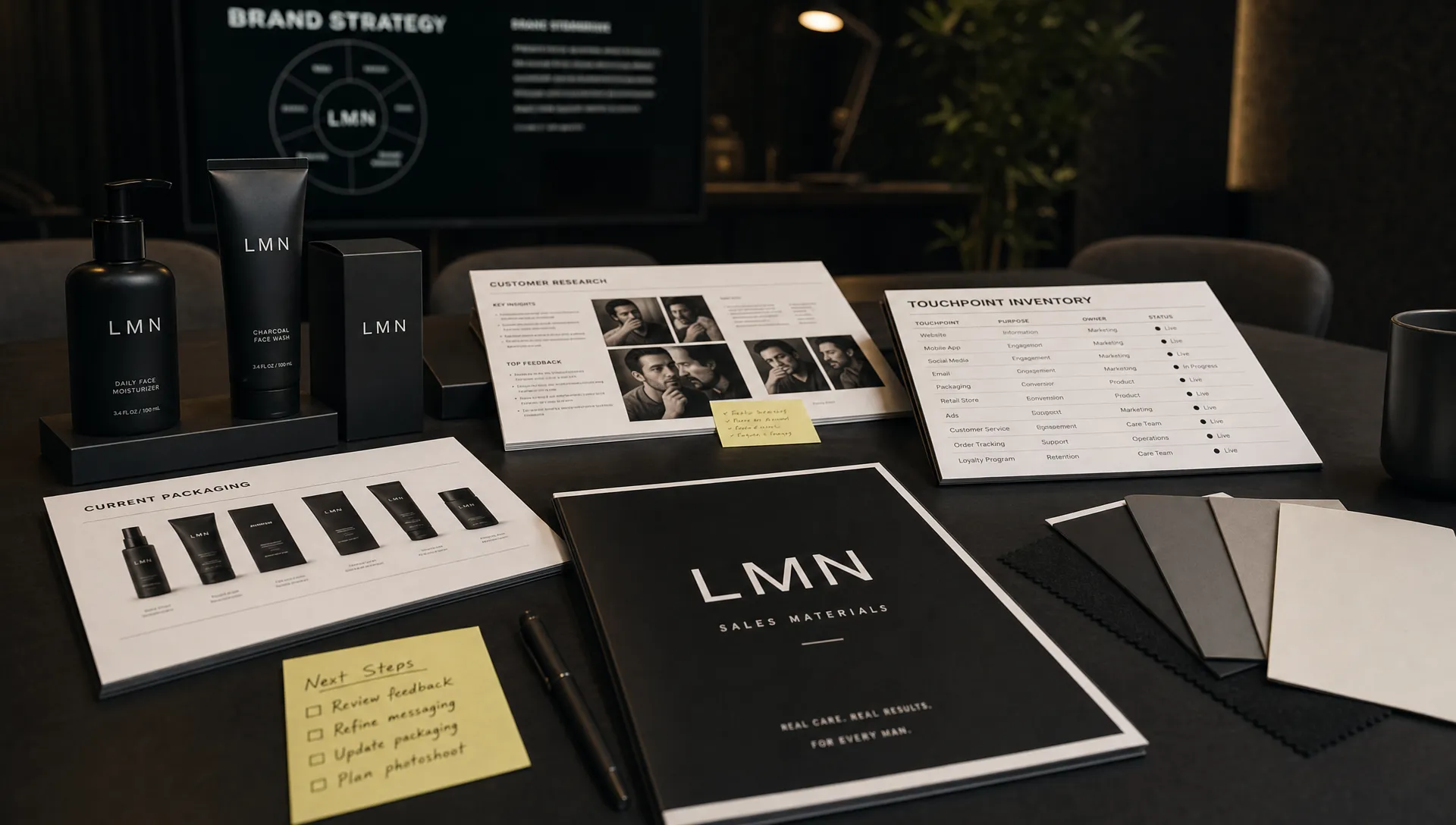
Give prospective partners the same core information so differences between proposals reflect their thinking rather than missing context. Your pack should contain:
- A business brief: The problem, priority audience and intended commercial outcome.
- An evidence folder: Customer feedback, performance baselines and relevant research.
- An asset inventory: Current materials, usage locations and known ownership restrictions.
- A scope outline: Required deliverables, implementation needs and explicit exclusions.
- A decision map: The sponsor, project owner, reviewers and final approver.
- Delivery constraints: Budget range, meaningful deadlines and launch dependencies.
Label unknowns honestly. “We need help establishing this” is more useful than an unsupported answer that later becomes a project assumption.
Define the business problem before discussing design
Start with the change your business needs, not the visual treatment you want. “Make us look more premium” is an interpretation. “Qualified buyers assume we serve smaller companies than we actually do” describes a problem worth investigating.
A brand refresh agency needs this distinction to challenge the brief constructively. Otherwise, it may solve a design preference while leaving the underlying obstacle untouched.
Write a short problem statement using this structure:
We need to improve [customer perception or behavior] among [priority audience] because [evidence]. The refresh should support [business outcome] while preserving [valuable existing recognition].
For example, a challenger software business might want enterprise buyers to understand its implementation support without losing the approachable identity valued by existing customers. That creates a more useful assignment than “update the logo and website.”
Also record why the project matters now. A new distribution agreement, changed buying audience or inconsistent presentation across acquisitions creates different requirements. Distinguish genuine external deadlines from an internal preference to launch next quarter.
If the investment case remains unclear, use the questions in Boil’s guide to building a rebranding business plan before commissioning creative work.
Set a working boundary between refresh and rebrand
A refresh generally updates how an existing brand expresses itself while retaining its core identity. A full rebrand may revisit positioning, naming, brand architecture or the underlying promise.
Treat that distinction as a working hypothesis, not a diagnosis you must complete yourself. Ask a brand refresh agency to explain which assumptions it would validate before confirming the scope.
Prepare three categories: what appears valuable, what appears broken and what remains uncertain. Recognition of a distinctive color might belong in the first category. Inconsistent product naming might belong in the second. Whether the positioning still resonates could sit in the third.
Avoid declaring everything untouchable. Equally, do not authorize wholesale change just because an agency presents attractive alternatives. Identify the evidence needed to justify changing established assets.
Write down the consequence if discovery reveals a deeper problem. Would you expand the engagement, commission a separate strategy phase or pause for leadership approval? Agreeing on that decision path makes proposals easier to assess and reduces pressure to force a larger problem into a refresh-sized budget.
Gather evidence and inventory the real customer experience
Bring customer evidence, including uncomfortable feedback
Collect recent customer interviews, sales objections, support themes, win-loss notes and relevant analytics. Include the questions buyers ask repeatedly and the language they use to describe your business.
Separate observations from interpretations. “Buyers asked whether onboarding was included in six recorded sales calls” is evidence. “Our brand lacks confidence” is a hypothesis.
Give your brand refresh agency access to both, with dates and context. Explain which findings come from a small sample and which recur across markets or customer segments. Remove personal information where it is unnecessary and confirm permission before sharing sensitive recordings or documents.
Inventory touchpoints, not just design files
Map where the brand appears: website templates, product interfaces, sales decks, packaging, email journeys, recruitment materials and partner listings. Record who owns each item, how often it changes and whether an editable source exists.
Include functional content that supports purchase decisions. A range such as O&K MUBY’s hands-free wearable breast pumps illustrates why a product-brand audit should cover model differences, fit information and warranty messaging alongside visual presentation. Those details help shoppers evaluate the offer and should remain clear through a refresh.
A shared spreadsheet is sufficient. Useful columns include touchpoint, audience, owner, current file location, update priority and implementation dependency. This exposes work that otherwise surfaces late, such as retailer imagery or a presentation library maintained outside marketing.
Define the scope a brand refresh agency should price
“Brand refresh” is not a standardized package. One proposal may cover visual identity and guidelines. Another may include research, messaging, website design and production support.
Specify the outputs you need without prescribing every creative answer. Distinguish an identity system from the materials required to put it into use. A set of guidelines is not the same deliverable as updated presentation templates, migrated website pages or print-ready packaging.
Make implementation responsibilities explicit. If website development sits with another supplier, identify who will provide design specifications, resolve questions and approve the finished build. If packaging changes are involved, include production partners early enough to surface constraints.
Share a budget range and explain what it must cover. Account for agency fees, research, licensing, development, production, training and replacement of physical materials where relevant. There is no useful universal allocation: the balance depends on your touchpoints and existing infrastructure.
Ask each brand refresh agency to separate essential work from optional extensions and identify the assumptions behind its estimate. This gives you a basis for reducing scope without quietly removing something necessary for launch.
Finally, request a clear change-control process. Additional concepts, stakeholder rounds or markets should trigger an explicit decision about fees and timing rather than an informal expansion of expectations.
Establish who decides and how feedback works
Before outreach, appoint one internal project owner who can consolidate feedback and keep decisions moving. Name the executive sponsor and the person authorized to approve scope, budget and final work.
Other stakeholders still matter. Sales can surface buyer objections, customer support can identify confusing language and regional teams can flag practical issues. Their role should be clear: providing evidence, advising on usability or approving a defined area.
A brand refresh agency should know whether it is presenting to an accountable decision-maker or a committee whose approval rules are unresolved.
Prepare a feedback protocol. Ask reviewers to connect comments to the agreed audience, objectives and acceptance criteria. “This feels wrong” needs clarification; “the hierarchy makes our entry-level offer look like the flagship” gives the team something testable.
Confirm availability as well as authority. A named approver who cannot attend milestone reviews can delay the project as effectively as having no approver. If legal, procurement or compliance reviews are required, put them into the proposed schedule before signing.
Prepare an agency-selection scorecard
Agree on evaluation criteria before viewing proposals. Otherwise, a compelling presentation can outweigh a weak delivery plan.
Use the following as a suggested scorecard, adapting the weights to your situation. Score each criterion from one to five, multiply by its weight and compare the reasoning behind the scores, not just the totals.
| Criterion | Suggested weight | Evidence to request |
|---|---|---|
| Understanding of the business problem | 25% | A clear diagnosis, relevant questions and explicit assumptions |
| Relevant experience | 20% | Comparable challenges, constraints and the agency’s actual contribution |
| Research and creative reasoning | 20% | How evidence informs decisions and how concepts are evaluated |
| Working team and decision process | 15% | Named roles, senior involvement and feedback procedures |
| Implementation capability | 10% | Handover examples, production support and supplier coordination |
| Commercial clarity and asset rights | 10% | Deliverables, exclusions, licensing terms and change control |
When interviewing a brand refresh agency, ask to meet the people who would actually do the work. Clarify which roles are employees, collaborators or subcontractors and who remains accountable across them.
For case studies, ask what changed, why it changed and how results were measured. A portfolio can demonstrate craft without proving business impact. Conversely, commercially relevant experience does not have to come from an identical category.
Avoid demanding unpaid creative concepts as the main selection test. A structured working discussion or clearly scoped paid discovery phase can reveal more about judgment and collaboration than speculative artwork.
Plan customer testing and success measures before concepts exist
Testing should answer defined questions, not produce a popularity contest. Before hiring, identify the audiences you can recruit and what you need to learn from them.
Useful questions include whether people recognize the brand, understand its offer, distinguish product tiers and find the information needed to act. Include existing customers when recognition matters and prospective customers when the refresh aims to change market perceptions.
Ask the brand refresh agency how it would test realistic applications, such as a product page or sales slide, rather than relying only on isolated logo comparisons. Employee testing should focus on usability too: can someone build a clear presentation or find the right asset without design support?
For a deeper treatment of what to preserve, Boil’s guide to refreshing a brand without losing recognition can help frame these conversations.
Establish baselines before launch. Match measures to the stated problem: message comprehension for an unclear offer, qualified inquiry conversion for poor lead quality or asset-production time for an unusable identity system.
Likes, launch impressions and positive internal comments may describe attention or sentiment. They do not establish commercial impact. Compare results over appropriate periods and record other changes, including pricing, media spend, seasonality and product updates. Where feasible, use controlled tests. Otherwise, describe the refresh as a possible contributor rather than claiming it caused every improvement.
Resolve rollout responsibilities and ownership before signing
A rollout plan does not need every launch task finalized at selection stage. It does need enough structure to expose cost and operational risk.
Identify which touchpoints must change together and which can transition gradually. Packaging stock, partner systems and product-release cycles may prevent a single launch date. Agree who can authorize exceptions and how long legacy assets may remain in use.
Your brand refresh agency should also explain what happens after creative approval: who prepares production files, supports vendors, checks implementation and resolves inconsistencies.
Include accessibility in acceptance criteria. For digital work, use WCAG 2.2 as a reference when defining requirements for contrast, text and interface behavior. Accessible color choices alone do not establish that an entire website is accessible; implementation must be tested too.
Before contracting, clarify ownership and usage rights for final deliverables. Ask which editable files are included, whether fonts or photography require separate licenses and whether third-party components restrict future use. Do not assume that paying for a project transfers every associated right.
Finally, assign ownership of the brand after handover. Someone must maintain the asset library, brief new vendors, onboard employees and approve future exceptions. Without that responsibility, regional teams and suppliers will gradually create competing versions of the refreshed identity.
Frequently asked questions
Do we need a complete strategy before approaching an agency? No. Bring your current strategy, evidence and unresolved questions. A brand refresh agency can help validate the direction, but its proposal should make that discovery work explicit rather than assume the strategy is settled.
How many agencies should receive the brief? Use a manageable shortlist that your team can evaluate consistently. The useful limit is your capacity to hold substantive conversations, check relevant work and assess delivery teams, not the number of proposals you can collect.
What if we do not have customer research? State the gap and ask agencies to scope appropriate research. Existing sales notes and support conversations provide a starting point, but they should not be presented as representative research when they are not.
Should we choose the lowest proposal? Compare equivalent scope first. A lower fee may exclude implementation, research, licensing or handover support. Choose based on the work required, the team’s ability to deliver it and the risks you would retain internally.
Start with a brief that supports a useful conversation
You are ready for agency discussions when you can explain the business problem, share the evidence, identify the decision-maker and describe your delivery constraints. The unanswered questions should be visible, not concealed by a polished deck.
For challenger brands connecting identity changes to a wider growth ambition, Boil’s branding and go-to-market services provide a relevant starting point. Bring the briefing pack and use the first conversation to test the problem, scope and fit before committing to creative work.
