Early growth rarely fails because a logo is not polished enough. It often slows because buyers cannot quickly understand why the company exists, why it is different, and why they should trust it now.
For startups, branding is not decoration. It is a decision system that shapes positioning, messaging, identity, customer experience, and go-to-market focus. The best startup branding makes the business easier to understand, remember, recommend, and buy from. The worst branding creates friction at the exact moment a young company needs momentum.
In 2026, that friction is even more expensive. Most categories are crowded, AI has made generic content cheap, and customers are more skeptical of promises from unknown companies. A startup does not need to look bigger than it is. It needs to look sharper, more relevant, and more credible than the alternatives.
Below are the startup branding mistakes that slow early growth, plus practical ways to fix them before they turn into a cost-per-acquisition problem, a sales problem, or a fundraising problem.
Why branding has a direct impact on early growth
Early-stage teams often separate brand from growth. Brand sits with the logo and website. Growth sits with ads, sales, product, and partnerships. In reality, buyers experience all of it as one story.
If the homepage says one thing, the pitch deck says another, and the sales call sounds like a third company, prospects have to work too hard. Confusion becomes a tax on conversion. It slows referrals because customers cannot repeat your value clearly. It weakens hiring because talent cannot feel the mission. It makes investors dig through noise to find the commercial logic.
Good branding reduces that tax. It gives the team a shared answer to the same recurring questions:
- Who is this for?
- What problem are we brave enough to own?
- What belief do we want the market to adopt?
- Why should customers choose us instead of the safe option?
- What proof makes that choice feel credible?
You do not need a giant brand manual to answer those questions. You need focus.
1. Waiting until later to define the brand
One of the most common startup branding mistakes is treating brand as something to fix after product-market fit. The logic sounds sensible: first build the product, then make it beautiful. But early positioning shapes what you build, who you sell to, which channels you test, and what customers remember after a demo.
That does not mean pre-seed teams need a full rebrand. It means they need a minimum viable brand. At the earliest stage, that can be a tight strategic foundation rather than a huge identity system.
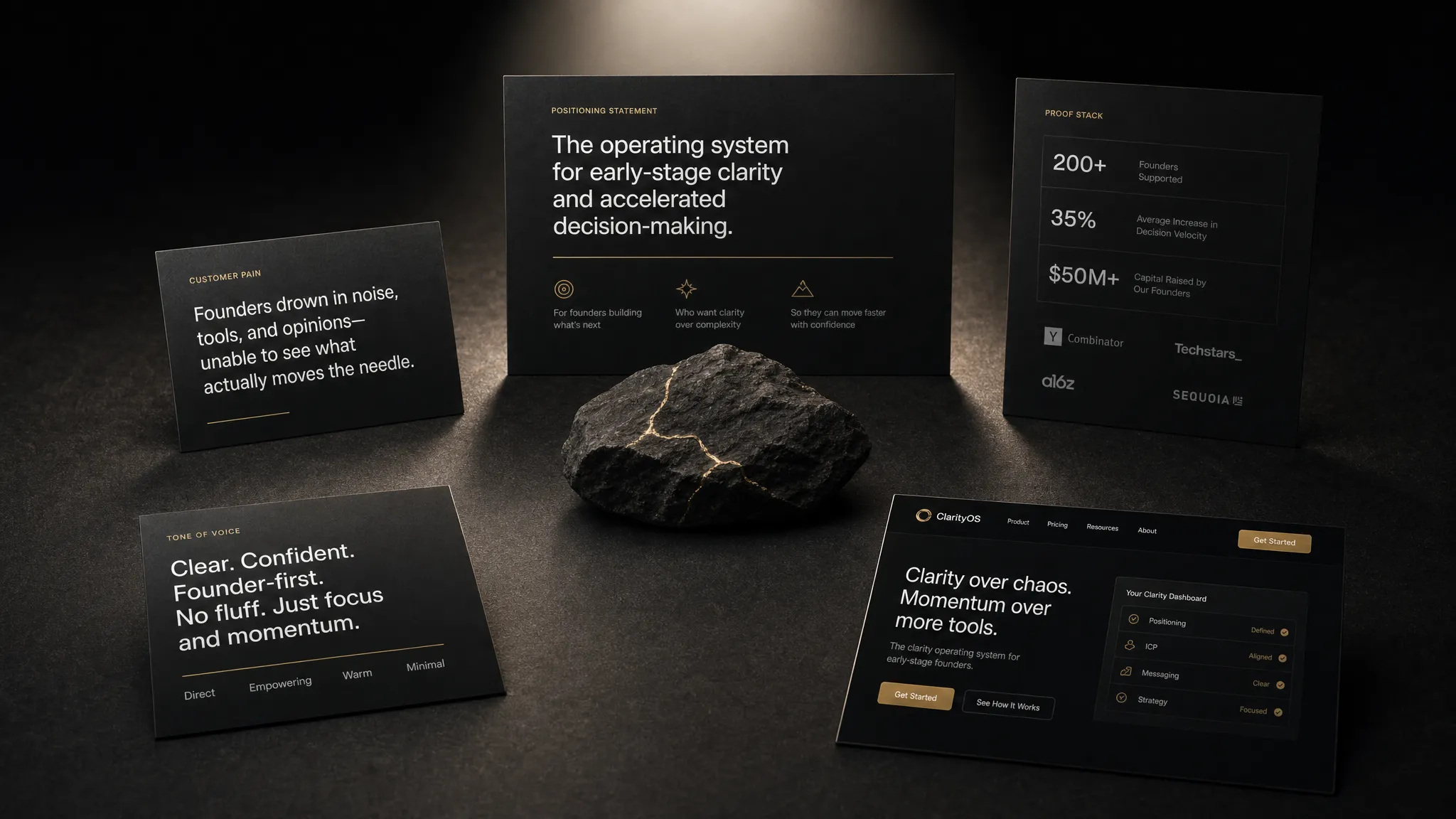
A minimum viable brand should include a clear audience, a category frame, a problem statement, a single promise, a proof stack, a tone of voice, and enough visual consistency to look intentional. This is the difference between moving fast with discipline and moving fast in random directions.
If you are unsure what kind of partner or scope fits your stage, Boil has a dedicated guide on choosing a branding agency for startups without overbuying or under-scoping the work.
2. Positioning for everyone instead of a beachhead
Startups often fear that narrow positioning will shrink the market. The opposite usually happens. A vague brand feels safer internally, but it is weaker externally. Buyers do not choose the company that could help anyone. They choose the company that clearly understands someone like them.
A beachhead audience gives your brand sharper language. It helps you describe a specific pain, show more relevant proof, and design a more believable customer journey. You can expand later, but early growth depends on winning a first market with intensity.
A useful test is simple: can a specific buyer read your homepage and feel that it was written for their world? If the answer is no, your startup may be hiding behind category language instead of customer language.
The fix is not just adding personas. It is making a strategic choice. Choose the audience where the pain is urgent, the value is easiest to prove, and the switching trigger is visible. Then build your brand around that first wedge.
3. Explaining what you built before explaining why it matters
Many startup websites open with the product category, not the market tension. The result sounds like every other pitch: an AI-powered platform, a seamless solution, a smarter way to manage something. It may be technically accurate, but it rarely creates urgency.
Buyers need to understand the problem before they care about the mechanism. If you lead with features, they compare you to familiar tools. If you lead with a sharper view of the problem, they start to see the category differently.
A better structure is to start with the old way that is failing, name the cost of that failure, introduce your belief, and only then explain the product. This turns messaging from a feature list into a point of view.
For example, do not just say that your startup automates customer onboarding. Say that growth teams are losing new users in the first 48 hours because onboarding is treated as a support function instead of a revenue moment. Now the product has context. Now the buyer knows why change matters.
4. Looking like the incumbent you want to beat
Early teams often copy the visual codes of category leaders because they want to borrow trust. In fintech, that might mean blue, grids, and conservative typography. In SaaS, it might mean gradients, rounded dashboards, and abstract product shapes. In health, it might mean calm colors and generic human illustrations.
Category cues can be useful. They help buyers recognize what kind of company you are. But if your entire brand is built from borrowed cues, you train the market to see you as a smaller version of the leader.
Challenger startups need a balance of familiarity and distinctiveness. Familiarity tells people where to place you. Distinctiveness tells them why to remember you.
This is where brand assets matter. A distinctive verbal hook, visual device, founder point of view, product metaphor, color behavior, or motion style can become memory infrastructure. It does not need to be loud for the sake of being loud. It needs to be ownable enough that the market can recognize you after repeated exposure.
5. Changing the story across every touchpoint
Another growth-slowing mistake is narrative drift. The founder pitch says the company is reinventing an industry. The website says it improves workflow efficiency. The ads talk about saving time. The sales deck focuses on cost reduction. None of these messages are necessarily wrong, but together they create a blurry brand.
A startup brand should have a message spine, a simple hierarchy that the team can reuse everywhere. It does not make every sentence identical. It keeps the underlying logic consistent.
A strong message spine usually includes:
- A one-line positioning statement
- The status quo you challenge
- The main customer pain
- Your core promise
- Three proof points
- A clear call to action
Once this exists, every channel can adapt without losing coherence. The website can simplify it. Sales can make it conversational. Ads can dramatize one part of it. Investor materials can connect it to market size and timing. The story stays recognizable even when the format changes.
6. Letting templates and AI define the voice
Templates and AI tools can help startups save time, especially when the team is small. They are useful for operational communication, internal drafts, and documents where structure matters more than distinctiveness. For example, founders who need polished admin or stakeholder correspondence can use tools that generate professional letters quickly while keeping the team focused on higher-value work.
The mistake is letting generic outputs become the brand voice. If your website, onboarding emails, pitch, ads, and product copy all sound like default software language, you lose one of the few advantages startups have: personality.
A useful brand voice is not a list of adjectives like bold, friendly, and human. It is a set of rules for how the brand thinks and speaks. What do you name directly that competitors avoid? Where are you opinionated? What words do you refuse to use? How much technical detail builds trust for your audience? When should the tone be challenging, reassuring, playful, or precise?
Voice matters because early-stage brands are remembered through language before they are remembered through fame. If people repeat your phrase in a meeting, sales call, Slack thread, or investor memo, your brand is already traveling.
7. Designing a brand that looks good but does not work
A beautiful identity can still fail a startup if it is not built for daily use. Many early brands launch with a logo, colors, type, and a polished homepage, but no practical system for the moments that drive growth.
The team then improvises. The pitch deck looks different from the site. Product screens use inconsistent language. LinkedIn posts feel unrelated to campaigns. Event materials get rebuilt from scratch. The brand slowly fragments, not because people do not care, but because the system is too fragile.
Startup branding should prioritize use cases. What assets does the team need in the next 90 days? A pitch deck? Landing pages? Demo screens? Paid social templates? Founder posts? Sales one-pagers? Onboarding emails? Partnership materials?
Design should support those realities. A good startup brand system gives people enough structure to move quickly without asking for permission every time. It should be recognizable, flexible, and easy to deploy across web, product, sales, and go-to-market activity.
8. Separating brand from go-to-market
A brand strategy that never meets the market is just internal theater. Early growth requires connection between what the brand promises and how demand is created, captured, and converted.
This is where many startups lose momentum. They build a positioning deck, launch a new website, and then run campaigns that ignore the strategic choices they just made. Or they define a strong challenger narrative but fail to translate it into channel tests, sales scripts, product onboarding, and customer proof.
Brand and go-to-market should reinforce each other. Your positioning should guide which audience you target first. Your proof should shape landing pages and sales decks. Your category language should show up in content and outbound. Your customer insights should feed back into the brand.
If you are working on market entry or launch planning, Boil's article on go-to-market mistakes goes deeper into the execution traps that can weaken a strong strategic idea.
9. Building the brand on untested assumptions
Founders are close to the product, which is both an advantage and a risk. You see the vision before everyone else does. But that can create assumptions about what buyers care about, which words they use, and what they need to believe before they switch.
Untested assumptions show up everywhere. The team chooses a category name customers do not understand. A value proposition sounds compelling internally but does not match the buyer's buying trigger. A premium identity is created for an audience that actually needs reassurance and clarity first. A tagline is memorable but irrelevant to the sales conversation.
The fix is to validate before scaling. You can test brand assumptions through customer interviews, landing page experiments, sales-call analysis, message testing, waitlists, small paid campaigns, and founder-led content. The goal is not to outsource strategy to the market. The goal is to understand which ideas create recognition, urgency, trust, and action.
Boil explores this in more detail in its guide to brand market research, including what to test before investing heavily in growth.
10. Rebranding every time growth gets uncomfortable
Startups change quickly. New segments emerge, product direction shifts, competitors respond, and investor expectations evolve. Some brand iteration is healthy. But constant repositioning creates whiplash.
If every difficult quarter triggers a new tagline, a new audience, or a new identity direction, the market never gets enough repetition to remember you. Internally, the team starts treating brand as opinion rather than strategy. Externally, customers see inconsistency instead of evolution.
The answer is not rigidity. It is governed flexibility. Decide which parts of the brand are stable and which parts can adapt. Your core belief, audience wedge, and promise should not change every month. Campaign themes, proof points, content angles, and channel execution can evolve faster.
Set review moments rather than reacting to every signal. For example, review positioning after a defined number of sales conversations, customer interviews, or campaign cycles. This gives you evidence without turning the brand into a mood board.
A quick audit for your startup brand
If you suspect branding is slowing growth, run a simple audit before you redesign anything. Ask your founder team, sales team, and a few customers to answer the same questions independently. Compare the answers.
Your startup brand may need attention if:
- People describe the company in different ways
- The website explains features but not urgency
- Customers understand the product only after a live demo
- Sales decks rely on the founder to make the story persuasive
- Competitors could use your headlines with minimal editing
- The identity looks polished but disappears across real channels
- Your team cannot explain what should stay consistent as you grow
The most important signal is not whether people like the brand. It is whether the brand helps people make a decision. Early growth depends on clarity, trust, and memorability. Taste matters, but decision-making matters more.
What to do instead
Avoiding startup branding mistakes does not mean slowing down for a long, abstract strategy project. It means making sharper choices before you spend energy scaling noise.
Start with the commercial problem. Are you struggling to be understood, trusted, remembered, differentiated, or converted? Each problem requires a different branding response. A startup with a credibility problem may need proof and experience design. A startup with a differentiation problem may need positioning and category framing. A startup with a conversion problem may need messaging, website, and GTM alignment.
Then define the smallest brand system that can support the next stage of growth. For an early-stage startup, that might mean a strategic narrative, core messaging, visual identity basics, pitch deck, and website. For a startup entering a new market, it might mean sharper positioning, market-entry messaging, sales enablement, and a digital experience that builds trust quickly.
Finally, measure whether the brand is doing its job. Look at qualitative and quantitative signals together. Are prospects repeating your language? Are sales conversations starting with better understanding? Are landing pages converting more clearly? Are partnerships easier to explain? Are candidates and investors grasping the ambition faster?
A strong startup brand is not the one that wins the most compliments. It is the one that makes growth easier to execute.
Frequently Asked Questions
When should a startup invest in branding? A startup should invest in branding as soon as unclear positioning, inconsistent messaging, or weak trust is slowing sales, fundraising, hiring, or launch execution. The scope should match the stage. Early teams often need a minimum viable brand, while scaling teams may need a deeper system.
What is the biggest startup branding mistake? The biggest mistake is treating branding as visual polish rather than strategic focus. Logos and colors matter, but they cannot fix a vague audience, weak positioning, or a promise the market does not understand.
How much branding does a pre-product-market-fit startup need? A pre-product-market-fit startup needs enough brand clarity to test the right market. That usually includes audience focus, problem framing, core promise, proof points, tone of voice, and a simple identity system. It should be flexible enough to evolve as evidence improves.
How do I know if branding is slowing our growth? Look for confusion in sales calls, low homepage comprehension, inconsistent team descriptions, weak referral language, generic campaign performance, or prospects who only understand the value after a long explanation. These are signs that the brand is adding friction.
Should startups rebrand after raising funding? Not automatically. Funding can create a good moment to sharpen the brand, especially if the startup is entering a new market or hiring aggressively. But a rebrand should solve a business problem, not simply signal that the company has raised money.
Build a startup brand that accelerates growth
Early-stage companies do not have the luxury of wasted attention. Every touchpoint should make the business easier to understand, trust, remember, and choose.
Boil helps ambitious challenger brands connect branding, go-to-market strategy, creative design, and digital experiences so growth is not slowed by unclear positioning or fragmented execution. If your startup is preparing to launch, enter a market, or sharpen its next growth chapter, explore Boil's work and see how brand can become a growth system instead of a cosmetic layer.
