
An Instagram rebrand can look deceptively simple from the outside. Change the logo, update the bio, post a launch Reel, done. In reality, it is a public reset of your brand promise, your content system, and the mental shortcut people use when they see you in the feed.
For challenger brands, that reset matters. Instagram is often where prospects, partners, hires, investors, creators, and customers check whether your story feels real. If your profile still reflects last year’s positioning, old visuals, or a content strategy that no longer fits your growth stage, it can quietly weaken trust.
This guide shows you how to rebrand Instagram step by step, from profile basics to content rollout, without confusing your audience or burning the equity you have already built.
When should you rebrand your Instagram?
Not every profile update needs a rebrand. Sometimes you only need a sharper bio, stronger thumbnails, or better Highlights. A true Instagram rebrand is justified when the account no longer represents the business you are becoming.
Common triggers include a new brand identity, a renamed company, a shift in audience, a new category position, a major product launch, expansion into a new market, or a content strategy that has become too inconsistent to scale. It can also be necessary after a merger, reputation issue, or strategic pivot.
The question is not, do we want a prettier profile? The better question is, does our current Instagram help the right people understand, trust, and choose us?
If the answer is no, a structured reset can help. If the issue is deeper than social media, start with the brand decision itself. Boil’s guide on rebranding for high-growth teams can help you separate surface symptoms from strategic causes.
Step 1: Audit the account before you change anything
Before touching your handle, bio, Highlights, or grid, take a snapshot of the account as it exists today. Rebranding without a baseline makes it impossible to know whether the reset worked.
Review performance over the last 90 to 180 days. Look at reach, follower growth, profile visits, website taps, engagement rate, saves, shares, DMs, and conversions where you can track them. Do not only look at the highest-reach posts. The posts that drive saves, comments, clicks, or qualified conversations often reveal more about what your audience values.
Then audit the content itself. Which posts still fit the future brand? Which ones feel outdated but contain useful proof? Which posts should be archived because they create confusion? Which ideas can be repurposed in the new identity?
A useful content audit sorts posts into four groups:
Avoid deleting everything in a dramatic sweep. Archiving gives you flexibility, preserves optionality, and lets you rebuild with more control.
Step 2: Define what the new Instagram must communicate
A rebrand is not a mood board. Your Instagram should express a clear strategic answer to the market: who you are for, what you help them achieve, why your approach is different, and why anyone should believe you.
Before you design the profile, write a one-page Instagram brand brief. Keep it practical. Define your primary audience, the problem you want to be known for solving, your point of view, your proof, your tone of voice, your content pillars, and the action you want visitors to take.
This is especially important for challenger brands because social content cannot just imitate the category leader. You need a sharper edge. If incumbents sound polished but generic, your Instagram might win by being more direct, more educational, more human, more provocative, or more transparent.
For example, a local manufactured housing business like Homes2Go San Antonio would not benefit from a vague lifestyle feed alone. Its Instagram reset should likely make affordable home ownership feel clear and attainable through model walkthroughs, financing education, local buyer questions, community proof, and simple next steps.
That is the difference between content decoration and content strategy. One makes the feed look active. The other helps a buyer move.
Step 3: Rebuild the profile as a conversion surface
Your profile is not just a header. It is a landing page inside Instagram. People decide within seconds whether they understand you, trust you, and want to go deeper.
Start with the handle and display name. If your company name has changed, update the handle only when you are ready to announce the change across every major touchpoint. Handles affect recognition, tagging, search, and word-of-mouth, so avoid changing them repeatedly.
Next, update the profile image. For most brands, that means a clean logo mark or recognizable symbol that works at tiny sizes. Complex lockups, small taglines, and detailed illustrations usually collapse in the circular crop.
Then rewrite the bio. A strong Instagram bio should answer three things quickly: who you help, what outcome you create, and what to do next. A simple structure works well:
We help [audience] achieve [outcome] through [distinct approach]. [Clear call to action].
For a challenger brand, the bio should not sound like every competitor. If your positioning has a real enemy, a clear belief, or a sharper mechanism, bring some of that language into the bio without turning it into a manifesto.
Finally, reset the link, contact buttons, category, Highlights, and pinned posts. These elements should support the next action, whether that is exploring a launch page, booking a call, browsing products, joining a waitlist, downloading a guide, or contacting sales.
Step 4: Turn the rebrand into a visual and verbal system
A common Instagram rebrand mistake is designing individual posts instead of building a system. The first week looks good, then the team runs out of templates, rules, and decisions. Within a month, the profile drifts back into inconsistency.
Your visual system should make content easier to produce and easier to recognize. Define how you use color, type, photography, illustration, motion, layout, covers, captions, and calls to action. Make sure the system works across Reels, carousels, Stories, Highlights, profile thumbnails, and paid placements.
Your verbal system matters just as much. Decide how the brand speaks when it educates, sells, challenges, celebrates, responds to comments, handles criticism, and introduces new offers. The same brand should be recognizable in a carousel headline, a Reel hook, a Story poll, and a DM response.
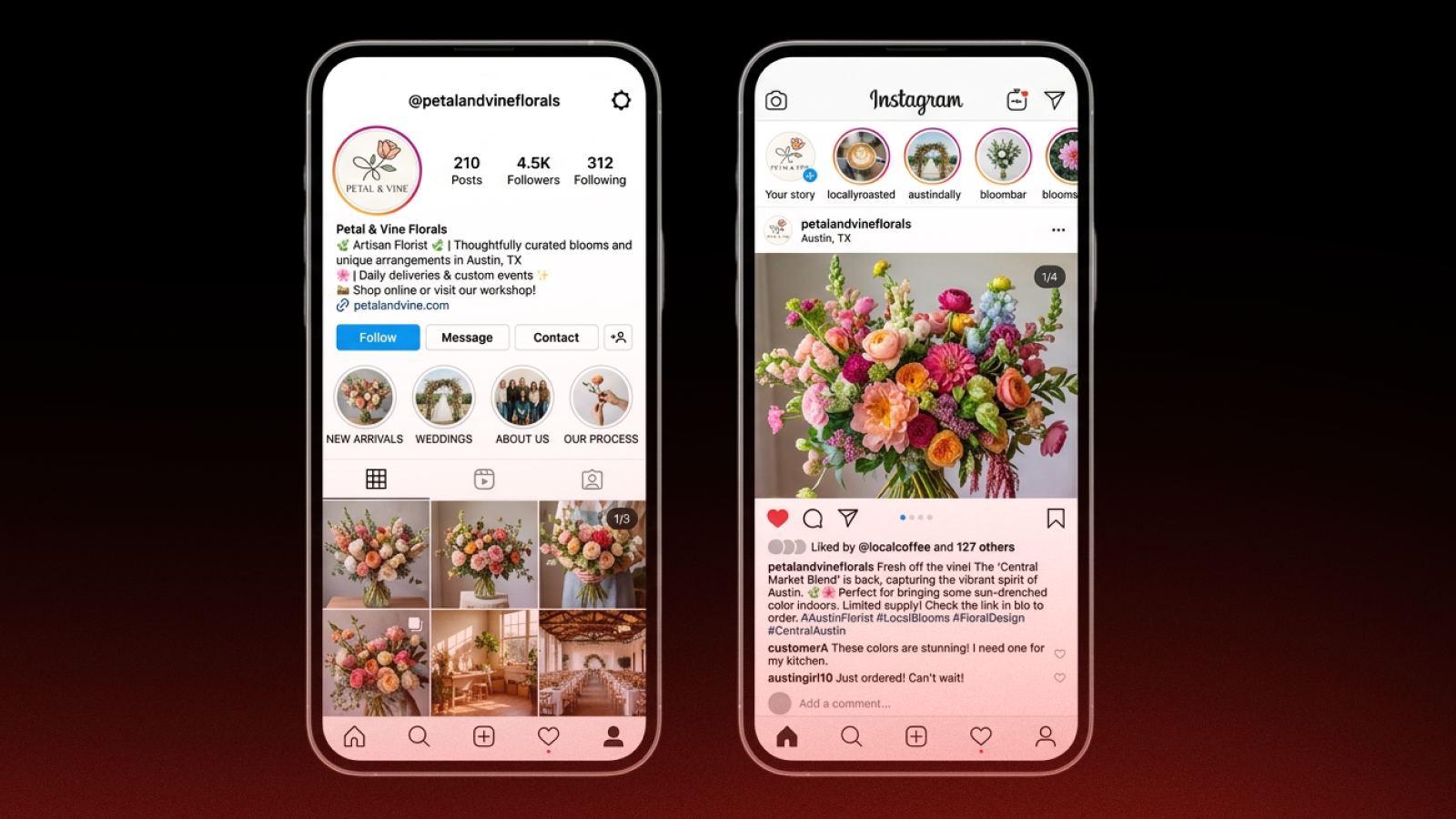
Do not optimize only for a beautiful grid. Instagram is consumed through many surfaces, including the feed, Reels tab, Stories, DMs, search, Explore, and shares. A strong rebrand creates recognition wherever the content appears.
Step 5: Reset your content pillars
Once the profile structure is clear, rebuild the content architecture. Most brands need three to five content pillars. Fewer pillars can become repetitive. Too many create chaos.
A strong Instagram content mix usually includes:
For challenger brands, point of view and proof are the most underused pillars. Many brands post educational content but fail to connect it to a distinctive belief. Others make bold claims but do not show enough evidence. The strongest content reset combines both: here is what we believe, and here is why you can trust us.
Map each pillar to formats. Reels can create reach and personality. Carousels can explain complex ideas and drive saves. Stories can create proximity and real-time engagement. Collab posts can borrow trust from partners, creators, employees, or customers. Static posts can still work when the idea is sharp and the visual is distinctive.
Step 6: Decide what happens to old content
One of the hardest questions in an Instagram rebrand is what to do with the old grid. There is no universal answer. The right decision depends on how far the brand has changed.
If the rebrand is mainly a visual refresh, keep more of the existing content and update key profile elements. If the positioning, name, audience, or offer has changed significantly, archive posts that actively create confusion. If old content has strong performance and still tells a credible story, consider keeping it while using pinned posts and Highlights to guide visitors into the new chapter.
Do not erase history just to make the grid look clean. Long-time followers often care about continuity. They want to know what changed, what stayed true, and why the new direction exists. A good rebrand respects existing equity while making the future impossible to miss.
The safest approach is to archive selectively, pin strategically, and explain generously.
Step 7: Build a launch sequence, not a single announcement
A rebrand should not appear out of nowhere. Sudden changes can confuse followers, especially if the handle, logo, name, or visual style changes overnight.
Plan the rollout in phases. Start with internal alignment, then prepare assets, update cross-channel touchpoints, brief employees and partners, warm up the audience, launch publicly, and follow up with content that explains the new direction.
A simple Instagram launch sequence might look like this:
The launch post should not be only about the logo. Lead with meaning. Explain the business reason, the customer insight, and the future you are building toward. People are more likely to accept change when they understand the why.
Step 8: Pin the right posts after the reset
Pinned posts are your profile’s editorial front door. Use them to reduce confusion and move visitors toward understanding.
For most Instagram rebrands, three pinned posts work well. The first should introduce the new brand or new chapter. The second should explain your point of view and what makes your approach different. The third should provide proof, such as a case, customer story, product walkthrough, or clear offer explanation.
This matters more than obsessing over the first nine squares. A polished grid is nice, but a visitor needs orientation. If someone lands on your profile after seeing one Reel, they should quickly understand who you are, what you stand for, and where to go next.
Step 9: Brief your team, creators, and partners
Instagram rebrands often fail because the brand team launches, but everyone else keeps using the old language. Sales teams use the previous pitch. Employees tag the old handle. Partners share outdated descriptions. Creators receive briefs that do not reflect the new positioning.
Create a short social rollout kit. It does not need to be complicated. Include the new profile link, updated handle, key message, short description, launch assets, post captions, Story frames, do and do not guidance, and answers to expected questions.
If you work with creators or partners, brief them on the narrative, not just the visuals. The goal is not to make everyone repeat the same corporate sentence. The goal is to help them describe the rebrand accurately, in their own voice, without diluting the strategy.
Step 10: Support the rebrand with paid and organic distribution
Organic reach alone may not be enough, especially if the rebrand affects an audience that includes prospects, customers, investors, retailers, distributors, or talent. Consider supporting the launch with targeted paid promotion, especially for the announcement, the strongest proof post, or a high-converting landing page.
You do not need a massive budget for this to work. What matters is clarity. Promote content that explains the change and moves the right people to the next step. Avoid spending behind vague brand films or aesthetic announcements if they do not help the audience understand the shift.
Organic distribution also matters. Use Stories, employee advocacy, newsletters, website banners, email signatures, LinkedIn posts, partner mentions, and customer communications to reinforce the change. Instagram should be part of the rebrand rollout, not the entire rollout.
Step 11: Measure the rebrand over 30, 60, and 90 days
A rebrand can temporarily disrupt performance. Some followers may disengage. Some content formats may need testing. The algorithm may take time to learn how people respond to the new direction. Do not judge the reset by the first 48 hours.
Measure in stages. In the first 30 days, look for awareness and comprehension signals: profile visits, reach, follower quality, comments, shares, Story replies, and the language people use when they describe the change.
At 60 days, look at engagement depth: saves, DMs, website taps, repeat viewers, qualified conversations, and whether new content pillars are earning attention.
At 90 days, connect Instagram to business outcomes where possible: leads, booked calls, sales, waitlist signups, retail inquiries, community growth, recruitment interest, or other meaningful conversions.
The goal is not just more followers. A successful Instagram rebrand should improve the quality of attention. The right people should understand you faster, remember you more clearly, and take the next step with less friction.
Common mistakes to avoid when you rebrand Instagram
The most dangerous Instagram rebrand mistakes usually come from speed without strategy. Teams rush to show the new look before they have clarified the new meaning.
Avoid these traps:
If the rebrand is worth doing, it is worth operationalizing. Build the system before you announce the change.
A practical Instagram rebrand checklist
Before launch, make sure you have the essentials covered. Your team should know what is changing, why it is changing, and how the new brand should behave on social.
Use this checklist as a final review:
The checklist is simple, but it prevents the most common failure mode: launching a new look without a system to sustain it.
Frequently Asked Questions
Can I rebrand Instagram without losing followers? Yes, but you need to manage the transition clearly. Explain what is changing, reassure followers about what will stay consistent, and use pinned posts, Stories, and Highlights to orient people. Some follower churn is normal, but the goal is stronger relevance with the right audience.
Should I delete old Instagram posts during a rebrand? Usually, archiving is safer than deleting. Keep posts that still support the new brand, refresh useful ideas, and archive content that creates confusion. If old posts contain strong proof or history, they may still be valuable.
How long does an Instagram rebrand take? A light refresh can be planned and launched in a few weeks. A deeper rebrand involving positioning, identity, content strategy, and launch assets often takes longer because the social reset depends on brand decisions made upstream.
What should I post first after a rebrand? Start with a clear new chapter post. Explain why the brand changed, what it means for your audience, and what they can expect next. Follow with your point of view, proof, offer clarity, and content that demonstrates the new direction.
Is changing my Instagram handle risky? It can be. A handle change affects recognition, tagging, search, and saved references. If you change it, announce the update clearly, coordinate it with other channels, and avoid repeated changes.
Make your Instagram reset part of a bigger brand growth system
A strong Instagram rebrand is not just a social media exercise. It is the visible edge of a strategic shift. The profile, content, visuals, voice, proof, and calls to action should all point in the same direction.
If your Instagram reset is part of a bigger repositioning, rebrand, market entry, or go-to-market push, Boil can help connect the strategy to the creative system and the rollout. Explore how Boil helps ambitious challenger brands grow through branding, go-to-market strategy, and digital experiences built to stand out.
