Turning features into brands is not a copywriting trick. It is the strategic work of moving from “what we built” to “why this should matter in someone’s life, work, identity, or ambition.”
Most ambitious companies have strong product truths. They have faster workflows, better materials, smarter technology, cleaner interfaces, more sustainable processes, or deeper expertise. Yet customers rarely remember a list of features. They remember a feeling, a point of view, a promise, and the language that helps them explain why they chose you.
That is the difference between a product people compare and a brand people recall.
For challenger brands, this distinction is critical. If you are not the biggest player in the category, you cannot afford to sound like everyone else with slightly better specs. You need to make your advantages easier to understand, easier to believe, and easier to retell.
Why features alone rarely stick
Features matter. They are proof that your product, service, or experience is real. The problem is not that companies talk about features. The problem is that they stop there.
A feature tells people what something does. But customers do not buy in a vacuum. They buy in a context full of pressure, trade-offs, identity, fear, hope, and comparison. A faster platform is not just “faster.” It can mean fewer late nights for an operations team. A more durable material is not just “durable.” It can mean confidence, taste, responsibility, or long-term value.
When brands lead only with features, three things often happen:
Meaning solves this. Not by making the brand vague or emotional for the sake of emotion, but by connecting the feature to a human outcome people already care about.
Feature, benefit, meaning: know the difference
To turn features into meaning, start by separating three layers.
A feature is the thing you offer. It is functional, observable, and usually easy to list. Examples include AI automation, recyclable materials, acoustic absorption, real-time reporting, modular components, or a 24-hour delivery promise.
A benefit is the practical improvement the feature creates. It answers the question, “What does this help me do?” Faster reporting helps teams make decisions sooner. Modular components make installation easier. Recyclable materials reduce waste.
A meaning is the interpretation customers attach to that benefit. It answers the deeper question, “Why should I care, and what does this say about me or my organization?” Faster reporting can mean control. Modular components can mean freedom to adapt. Recyclable materials can mean progress without compromise.
This is where brands are built. Not by ignoring the product, but by translating the product into a memorable human truth.
For example, acoustic panels could be marketed only through technical specifications, such as absorption values, materials, and dimensions. Those details are important, but the stronger brand move is to connect them to the desire for calm, focus, and beauty in the spaces people inhabit. Reducel’s positioning around acoustic comfort as a design statement is a useful example of how a functional product category can become more meaningful when performance and aesthetics work together.
Start with the tension behind the feature
A feature becomes meaningful when it resolves a tension. The tension is the uncomfortable gap between how customers currently experience the world and how they believe it should be.
Many brands skip this step. They jump from “we have a new capability” to “let’s launch a campaign.” But without tension, the message has no energy. It may be accurate, but it will not move people.
Ask sharper questions before writing any claim:
If your feature is “automated onboarding,” the tension might be that growing teams are tired of messy handovers and inconsistent customer experiences. The meaning could become confidence at scale.
If your feature is “locally sourced ingredients,” the tension might be that consumers distrust opaque supply chains. The meaning could become food you can feel close to.
If your feature is “enterprise-grade security,” the tension might be that teams want innovation without exposing the business. The meaning could become progress without vulnerability.
The best brand ideas usually sit one layer below the obvious benefit.
Use the feature-to-meaning chain
A simple way to translate product truth into brand meaning is to build a chain:
We do X, which creates Y, so people can Z, therefore we stand for A.
Here is how it works in practice.
“We use real-time data synchronization, which creates one shared view of operations, so teams can make decisions without chasing updates, therefore we stand for clarity in motion.”
Or:
“We use premium recycled materials, which creates long-lasting products with lower environmental impact, so customers can choose quality without guilt, therefore we stand for better taste with a lighter footprint.”
This chain forces discipline. It prevents the brand from becoming a cloud of attractive but disconnected words. It also makes sure your emotional promise is anchored in a real feature, not invented in a workshop and forgotten in the product experience.
Choose one meaning to lead with
A common mistake is trying to make every feature equally important. The result is a brand that feels complete but not memorable.
Strong brands are selective. They choose one central meaning and let supporting features reinforce it. That meaning becomes the organizing idea for messaging, design, product experience, sales narratives, and go-to-market execution.
This does not mean reducing the company to one slogan. It means creating a hierarchy. Your lead meaning should be the thing you want people to remember after they forget the details.
A project management tool might have dozens of features, but the brand may lead with “calm control for growing teams.” A sustainable personal care product may have many ingredient and packaging claims, but the brand may lead with “care without compromise.” A fintech platform may have technical infrastructure, compliance, and integrations, but the brand may lead with “financial freedom built on trust.”
The features still exist. They simply have a job now. They prove the meaning.
Make the meaning distinctive, not decorative
Meaning is not the same as adding a warm tone of voice or a poetic headline. A brand idea has to create difference.
If every competitor can say the same thing, you have not found meaning yet. You have found category wallpaper.
Words like “simple,” “innovative,” “sustainable,” “premium,” “seamless,” and “customer-centric” are not wrong. But on their own, they are too generic to carry a brand. They need a sharper angle.
Instead of “simple,” what kind of simplicity do you mean? Simplicity for first-time users? Simplicity for complex teams? Simplicity that removes shame? Simplicity that gives experts more power?
Instead of “sustainable,” what is your specific belief? That sustainability should be invisible? Beautiful? Affordable? Measurable? Luxurious? Radical? Local?
Instead of “premium,” what kind of premium are you challenging? Old-world status? Quiet craft? Intelligent performance? Minimal waste? Bespoke service?
Distinctiveness comes from your point of view. Features tell people you can deliver. Meaning tells people why your version of the future is worth choosing.
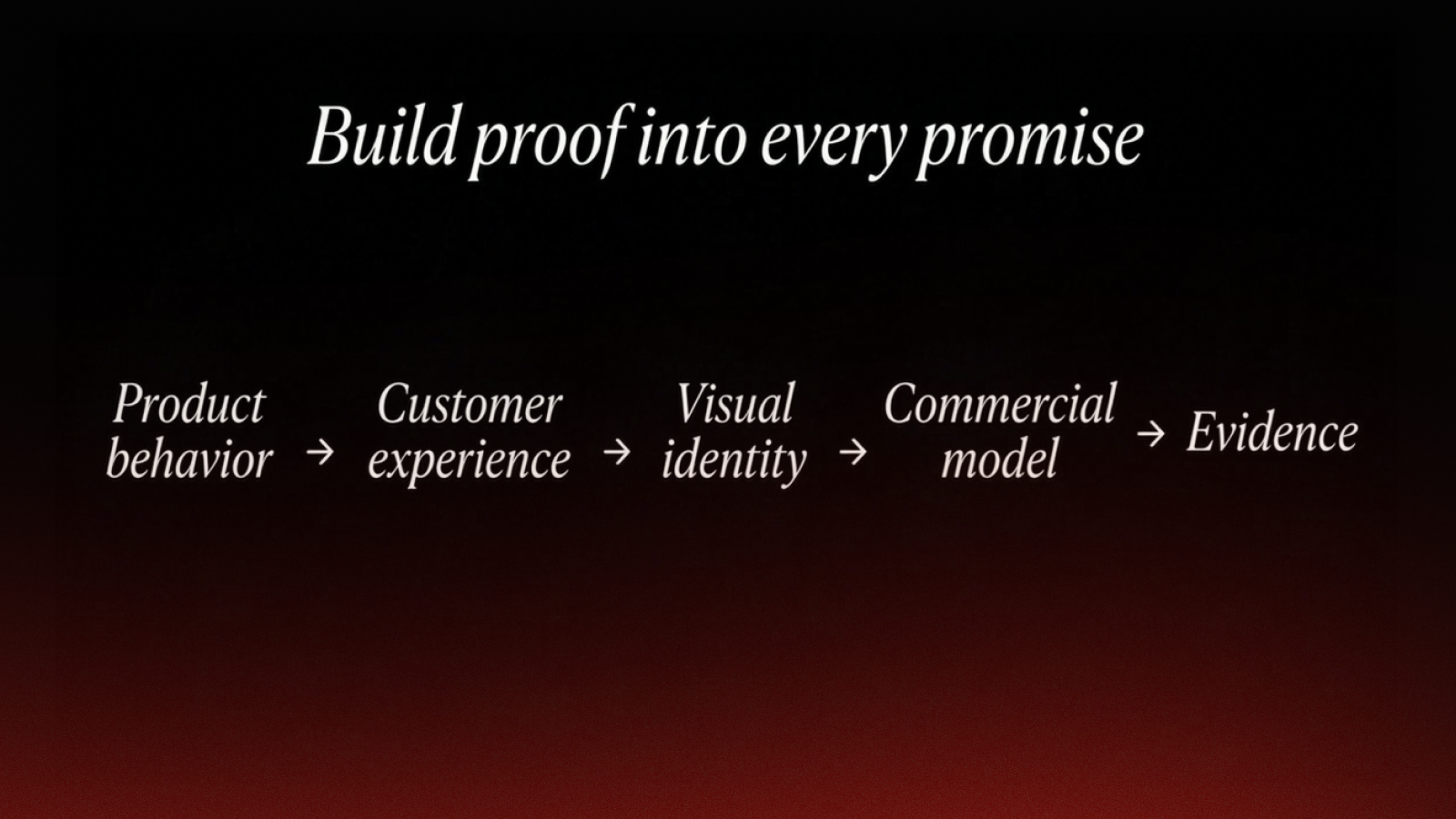
Build proof into every promise
The fastest way to weaken a brand is to make a meaning claim the business cannot prove.
If you say you stand for control, your interface cannot feel chaotic. If you say you stand for care, your customer support cannot feel cold. If you say you stand for sustainability, your supply chain and packaging need to withstand scrutiny. If you say you stand for speed, the buying journey cannot be slow.
Meaning must be operational, not just verbal.
Look for proof in five places:
This is especially important in 2026, when customers are more exposed to polished messaging than ever. AI has made it easier to produce words, images, and campaigns at speed. That makes proof more valuable. A memorable brand is not the one with the most content. It is the one whose content, experience, and behavior point in the same direction.
Turn meaning into a repeatable brand system
Once you define the meaning, translate it into a system. A brand does not become memorable because it says something once. It becomes memorable because the same idea shows up consistently across touchpoints.
Your homepage should introduce the meaning quickly. Your product pages should connect features back to it. Your sales deck should help buyers retell it. Your ads should dramatize it. Your onboarding should let customers feel it. Your visual identity should make it recognizable before people read a word.
This is where many companies lose momentum. Strategy gets approved, then execution fragments. The website says one thing, sales says another, product uses different language, and paid media optimizes itself into generic claims.
A strong brand system gives teams usable rules. It defines the core idea, key messages, proof points, tone of voice, visual principles, and priority touchpoints. It allows creativity without losing coherence.
For challenger brands, this matters because every impression has to work harder. You may not have the budget to be everywhere, but you can be unmistakably yourself wherever you show up.
The challenger advantage: meaning beats feature comparison
Incumbents often win feature comparisons because they have more resources, more integrations, more legacy trust, and more market visibility. Challengers rarely win by trying to look bigger than they are.
They win by making the customer see the category differently.
That shift can be small but powerful. A challenger does not always need to invent a new category. Sometimes it needs to reframe what matters inside an existing one. Instead of “we have the same features for less,” the message becomes “the old way forces a compromise you no longer have to accept.”
This is how features become a belief system.
A challenger accounting platform might not say, “We automate expense management.” It might say, “Finance should not be a monthly panic.” A challenger construction partner might not lead with “collaborative project methodology.” It might lead with “complex builds deserve less friction and more trust.” A challenger wellness brand might not say, “clinically tested ingredients.” It might say, “self-care that respects your intelligence.”
The feature still matters. But now it has meaning, tension, and memorability.
A practical feature-to-meaning sprint
If your team is sitting on a strong product but struggling to express why it matters, run a short sprint before changing your website, campaign, or pitch deck.
After that, pressure-test the idea with real people. Can they repeat it in their own words? Do they understand what makes you different? Does it make the product feel more valuable without overpromising? Does it help sales conversations move faster?
If the answer is yes, you are no longer just describing features. You are building brand memory.
Common mistakes when turning features into meaning
The first mistake is making the meaning too abstract. “Empowering transformation” may sound impressive, but it often fails because people cannot picture it. Meaning should be emotionally resonant and concrete enough to act on.
The second mistake is disconnecting meaning from proof. A bold promise can create attention, but only proof creates trust. If customers experience a gap between the message and reality, the brand loses credibility.
The third mistake is changing the meaning too often. Companies get bored of their own message long before the market remembers it. Consistency is not a lack of creativity. It is how memory is built.
The fourth mistake is letting internal language leak into the market. Your team may care about the feature architecture, technical stack, or operational model. Customers care about what those things make possible.
The fifth mistake is treating brand as a layer added after product. The strongest brands emerge when product, positioning, identity, experience, and go-to-market reinforce the same idea.
Frequently Asked Questions
What does it mean to turn features into meaning? It means translating what your product does into why it matters to customers. A feature explains functionality, while meaning connects that functionality to outcomes, emotions, beliefs, and memorable differentiation.
Should every feature become part of the brand message? No. Most features should support the brand message, not compete with it. Choose the features that best prove your central meaning and let secondary features play a supporting role in product pages, sales materials, and onboarding.
How do I know if our brand meaning is distinctive enough? Test whether competitors could say the same thing without changing a word. If they can, sharpen the point of view, the tension, or the proof. Distinctive meaning should feel specific to your product truth, audience, and market stance.
Is this the same as brand storytelling? It is closely related, but not identical. Storytelling gives structure to your message. Feature-to-meaning translation gives the story substance by connecting product reality to a customer-relevant belief.
Why is this especially important for challenger brands? Challengers usually cannot outspend incumbents on awareness. They need sharper positioning, stronger memory structures, and clearer reasons to choose them. Turning features into meaning helps customers understand and repeat why the challenger matters.
Ready to make your product mean more?
If your company has strong features but the market still struggles to remember why you matter, the issue may not be the product. It may be the translation from product truth into brand meaning.
Boil helps ambitious brands connect branding, go-to-market strategy, creative design, and digital experience so their difference becomes easier to understand, believe, and choose.
Explore how Boil helps challenger brands grow market share by turning what they do into meaning people remember.
