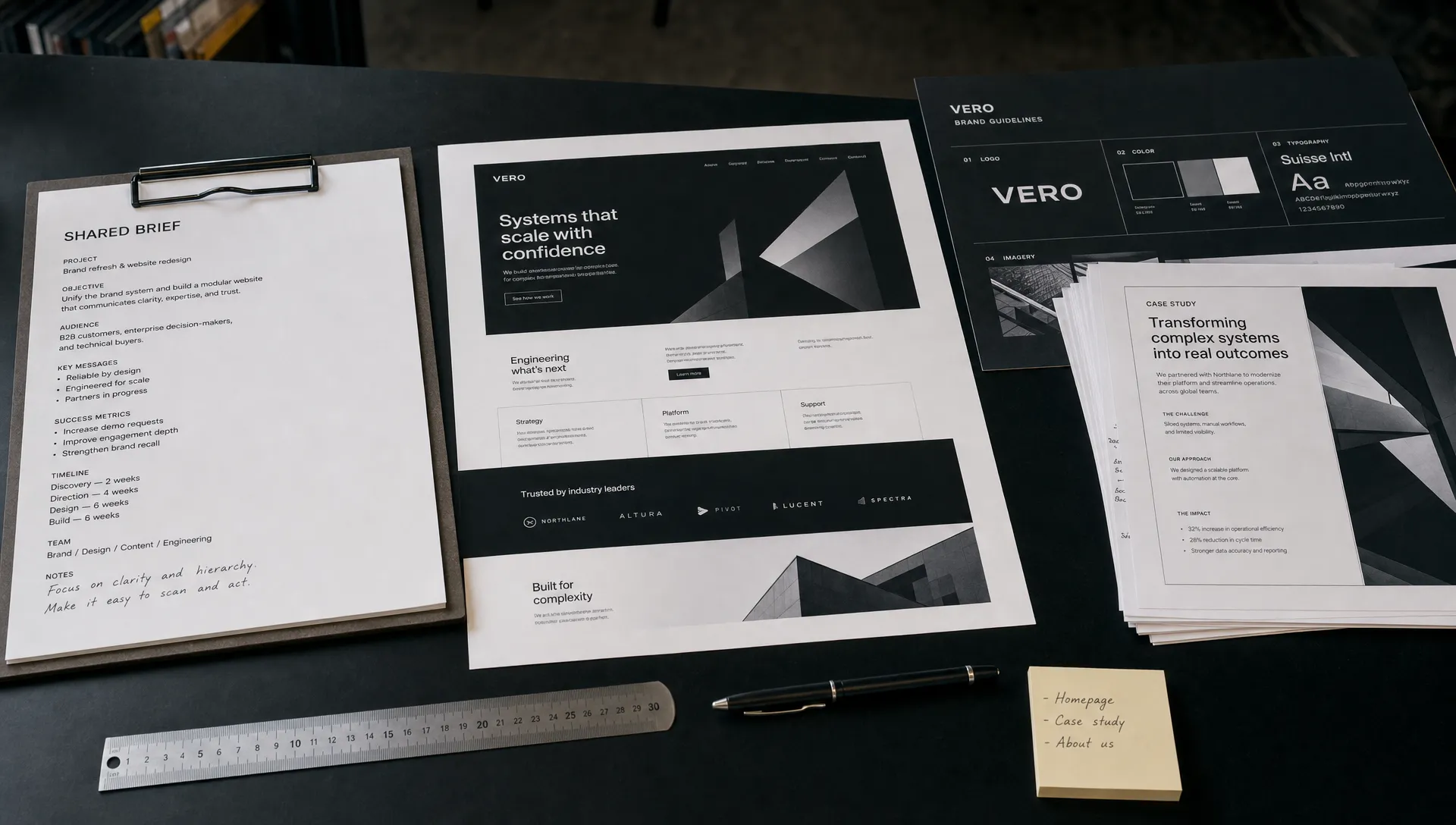
Hiring a web design and branding agency should give you one connected system: a clear market position, a recognizable identity and a website that helps the right customers act. Yet buying both services from the same company does not automatically make the work coherent. Brand strategy can still happen in one silo while website decisions happen in another.
The practical solution is one shared brief, supported by connected deliverables and explicit acceptance criteria. Use that brief to select the agency, compare proposals and keep the project accountable through launch.
Write one shared brief before you shortlist
Start with the business problem, not a shopping list of assets. “New identity and new website” describes outputs. “Help procurement teams understand why our specialist offer is worth a premium” gives both workstreams a decision to support.
For a challenger brand, that distinction matters. An identity might communicate confidence and originality, but the website still needs to explain the offer, establish credibility and make the next step obvious.
Define one primary audience and one priority action. Record secondary audiences separately so they do not compete for equal attention on every page. Also distinguish what the project can influence from what it cannot control, such as sales follow-up or product availability.
Your web design and branding agency should be able to explain how its proposed work addresses this shared problem, rather than presenting two unrelated service packages.
A practical shared-brief template
Use the following structure as a starting point. Keep the main brief short, with research, technical requirements and existing assets attached separately.
- Business outcome: State the commercial change you want and the current baseline, if available.
- Audience and buying context: Describe who decides, what triggers their search and what creates hesitation.
- Positioning challenge: Explain which alternatives buyers consider and what they misunderstand about your offer.
- Brand and website scope: Identify the identity elements, content, page types, languages and functionality involved.
- Constraints and responsibilities: Record budget boundaries, deadlines, platform requirements and who supplies or approves each input.
- Evidence of completion: Define what must be demonstrated before you approve strategy, design, development and launch.
For example, a hypothetical specialist manufacturer might need to replace a low-cost supplier perception with a credible engineering-partner position. Its identity, case studies, product navigation and inquiry form would all need to support that change. A more distinctive logo alone would not resolve the problem.
What a web design and branding agency must connect
A strong combined engagement translates positioning into messaging, messaging into page structure and identity into usable interface rules. Ask agencies to walk through that translation in an existing project.
The explanation should go beyond “we carried the colors across.” You want to understand why certain information appeared first, how evidence supported the brand promise and how the interface helped visitors complete important tasks.
Look for the actual working system: typography rules, color roles, image direction, reusable components and content patterns. A presentation deck can look coherent while the live website breaks down on long headlines, error messages or small screens.
Run a continuity check on one real journey
Choose an existing agency project and follow one customer task from beginning to end. For a B2B company, that might mean moving from a service page to a relevant case study and then to an inquiry form.
Check whether the language expresses the same position throughout. Look at whether buttons are recognizable, forms explain what happens next and proof appears where a buyer might hesitate.
Then ask how the system handles change. What happens when a new service is added, a headline doubles in length or a campaign needs a new landing page? Request existing documentation or a walkthrough, not unpaid custom creative work.
A web design and branding agency that can explain these decisions is demonstrating integration. One that only shows polished homepages has not yet established that its brand system works across a real customer journey.
Verify the website behind the portfolio
Visual quality is only one part of the evaluation. Review live sites, ask what the agency actually delivered and distinguish its original work from later client changes.
If an agency reports better conversion or search results, ask for the baseline, measurement period and other changes made at the same time. Results without context do not establish what caused them.
Check usability and accessibility
Try a few basic tasks yourself: navigate by keyboard, locate the main action, submit an incomplete form and use the site on a narrow screen. These checks can reveal problems, although they are not a complete accessibility audit.
Ask what standard the team works toward and how it tests. WCAG 2.2 provides a recognized accessibility framework; an agreed Level AA target is a useful project requirement, not an automatic guarantee of legal compliance.
Ask your web design and branding agency how identity decisions affect accessibility. Color combinations, type sizes, focus indicators and motion should be addressed during design, not left for developers to repair at the end.
Check performance and search foundations
Request performance evidence for representative page types, not just the lightest page. Google's Core Web Vitals guidance defines good thresholds as Largest Contentful Paint of 2.5 seconds or less, Interaction to Next Paint of 200 milliseconds or less and Cumulative Layout Shift of 0.1 or less, assessed at the 75th percentile of visits.
Distinguish real-user data from laboratory tests. A new site may lack sufficient field data at launch, so agree on prelaunch tests and subsequent monitoring rather than accepting a single score as proof.
For an existing website, ask who owns URL mapping, redirects, indexability checks and analytics continuity. If migration is central to the project, Boil's guide to choosing a website rebranding agency for growth explores that broader rebranding context. A redesign should not discard useful content or established search visibility without a reason.
Agree on deliverables and acceptance criteria
A proposal becomes easier to compare when every deliverable has an owner, a format and a clear approval condition. Your web design and branding agency should specify these before production begins.
“Brand guidelines” could mean a short PDF or a maintained system with digital usage rules. “Website development” might exclude copy, migration, integrations or tracking. Clarify the difference before comparing prices.
| Workstream | Deliverable to request | Example acceptance criterion |
|---|---|---|
| Strategy | Positioning and messaging framework | Priority audience, differentiation and supporting evidence are documented |
| Identity | Guidelines and editable source files | Agreed rules cover both brand expression and digital use |
| Experience | Sitemap, content model and key journeys | Priority visitor tasks are supported by approved page structures |
| Interface | Responsive designs and reusable components | Agreed page types, interaction states and screen sizes are covered |
| Development | Working site and test records | Scoped functionality works and agreed defects are resolved |
| Handover | Documentation, access and training | Named client owners can perform agreed publishing and administration tasks |
These are starting points, not universal specifications. A multilingual product site needs different acceptance tests from a compact services website.
For another useful checklist, Afluente Digital's Spanish-language guide to deliverables to request from a digital strategy agency covers diagnosis, roadmaps, measurement and handover documentation. Its emphasis on written responsibilities and acceptance conditions also applies to a combined brand and website engagement.
Make collaboration and decision rights explicit
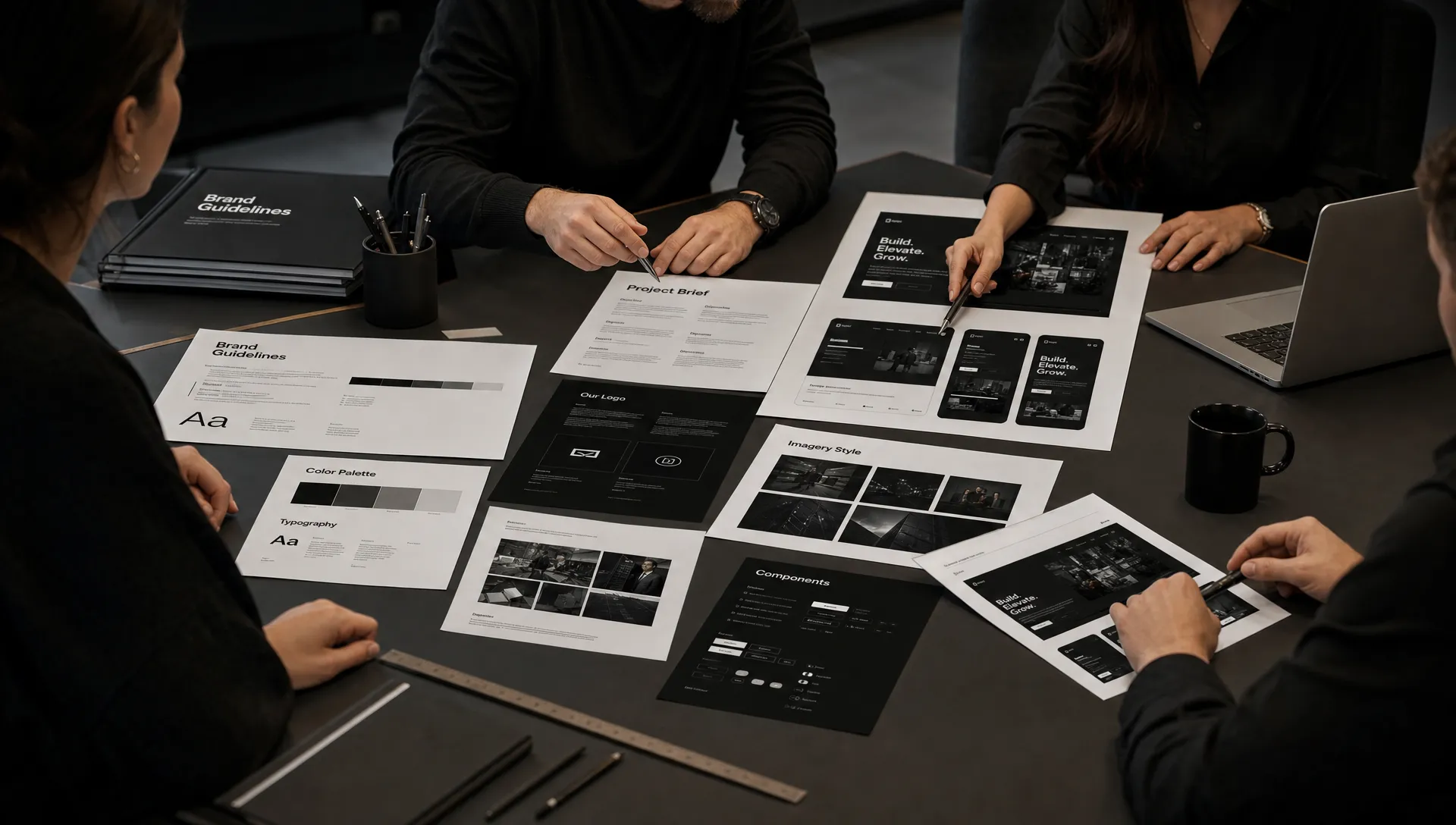
One shared brief still needs distinct specialists. Ask who handles strategy, writing, identity, user experience and development, including any subcontractors. Find out who resolves disagreements between disciplines and who is accountable for the whole delivery.
On the client side, name one decision owner and identify the people who must approve specific areas. Legal, sales and technical stakeholders should contribute before their requirements become expensive changes.
Use approval gates that connect the work
Agree on decision points rather than relying only on presentation dates. Strategy approval should establish the audience and proposition before detailed design proceeds. Interface approval should include representative content and responsive behavior before the full build.
Some work can overlap, but dependencies must remain visible. If positioning changes after page designs are approved, the agency should explain the consequences for messaging, navigation and scope.
Ask the web design and branding agency how it records decisions and handles conflicting feedback. A credible answer includes an escalation route, consolidated client feedback and a written change process.
If your internal team is still deciding who should shape the strategy, Boil's guide to hiring and briefing branding consultants can help clarify that role before the wider project starts.
Compare proposals on the same scope
Ask shortlisted agencies to respond to the same brief and separate included work, optional work, assumptions and exclusions. Otherwise, a lower fee may simply reflect fewer page types, less content support or no migration work.
Compare the likely total cost, not just the initial project fee. Request clarity on hosting, platform subscriptions, licensed fonts, stock assets, maintenance and third-party integrations. Identify which costs are recurring and which may increase with usage.
If discovery is needed before a reliable build estimate, a paid discovery phase can be reasonable. It should have its own deliverables, fee and decision point, with clarity about whether another supplier could use the resulting documentation.
Check ownership before signing
Confirm what transfers to you, when it transfers and what remains subject to third-party licensing. Address editable design files, custom code, content, domains, hosting access and analytics accounts. Platform portability and intellectual-property ownership are related but different questions.
Your web design and branding agency should also distinguish defects from new requests, explain revision limits and state what happens if the project pauses or ends early.
For selection, score each agency against the same criteria: strategic understanding, brand-to-web continuity, technical evidence, delivery accountability and commercial clarity. Set the relative importance before the final pitches. Keep essential requirements as pass-or-fail conditions so an impressive presentation cannot outweigh a missing capability.
Decide what happens after launch
Launch is a handover point, not proof that the project has achieved its business objective. Agree on who checks production forms, redirects, analytics events and consent behavior immediately after release.
Separate three types of ongoing work. Maintenance keeps the site secure and operational. Support resolves publishing or usage issues. Optimization changes content or experiences in response to evidence. A contract covering one does not necessarily include the others.
Define who handles updates, backups and restoration, alongside response expectations and exclusions. Your team should know where to report an incident and who controls the accounts needed to fix it.
Build a measurement plan around the original brief
Return to the commercial problem. A specialist B2B brand might track qualified inquiries and sales acceptance alongside form submissions. An ecommerce brand would need different measures. Neither should treat traffic growth alone as sufficient evidence of success.
Ask the web design and branding agency to document event definitions, reporting responsibilities and the first review date. Where possible, establish a prelaunch baseline and annotate major changes. Compare periods carefully when seasonality, campaigns or sales processes have also changed.
A review after an agreed initial period can identify friction and missing content. The timing should reflect traffic volume and the buying cycle, not an assumption that every business will produce meaningful results within the same number of weeks.
Frequently asked questions
Is using one agency better than hiring separate branding and website specialists? It can reduce handoffs and make accountability clearer, but only if the team genuinely connects strategy, design and development. Separate specialists can also work well when one lead owns the shared brief, dependencies and acceptance criteria.
Should branding be finished before website work starts? Agree on the core audience, positioning and messaging before committing to detailed interface design. Research, content auditing and technical discovery can run alongside early brand work. Website requirements should also inform the identity so it functions in real digital situations.
How much should a combined project cost? There is no useful universal figure without scope. Research depth, identity requirements, content volume, functionality, integrations and migration all affect cost. Ask each web design and branding agency to price the same requirements and identify recurring costs, exclusions and responsibilities before comparing totals.
What should we ask client references? Ask how the agency handled difficult decisions, changes and handover. Find out whether the client can maintain the website and extend the identity without unexpected dependencies. Confirm that the reference's project involved comparable work and, where possible, the team proposed for yours.
Bring one connected challenge to Boil
Boil combines branding, go-to-market strategy and digital experiences for ambitious challenger brands. If your brand and website need to solve the same growth problem, start by defining that problem together rather than commissioning disconnected outputs.
Bring your audience priorities, current website constraints and commercial goals to a conversation with Boil. Use the shared brief to establish what needs to change, what evidence will guide decisions and what a successful handover should include.
