
Choosing a brand story agency means choosing who will help your business explain why buyers should care, believe you and act. A compelling pitch presentation is not enough. The agency needs to understand what triggers a purchase, what makes change feel risky and which alternatives your buyers already trust.
For challenger brands, that distinction matters. You rarely have the recognition or distribution advantage of an established competitor. Your story has to make your difference relevant, not simply make your company sound interesting. Here is how to evaluate whether an agency can do that before you commit.
Start by defining the buyer decision
Before building a shortlist, write down the decision your story needs to influence. “We need clearer messaging” describes an internal frustration. “Buyers see us as a cheaper version of the market leader” identifies a commercial problem an agency can investigate.
A useful brief names the priority audience, the situation that starts their search and the belief preventing them from choosing you. Include the alternative you need to displace, which may be a competitor, a spreadsheet or doing nothing.
You do not need perfect answers yet. Separate what you know from what your team assumes. A strong partner should investigate those assumptions rather than turn them straight into polished copy.
How does a brand story agency learn about your buyers?
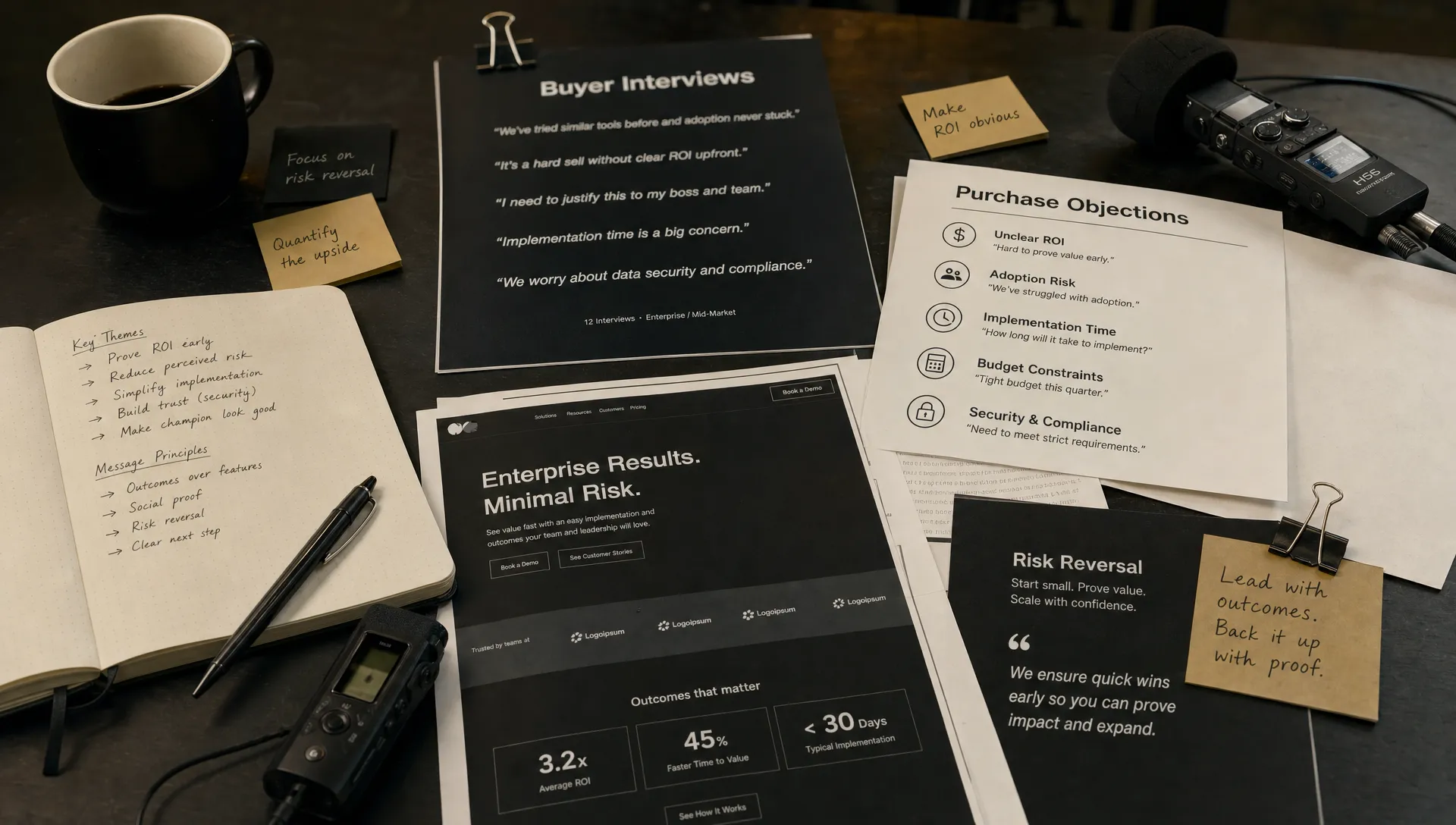
Ask the agency to walk through its research process using a previous project. Confidential information can be anonymized. You are looking for a connection between actual buyer evidence and the eventual recommendation.
Useful inputs can include customer interviews, lost-deal conversations, sales recordings, support requests and reviews of competing products. Each reveals something different. Happy customers can explain experienced value, but they may struggle to remember the uncertainty they felt before buying. Recent prospects and lost opportunities can expose that uncertainty more directly.
Ask: “Who would you speak to, and what would each group help you understand?” A credible answer explains the selection logic, not just an interview count. For a complex purchase, that might mean including users, budget owners and people who can block approval. For a consumer brand, it might mean comparing first-time buyers with people who considered the product but chose something else.
Also establish who recruits participants, obtains permission to use recordings and handles sensitive information. If direct research is outside the proposed scope, the agency should explain which existing evidence it will use and what will remain unverified. Desk research can inform a story, but it should not be presented as firsthand buyer understanding.
Ask to see the reasoning behind the creative work
A brand story agency should be able to explain how it moved from research to a strategic choice. Ask for one example that traces a buyer concern through the positioning, narrative and finished messaging.
Consider this hypothetical example: a purchasing-software company wants to tell a story about helping teams move faster. Buyer conversations instead reveal that finance leaders are worried about discovering spending commitments too late. The narrative may need to connect speed with earlier visibility and control, rather than celebrate speed alone.
The useful evidence is not the resulting headline. It is the reasoning behind it: which buyers raised the issue, whether it affected their decision and what the product can demonstrate in response.
Then ask what the agency decided not to say. Strong strategic work involves trade-offs. If every customer need, product feature and founder ambition receives equal emphasis, the story will be difficult to remember.
Your founder’s experience can still supply conviction, credibility and character. But the agency should distinguish an origin story from a purchase argument. Buyers may appreciate why you started the company while needing a different reason to put their money or reputation behind it.
Check whether they understand everyone involved in the purchase
Ask your prospective brand story agency how it handles situations where the user, decision-maker and payer are different people. A single audience persona can hide disagreements that determine whether a sale happens.
For a B2B service, an operational lead might value easier delivery while finance wants predictable costs and procurement needs defensible supplier selection. These people do not necessarily need separate brand stories. They need a coherent central promise supported by evidence relevant to their responsibilities.
The same distinction applies outside B2B. Someone buying a household product may need to persuade another family member, justify a premium or feel confident about switching from a familiar brand.
Ask the agency to show how one narrative changes emphasis across a website, a sales conversation and an approval discussion without becoming contradictory. Look for meaningful adaptation, not the same paragraph shortened for different channels.
Industry experience can help an agency recognize these dynamics. Still, category familiarity is not proof of buyer understanding. A partner should demonstrate how it checks inherited assumptions, especially when your growth depends on reaching people the category has historically overlooked.
Look for testing that could change the recommendation
A brand story agency that understands buyers should welcome evidence that challenges its preferred direction. Ask what it would test before rollout and what findings would trigger a revision.
“Which version do you like?” is a weak basis for choosing a narrative. Preference can reflect taste rather than purchase relevance. More useful questions reveal comprehension, credibility and the buyer’s likely next step.
After showing a draft in a realistic context, the agency could ask participants to explain who the offer is for, what problem it addresses and why they would believe its promise. Follow-up questions should uncover what feels generic, confusing or unsupported. Participants should not need the strategist beside them to explain the intended meaning.
Good testing also distinguishes a weak story from a weak offer. If buyers understand the promise but do not value it, copy changes alone may not solve the problem. The recommendation may need to revisit the target audience, positioning or offer itself.
Treat small qualitative tests as a way to diagnose misunderstandings and objections, not forecast conversion rates. If an agency promises measurable commercial improvement, ask how it will separate the effect of the story from changes in traffic, pricing, sales execution or product experience.
Compare agencies with an evidence-based scorecard
Use the same evaluation criteria for each shortlisted partner. Otherwise, a confident presenter or attractive portfolio can dominate the decision without answering your most important questions.
The following rubric is a practical comparison tool, not an industry benchmark. Score each area from zero to two: zero for an unsupported claim, one for a relevant example and two for an example backed by a clear, repeatable process.
| Evaluation area | Evidence to request | Warning sign |
|---|---|---|
| Buyer research | Participant selection, interview approach and acknowledged gaps | Internal workshops presented as customer research |
| Strategic reasoning | A traceable path from insight to narrative choice | Creative concepts with no explanation of the underlying decision |
| Credibility | A method for connecting promises to product or service evidence | Claims that sound impressive but cannot be substantiated |
| Validation | Test questions and an example of work revised after feedback | Testing limited to whether stakeholders liked the work |
| Activation | Examples of the story working across buyer-facing touchpoints | A polished presentation with no practical application |
Discuss differences in scores before adding them up. Missing research capability may matter more than presentation quality, even if the totals look similar. For a brand story agency, understanding buyers and making defensible strategic choices should be essential capabilities, not optional extras.
Make the scope useful beyond the final presentation
Once you have a preferred partner, check what your team will actually receive and use. “Brand narrative” can mean anything from a one-page manifesto to a documented messaging system. Agree on the contents rather than relying on the label.
Depending on your needs, useful deliverables may include:
- A buyer insight summary: The purchase triggers, alternatives, objections and evidence gaps that informed the work.
- A narrative foundation: The central problem, your point of view, the promise and the reasons buyers should believe it.
- Audience-specific messaging: Guidance on changing emphasis for different decision-makers without changing the underlying story.
- Worked applications: Examples for priority touchpoints, such as a homepage, sales deck or market-entry campaign.
- Usage guidance: Clear instructions on what teams can adapt, which claims need support and who approves changes.
Your brand story agency should distinguish agreed deliverables from optional execution work. Confirm who owns copy development, design, website implementation and sales enablement, along with revision rounds and approval responsibilities.
The goal is a repeatable messaging system, not language only the original strategist knows how to use. Ask whether the handoff includes a working session with the people who will apply it.
Also compare proposals on the same basis. Research access, audience complexity, testing and implementation can materially change the scope. A lower fee is not necessarily better value if your team must fill those gaps afterward.
Frequently asked questions
Does a brand story agency need experience in our industry? Relevant experience can reduce the learning curve, particularly in regulated or technically complex categories. But ask what the agency learned about buyers on those projects. Familiarity with industry language is less useful than evidence that it can uncover purchase barriers and challenge category conventions.
Can we choose an agency without commissioning a speculative pitch? Yes. Evaluate existing work, interview the proposed delivery team and discuss how they would investigate your challenge. If uncertainty remains, a paid discovery phase with clear outputs can offer a fairer assessment than asking several agencies to invent a strategy without access to buyers.
How should we measure whether the new story works? Establish a baseline around the problem you are trying to solve. Early measures might include buyer comprehension and message consistency. Later measures could include qualified inquiries, objections raised during sales or progression between buying stages. Choose measures your team can track and account for other changes that could influence them.
Do we need a full rebrand? Not necessarily. If your positioning and identity still fit, focused narrative and messaging work may be enough. Ask the agency to explain why a broader change is necessary before expanding the engagement.
Choose the partner whose reasoning you can trust
The right brand story agency should make your buyers easier to understand and your strategic choices easier to defend. Before signing, request three things: an example of buyer research, a clear explanation of how it shaped the story and evidence that the story could work beyond a presentation.
If you are evaluating partners for a challenger brand, explore Boil’s branding and go-to-market services. Use your first conversation to discuss the buyer decision you need to change, the evidence already available and how the narrative needs to support your next stage of growth.
