
Most companies don’t fail because they lack a logo. They fail because they can’t explain (quickly, clearly, consistently) why they exist, who they’re for, and why they’re the obvious choice.
If you want to develop a brand fast, the goal isn’t to “make it pretty.” The goal is to move from a raw idea to a usable identity that customers recognize, trust, and remember, and that your team can deploy without debating every sentence and pixel.
This guide shows a practical, high-speed path from idea to identity, built for founders and challenger teams who need momentum without cutting corners.
Developing a brand, in plain English
A brand is the set of decisions that make you make sense in a crowded market.
Your identity (name, visuals, voice) is the expression of those decisions. Your go-to-market is how those decisions show up in real buying moments, like your homepage, pitch deck, product onboarding, outbound emails, and sales calls.
When teams say “we need branding,” they usually mean one (or more) of these problems:
The fastest path to fix this is a sprint that produces decisions you can ship, not a strategy doc that sits in Notion.
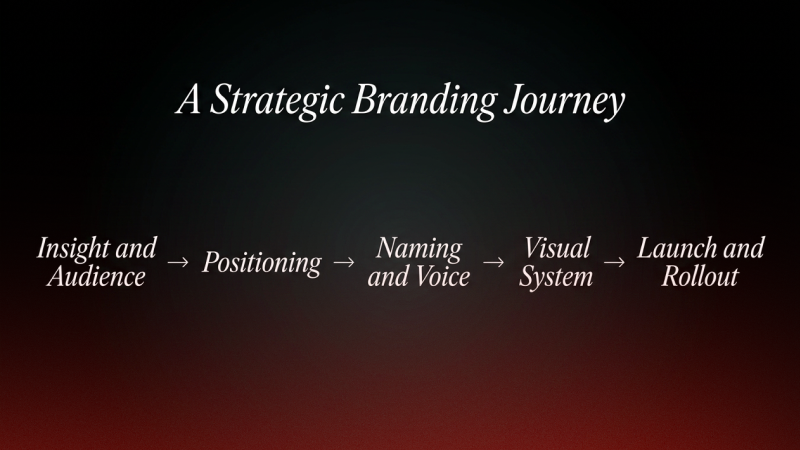
Phase 1 (Day 1): Find the sharpest market truth you can own
Speed comes from constraints. Before you write taglines or pick colors, you need a single organizing truth that everything else can align to.
Start with the “so what” triangle
If you can only answer three questions this week, make them these:
Not a demographic. A real buyer situation. “Ops leaders at 100 to 500-person logistics companies who are drowning in manual exceptions” beats “mid-market operations.”
This is the status quo story. Buyers don’t change because you’re better. They change because their current approach is failing.
This is your challenger Point of View. It should feel slightly uncomfortable, because it creates contrast.
A useful gut-check: if your biggest competitor could paste your positioning into their site with no edits, it is not positioning yet.
Make your positioning falsifiable
To develop a brand that holds up under pressure, your claims need to be testable.
Instead of:
Try:
Even if you cannot publish the exact metric yet, your internal positioning should be specific enough that your team can debate it like a product decision.
Phase 2 (Days 2 to 3): Turn strategy into a message that travels
Your brand is only as strong as the sentence your team repeats when you are not in the room.
Build one killer one-liner
Use this format:
For [specific audience] who struggle with [pain], [brand] is the [category / new frame] that delivers [outcome], because [mechanism / proof].
Example (fictional):
“For compliance leaders in fast-growing fintechs who need audits without chaos, Acme is the always-ready compliance workspace that keeps evidence current, because it captures decisions automatically inside the tools you already use.”
That one-liner becomes the spine for your homepage headline, pitch opening, LinkedIn bio, and outbound.
Define your proof stack
Challenger brands win by being believable, not just bold.
A proof stack is a short list of credibility signals you can attach to your claims:
If you lack proof, do not inflate the claim. Narrow the claim until it is true, then win the right to expand.
Phase 3 (Days 4 to 7): Build the identity system (not “a logo”)
A brand identity is a set of reusable rules. The goal is speed and consistency across touchpoints.
Naming: don’t chase clever, chase usable
Fast naming is not about brainstorming 200 words. It is about finding a name that survives reality:
You can develop a brand quickly and still do naming responsibly. At minimum, do basic trademark and competitive checks in the markets you plan to enter (and involve legal counsel when it matters).
Voice: create constraints your team can actually use
Tone-of-voice guides fail when they become vague mood boards (“friendly, bold”). Make it behavioral.
Define:
This is where many B2B brands unlock speed, because copy stops being a weekly debate.
Visual identity: optimize for recognition, not decoration
Distinctive brand assets (like consistent colors, shapes, typography, icon styles, and layout patterns) help buyers recognize you faster. Research from the Ehrenberg-Bass Institute has long emphasized the role of distinctive assets in building mental availability and recognition in competitive categories (overview: Ehrenberg-Bass Institute).
A practical identity system typically includes:
If you are moving fast, prioritize the formats that generate revenue this quarter: homepage, core landing page(s), pitch deck, and a simple social kit.
Phase 4 (Week 2): Make the brand real in your product and digital experience
This is the step teams skip, and it is why “branding” sometimes doesn’t improve conversion.
Your brand is experienced through:
If your brand promise is “effortless,” but your onboarding feels like a tax form, you do not have a brand problem. You have an experience mismatch.
Build one flagship touchpoint: the homepage
A fast but effective homepage structure:
Make accessibility part of speed, not a slowdown
Accessible design is not just compliance. It improves usability and clarity.
If you want a reputable baseline, use the WCAG overview to sanity-check color contrast, typography, and interaction patterns.
When brand meets AI and IT reality
For many modern challengers, especially in SaaS and services, identity and product experience are deeply tied to implementation, security, and integrations.
If your brand depends on delivering credible “modern operations” (automation, AI, data security), it can help to involve a partner who understands that delivery layer. For example, a team like Syneo’s digital and AI solutions can support the operational side (implementation and security) that often sits behind the promise your brand makes.
Phase 5 (Week 2): Rollout like a go-to-market launch
A brand launch is change management. To develop a brand that sticks, you need internal alignment and external repetition.
Internal enablement (the step that protects revenue)
Before you post the new logo, align the people who sell and support.
Create a short “brand in use” kit:
If Sales and Customer Success improvise the story, the market hears five different brands.
External rollout: choose consistency over noise
You do not need a giant campaign to launch. You need repeated clarity across the channels that already work.
Common rollout order:
A strong challenger launch explains the “why now” without sounding like a rebrand apology.
The biggest speed traps (and how to avoid them)
Trap 1: Confusing speed with skipping decisions
Moving fast is not doing less work. It is making the hard calls earlier.
If you avoid picking an audience, a claim, or a point of view, you will pay for it later in endless revisions.
Trap 2: Overbuilding identity before product-market clarity
If you are pre-PMF, your brand should be clear and deployable, not ornate.
You need:
You can always scale the system later. What you cannot afford is a beautiful brand that fails to explain what you do.
Trap 3: “We’ll validate it after launch”
The fastest teams validate in parallel. Test your headline and one-liner with:
This reduces risk and strengthens your proof stack.
A practical “fast brand” checklist
Use this as a gut-check for whether your idea has become an identity your team can ship.
If you cannot check most of these, you do not need “more design.” You need sharper decisions.
Frequently Asked Questions
How long does it take to develop a brand properly? You can develop a brand in 2 to 4 weeks if you focus on decisions that drive clarity (positioning, messaging, identity system, and key touchpoints). Bigger rollouts and complex portfolios take longer.
What’s the difference between brand strategy and brand identity? Brand strategy is the logic (who you’re for, what you stand for, why you win). Brand identity is the expression (name, visuals, voice) that makes that logic recognizable and repeatable.
Should early-stage startups invest in branding? Yes, but invest in the right kind: clear positioning, a credible story, and a lightweight identity system that supports conversion. Save heavy brand worlds and large-scale campaigns for later.
How do we know if our positioning is strong enough? If buyers quickly understand what you do, can repeat it accurately, and can tell why you’re different from the alternatives, your positioning is working. If they ask “so what?” or compare you to everyone else, it needs tightening.
Can we develop a brand internally, or should we hire an agency? If you have strong strategic leadership, time, and execution skills across strategy, copy, design, and web, you can do a lot in-house. An agency is often worth it when you need speed, cross-functional craft, and an outside perspective to break internal bias.
Want the fastest route to a brand you can actually launch?
Boil is a branding and go-to-market agency built for challengers. If you need to develop a brand from idea to identity, and ensure it shows up in the website and GTM execution (not just a deck), explore Boil’s approach at Boil Agency and start a conversation about your next move.
